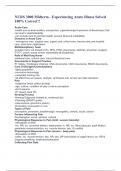
NURS 3000 Midterm - Experiencing Acute Illness Solved
100% Correct!!
Acute Care
-health acre to treat sudden, unexpected, urgent/emergent episodes of illness/injury that
can lead to death/disability
-can include care to promote health, prevent illness & rehabilitate
Domains in Acute Care
- emergency care, surgery care, urgent care, critical care, trauma care, pre-hospital
care, short-term stabilization
Multidisciplinary Team
Includes but is not limited to Rn, RPN, PSW, pharmacist, dietician, physician, surgeon,
PT/OT, psych, social worker (essentially all disciplines)
Role of Med-Surg Nurse
relational care, cultural care, inter-professional care
Documents to Support Practice
Pt. Safety, Workplace Violence, CNA documents, CNO documents, RNAO documents,
Care Challenges/Considerations
-aging population
-innovative technology
-expanded nursing role
*all effect how we reason, analyze, synthesize info. & how we make decisions
Pain
-subjective (must collect all data)
-age, culture, condition all play a role in perception
-don't assume
-#1 reason seek HC
Nursing Process
-Nursing Diagnosis (related to, evidenced by)
-Planning (SMART goals)
-Interventions (pharm/no pharm)
-Evaluation (successful or not)
Types of Pain
nociceptive, persistent, breakthrough, neuropathic, chronic, acute, cancer
Factors Influencing Pain
Psychological, social, spiritual, cultural
Physiological Response to Pain (mild - severe intensity)
-stimulation of SNS
-inc. RR, inc. bronchial dilation, diaphoresis, in. HR, inc. Blood glucose, pupil dilation,
peripheral vasoconstriction, inc. muscle tension, dec. GI motility
Physiological Response to Pain (severe - deep pain)
-Stimulation of PNS
-pallor, inc. muscle tension, dec. HR, dec. BP (stimulation of vagal nerve), inc. RR &
irregular breathing, weakness/exhaustion
Collecting Pain Data
, OPQRST: onset, palliation, quality, region, severity, timing, understanding, value
P.A.I.N: pattern, area, intensity, nature
Pain Scales: 0-10, faces, PIPP
Burn Injury
- injury to tissues caused by heat, chemicals, electric, radiation
Types of Burns
Thermal, Chemical, Smoke Inhalation, Electrical
Thermal Burns
-flame, flash, scald
-most common type of burn
Chemical Burns
- acids, alkalis, organic compounds
Smoke Inhalations Injury/Burn
- inhalation of hot air/noxious chemical
-causes damage to resp. tract
- major predictor of mortality in burn victims
- needs to be treated quickly
Three types of smoke inhalation injuries
-carbon monoxide poising
-injury above glottis
-injury below glottis
Carbon Monoxide Poisoning
- caused by incomplete combustion of burning materials
-displaces oxygen & leads to hypoxia, carboxyhemoglobinemia, death
-can occur in absence of burn to skin
-skin can appear cherry-red
***treat w/ 100% humidified oxygen
Inhalation Injury Above Glottis
-thermally produced (hot air, steam, smoke)
-mucosal, oropharynx & larynx burns
-mechanical obstruction can occur quickly & can lead to a true medical emergency
- reliable clues may be > facial burns, singed nose hair, hoarseness, painful swallowing,
darkened oral/nasal membranes, carbonaceous sputum, burned clothes around
neck/chest
Inhalation Injury Below Glottis
-injury related to exposure to smoke/toxic fumes
- pulmonary edema may not appear until 12-24 hrs after injury
- manifests as acute respiratory syndrome
Electrical Burns
- results from coagulation necrosis caused by intense heat generated from an electrical
current
- may result from direct damage to nerves/vessels causing tissue anoxia & death
- severity of burn depends on voltage, duration, current pathway, surface area affected
-passing through vital organs is more life-threatening
-can ignite clothing & cause electrical & thermal injury
100% Correct!!
Acute Care
-health acre to treat sudden, unexpected, urgent/emergent episodes of illness/injury that
can lead to death/disability
-can include care to promote health, prevent illness & rehabilitate
Domains in Acute Care
- emergency care, surgery care, urgent care, critical care, trauma care, pre-hospital
care, short-term stabilization
Multidisciplinary Team
Includes but is not limited to Rn, RPN, PSW, pharmacist, dietician, physician, surgeon,
PT/OT, psych, social worker (essentially all disciplines)
Role of Med-Surg Nurse
relational care, cultural care, inter-professional care
Documents to Support Practice
Pt. Safety, Workplace Violence, CNA documents, CNO documents, RNAO documents,
Care Challenges/Considerations
-aging population
-innovative technology
-expanded nursing role
*all effect how we reason, analyze, synthesize info. & how we make decisions
Pain
-subjective (must collect all data)
-age, culture, condition all play a role in perception
-don't assume
-#1 reason seek HC
Nursing Process
-Nursing Diagnosis (related to, evidenced by)
-Planning (SMART goals)
-Interventions (pharm/no pharm)
-Evaluation (successful or not)
Types of Pain
nociceptive, persistent, breakthrough, neuropathic, chronic, acute, cancer
Factors Influencing Pain
Psychological, social, spiritual, cultural
Physiological Response to Pain (mild - severe intensity)
-stimulation of SNS
-inc. RR, inc. bronchial dilation, diaphoresis, in. HR, inc. Blood glucose, pupil dilation,
peripheral vasoconstriction, inc. muscle tension, dec. GI motility
Physiological Response to Pain (severe - deep pain)
-Stimulation of PNS
-pallor, inc. muscle tension, dec. HR, dec. BP (stimulation of vagal nerve), inc. RR &
irregular breathing, weakness/exhaustion
Collecting Pain Data
, OPQRST: onset, palliation, quality, region, severity, timing, understanding, value
P.A.I.N: pattern, area, intensity, nature
Pain Scales: 0-10, faces, PIPP
Burn Injury
- injury to tissues caused by heat, chemicals, electric, radiation
Types of Burns
Thermal, Chemical, Smoke Inhalation, Electrical
Thermal Burns
-flame, flash, scald
-most common type of burn
Chemical Burns
- acids, alkalis, organic compounds
Smoke Inhalations Injury/Burn
- inhalation of hot air/noxious chemical
-causes damage to resp. tract
- major predictor of mortality in burn victims
- needs to be treated quickly
Three types of smoke inhalation injuries
-carbon monoxide poising
-injury above glottis
-injury below glottis
Carbon Monoxide Poisoning
- caused by incomplete combustion of burning materials
-displaces oxygen & leads to hypoxia, carboxyhemoglobinemia, death
-can occur in absence of burn to skin
-skin can appear cherry-red
***treat w/ 100% humidified oxygen
Inhalation Injury Above Glottis
-thermally produced (hot air, steam, smoke)
-mucosal, oropharynx & larynx burns
-mechanical obstruction can occur quickly & can lead to a true medical emergency
- reliable clues may be > facial burns, singed nose hair, hoarseness, painful swallowing,
darkened oral/nasal membranes, carbonaceous sputum, burned clothes around
neck/chest
Inhalation Injury Below Glottis
-injury related to exposure to smoke/toxic fumes
- pulmonary edema may not appear until 12-24 hrs after injury
- manifests as acute respiratory syndrome
Electrical Burns
- results from coagulation necrosis caused by intense heat generated from an electrical
current
- may result from direct damage to nerves/vessels causing tissue anoxia & death
- severity of burn depends on voltage, duration, current pathway, surface area affected
-passing through vital organs is more life-threatening
-can ignite clothing & cause electrical & thermal injury