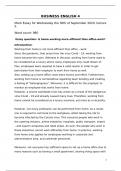
chem 111 study guide Already Graded A+
sig fig zeros - Answer-1. zeros at beginning NOT signif 2. zeros between ARE SIGNIF 3. zeros at end of number are signif if number contains a decimal point 3.489 x (5.67-2.3) - Answer-3.489 x 3.(3)7 11.75793 12 matter - Answer-composed of mass and must occupy space scales of matter - Answer-macroscopic, microscopic, particulate. scientists think on a particulate scale, observe macroscopically states of matter - Answer-1. change from solid to liquid to gas as temp increases 2. motion of particles increase as temp increases 3. distance between particles increases as temp increases matter - Answer--pure substance 1. element 2. compound -mixtures 1. homogeneous 2. heterogeneous physical properties - Answer-the atoms or molecules in the matter do not change (color, taste, melting point, boiling point, odor, density) chemical properties - Answer-molecules react, composition of matter changes (flammability, oxidation, corrosiveness)physical changes - Answer-appearance change but not comp (change in state, change in shape) chemical changes - Answer-chem reaction occurs, so comp changes... reactants and products mass is always conserved - Answer-matter can not be created nor destroyed energy - Answer-the other main component of our universe, if something has energy it can do work energy is also conserved - Answer-it can be transformed or converted to a different form but the total energy stays the same 4 energy types - Answer-kinetic potential chemical electrical calorie - Answer-amount of energy to raise temp of 1 gram of water by 1 degree Celsius 1 calorie = ? J - Answer-4.184 J = ? cal energy and chemical changes - Answer-1. chemical reactions often have associated energy changes 2. reactions that give off heat = exothermic (burning) 3. reactions that absorb heat = endothermic (chem ice pack) as temp increases the movement of the atoms or molecules in the substance increase - Answer-- move fastest in gas phase -molecules in a solid don't move they just vibrate around a fixed point heat is... - Answer-a transfer of energy between 2 temps physical changes require... - Answer-energyliquid to gas is - Answer-endothermic, water is gaining energy from the surroundings gas to liquid is - Answer-exothermic, heat is given off water melts - Answer-273 K water boils - Answer-373 K heat capacity - Answer-1. all substances change temp when they absorb and give off heat (the amount of change varies between substances) 2. heat capacity shows how much energy needed to raise temp of a substance 1 degree cel 3. water has a very high heat capacity (changing temp has a lot of energy) Dalton - Answer--each element made of indivisible particles called atoms -all atoms of a single element have the same mass which are different from other elements -atoms combine in single whole ratios to form compounds Thompson - Answer-found the electron -plum pudding model -believed subatomic particles made up atoms Rutherford and gold foil - Answer-shot alpha particles at gold foil and predicted that all would pass through, some bounced back! a real atom... - Answer-1. mostly empty space 2. dense core of protons and neutrons 3. cloud of electrons to sum up the sizes of p, e, n - Answer-protons and neutrons have almost identical masses and make up the positive nucleus while electrons have almost no mass and a negative charge amu - Answer-100 amu = 1/12 carbon 12 atommatter is usually neutral - Answer-number of electrons and protons are equal elements are defined by # of protons - Answer-aka atomic number atoms do vary in mass - Answer-mass number = protons and neutrons (the nucleus) isotope - Answer-different number of neutrons left v. right - Answer-metals on left. non metals on right. staircase with metalloids on either side 1A - Answer-alkali metals, lose 1 electron 2A - Answer-alkaline earth metals, lose 2 electron 3A - Answer-lose 3 electrons (except B) 5A - Answer-gain 3 electrons 6A - Answer-gain 2 electrons 7A - Answer-halogens, gain 1 electron 8A - Answer-noble gases protons-electons= - Answer-charge Ag is always - Answer-+1

Geschreven voor
- Instelling
- Chem 111
- Vak
- Chem 111
Documentinformatie
- Geüpload op
- 16 maart 2024
- Aantal pagina's
- 6
- Geschreven in
- 2023/2024
- Type
- Tentamen (uitwerkingen)
- Bevat
- Vragen en antwoorden
Onderwerpen
-
chem 111

Ook beschikbaar in voordeelbundel