EXSS 181 Final Test Questions with Correct Answers
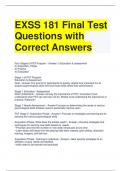
EXSS 181 Final Test Questions with Correct Answers Four Stages of PST Program - Answer-1) Education & assessment 2) Acquisition Phase 3) Practice 4) Evaluation Stage 1 of PST Program Education & Assessment Goal - Answer-The goal is for participants to quickly realize how important it is to acquire psychological skills and how those skills affect their performance Stage 1 Education / Assessment Must Understand: - Answer-Convey the importance of PST- Consultant must understand what PST can and can not do, Athlete must understand the importance of practice, Patience!! Stage 1 Needs Assessment: - Answer-Focuses on determining the areas or various psychological skills athletes need to personally improve upon PST Stage 2- Acquisition Phase - Answer-• Focuses on strategies and techniques for learning the various psychological skills Acquisition Phase- What does the athlete need? - Answer-• Develop strategies and techniques for learning new skills based on needs • Prioritize and limit the number of new skills introduced at one time • Learn basic skill away from the playing field (later classes: goal setting, relaxation training, Imagery, self-talk etc) Acquisition Phase- Tailoring to individual - Answer-• tailor specific strategies to an athlete's unique needs and abilities • skills need to be learned and practiced • expect improvement as they develop these skills and refine them PST 3rd Stage- Practice Phase: - Answer-Automation Integration Simulation • automate skills through overlearning- • teach people to systematically integrate psychological skills into performance situations • simulate skills people will want to apply in actual competition PST Practice Phase- Automation - Answer-• Practicing until skill can be performed without a lot of higher-level cognitive control - "automatic" PST Practice Phase - Integration - Answer-• Use the skill, or version of it in practice, then competition • Gradually introduce • Find ways to adapt the skill to avoid disrupting performance PST Practice Phase- Simulation - Answer-• Re-create the situation that requires the use of the skill in a practice setting to get "real world" experience before using it in real competition PST Stage 4- Evaluation Phase - Answer-Was the PST program carried out as planned? by athlete, by coach by consultant? Did the athlete improve their mental skill? Did the athlete meet the goal of the program / solve the initial problem? Subjective and performance feedback Reassessment - Answer-what could be modified or done next to deal with problems or aid further improvement? Continue through steps again- Acquisition, Practice, Evaluation Why is PST programs described in a circular process? - Answer-One you complete the phases and evaluate, you reassessment and continue through the steps again, so this continues in a circular process until the goal of self-regulation is met What is the ultimate goal of PST? - Answer-Self-regulation The ability to work toward one's short and long term goals by effectively monitoring and managing one's thoughts, feelings and behaviors. 5 Stage Self -Regulation Model - Answer-Stage 1 Problem Identification Stage 2 Commitment Stage 3 Execution Stage 4 Environmental Management Stage 5 Generalization Review real life example Slide 20 of Chap 17 - Answer- Common problems implementing a PST - Answer-Lack of conviction by athlete Lack of time by athlete Lack of sport knowledge by consultant Lack of follow-up (both) Relaxation Training Method: 1) Deep Breathing - Answer-• Easy, effective • Breathing out decreases muscle tension.. but tendency in stressful situation to hold breath or increase breathing rate • Deep, diapraghmatic breathing at a slow and controlled pace - Complete breaths - Rhythmic breaths: 4-4-4 count • Best use in competition: during breaks in action Relaxation Training Method: 2) Progressive Relaxation - Answer-• objective is to teach/train contrast between tension and relaxation • Involves contracting and relaxing major muscle groups in a sequence progressing through the whole body Major Premises of Progressive Relaxation - Answer-• Tension and relaxation cannot occur simultaneously • Relaxation of the muscles (body) contributes to relaxation of the mind Progressive Relaxation- Practice & Integration - Answer-Full program practice (30 min) Abbreviated program (shorter time periods) Relax on-site in competition Relaxation Training- 3) Autogenic Training - Answer-• Exercises aimed at producing 6 types of sensations - Heaviness in extremities - Warmth in extremities - Regulation of heart rate - Regulation of breathing - Abdominal warmth - Cool forehead Longer time to learn, extensive practice Relaxation Training - 4) Biofeedback - Answer-• designed to teach control of physiological or autonomic responses • Visual and / or auditory feedback of: - muscle activity - skin temperature - brain wave - heart rate Coping - Answer-• constantly changing cognitive and behavioral efforts used to manage specific external and / or internal demands that are appraised as taxing or exceeding the resources of the person • Does not happen by accident..It only counts if it's something effortful, done in an attempt to manage the transaction Problem-Focused coping: - Answer-• Efforts directed at changing the transaction (try to solve the problem) Emotion-Focused coping - Answer-• Efforts directed at changing the emotional response without changing the transaction (manage your feelings about the problem) Coping Strategies of Elite Athletes - Answer-• Thought-stopping • Narrowing focus • Rational thinking & Self-talk • Positive focus • Social Support • PST • Time Management • Training Hard and Smart "On-site" Coping / Relaxation Tips - Answer-• Smile in response to tension • Enjoy the situation • Slow Down • Stay focused in the present • Be prepared with a competition plan Key: set up stressful situation in practice to develop these techniques Arousal - Increasing Techniques Sometimes it may be necessary to increase arousal - Answer-• Increased breathing rate • Act Energized • Self-talk: mood words & positive self-statements • Energizing music • Energizing imagery • Precompetitive workout Imagery - Answer-• Creating or recreating an experience on the mind. Put simply- visualization • Involves recalling from memory pieces of information stores from experience and shaping those pieces into meaningful information Imagery = - Answer-= Recall + Construction Internal or External? What senses do you use in Imagery - Answer-Visual Auditory Tactile Olfactory Characteristics of Imagery - Answer-• Multisensory • Internal vs external perspective • Timing in imagery should match physical performance Internal Imagery - Answer-being the person actually going through the motions, so you have a keen sense of it External Imagery - Answer-As if you are the spectator or watching a video of yourself Two keys to effective imagery - Answer-• Vividness • Controllability Uses of Imagery - Answer-Improve concentration Enhance motivation Build confidence Control emotional responses Develop sport skills Acquire and practice strategy Competition preparation Cope with pain and injury Solve Problems

Geschreven voor
- Instelling
- EXSS 181
- Vak
- EXSS 181
Documentinformatie
- Geüpload op
- 5 juni 2024
- Aantal pagina's
- 41
- Geschreven in
- 2023/2024
- Type
- Tentamen (uitwerkingen)
- Bevat
- Vragen en antwoorden
Onderwerpen
-
exss 181
-
exss 181 final test questions
-
exss 181 final test questions with correct answers
-
four stages of pst program
Ook beschikbaar in voordeelbundel