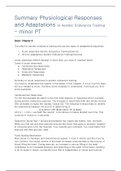
Summary Physiological Responses
and Adaptations to Aerobic Endurance Training
– minor PT
Book: Chapter 6
The effect to aerobic endurance training discuss two types of adaptations/responses.
1. Acute responses Aerobic Endurance Training/Exercise
2. Chronic adaptations Aerobic Endurance Training/Exercise
Acute responses (Which develop in short time, you have to maintain them)
Types of acute responses:
Cardiovascular Responses
Respiratory Responses
Endocrine Responses
Metabolic Responses
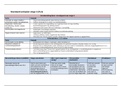
Summary of acute responses to aerobic endurance training
You have to understand the system in the tables of this Chapter. It is too much to learn
but you needed to know. Combine some variables to understand. Continued you find
some examples.
Cardiovascular Responses
For the first example we watch to the first three aspects of responses which increase
during aerobic endurance exercise. The increase in Heart Rate (HR) and Stroke Volume
(SV) ultimately increase the Cardiac Output (Q). The following formula helps to identify
the relationship between HR and SV in determining Q:
𝑄 (𝐿/𝑚𝑖𝑛) = 𝐻𝑅 (𝑏𝑒𝑎𝑡𝑠/𝑚𝑖𝑛) ∙ 𝑆𝑉 (𝐿/𝑏𝑒𝑎𝑡)
Unit Q = L/min = eenheid. Be careful! A dot above Q means divided over time. This
could be in minute or in seconds.
Splanchnic blood flow > around and between the organs like kidney, liver, stomach.
When you first eat and then exercise ensures the blood flow goes to stomach (organs)
to consume and not to the muscles. Your systems get confused. You could better first
exercise and then get your meal.
Frank Starling Mechanism
More blood in chambers and toward blood vessels > more it stretch and the more he
can contract. The stroke volume of the heart increases proportionally to the volume of
blood filling the heart. During exercise, an increase in venous filling of the heart
contributes to an increased pressure and stretching of the walls of the heart, resulting
in an increase in elastic contractile force that is independent of neural and humoral
, factors. This is one explanation of why more blood is ejected from the left ventricle
(increasing SV), and it is known as the Frank-Starling Mechanism.
Mean Arterial Pressure (MAP) is the average pressure between DBP (diastolic blood
pressure) and SBP (systolic blood pressure). The DBP is more important (66% of
Heartbeat duration) then the SBP (33% of Heartbeat duration).
During aerobic endurance exercise involving large muscle groups, such as walking,
jogging, cycling and swimming, there is a linear increase in SBP in direct proportion to
the exercise intensity and cardiac output and a negligible (te verwaarlozen) change in
DBP. TPR (resistance to blood flow in the systemic vascular system) also decreases
(but Q increases to a greater extent) as the exercise intensity increases and has a
major effect on blood pressure. As a result, mean arterial blood pressure (MAP)
increases during exercise and can be expressed quantitatively by the following two
formulas:
MAP = DBP + (0.333 • (SBP – DBP))
1
0.333 = 3
MAP = Q • TPR
DBP (diastolic blood pressure) is de lage bloeddruk en dus de minimale bloed druk wat
je hart nodig heeft om het bloed rond te pompen. DBP blijft dus hetzelfde en SBP stijgt
gedurende training en oefening.
By exercise: SBP increase because the pumping part has to create extra flow.
Arteries > Oxygen RICH blood
Venous > Oxygen POOR blood
Capillaries (haarvaten) > around the organs, the smallest part between arteries and
venous where the exchanging O2 and CO2.
HBP = high blood pressure Hypertension > 140/90 Blood pressure
LBP = low blood pressure (Hypotension > 100/60 Blood pressure)
TPR = Total Periphal Resistance
𝑴𝑨𝑷
TPR =
𝑸
TPR should be low to let the blood better flow. So this one decrease.
RPP = Rate Pressure Product
RPP = HR • SBP
RPP is the measurement of systolic blood pressure
Note: Myocardia Oxygen Uptake = Muscle Heart Oxygen Uptake
Cardiac output, heart rate, stroke volume, mean arterial blood pressure, coronary artery
diameter and rate pressure product increase during exercise.
and Adaptations to Aerobic Endurance Training
– minor PT
Book: Chapter 6
The effect to aerobic endurance training discuss two types of adaptations/responses.
1. Acute responses Aerobic Endurance Training/Exercise
2. Chronic adaptations Aerobic Endurance Training/Exercise
Acute responses (Which develop in short time, you have to maintain them)
Types of acute responses:
Cardiovascular Responses
Respiratory Responses
Endocrine Responses
Metabolic Responses
Summary of acute responses to aerobic endurance training
You have to understand the system in the tables of this Chapter. It is too much to learn
but you needed to know. Combine some variables to understand. Continued you find
some examples.
Cardiovascular Responses
For the first example we watch to the first three aspects of responses which increase
during aerobic endurance exercise. The increase in Heart Rate (HR) and Stroke Volume
(SV) ultimately increase the Cardiac Output (Q). The following formula helps to identify
the relationship between HR and SV in determining Q:
𝑄 (𝐿/𝑚𝑖𝑛) = 𝐻𝑅 (𝑏𝑒𝑎𝑡𝑠/𝑚𝑖𝑛) ∙ 𝑆𝑉 (𝐿/𝑏𝑒𝑎𝑡)
Unit Q = L/min = eenheid. Be careful! A dot above Q means divided over time. This
could be in minute or in seconds.
Splanchnic blood flow > around and between the organs like kidney, liver, stomach.
When you first eat and then exercise ensures the blood flow goes to stomach (organs)
to consume and not to the muscles. Your systems get confused. You could better first
exercise and then get your meal.
Frank Starling Mechanism
More blood in chambers and toward blood vessels > more it stretch and the more he
can contract. The stroke volume of the heart increases proportionally to the volume of
blood filling the heart. During exercise, an increase in venous filling of the heart
contributes to an increased pressure and stretching of the walls of the heart, resulting
in an increase in elastic contractile force that is independent of neural and humoral
, factors. This is one explanation of why more blood is ejected from the left ventricle
(increasing SV), and it is known as the Frank-Starling Mechanism.
Mean Arterial Pressure (MAP) is the average pressure between DBP (diastolic blood
pressure) and SBP (systolic blood pressure). The DBP is more important (66% of
Heartbeat duration) then the SBP (33% of Heartbeat duration).
During aerobic endurance exercise involving large muscle groups, such as walking,
jogging, cycling and swimming, there is a linear increase in SBP in direct proportion to
the exercise intensity and cardiac output and a negligible (te verwaarlozen) change in
DBP. TPR (resistance to blood flow in the systemic vascular system) also decreases
(but Q increases to a greater extent) as the exercise intensity increases and has a
major effect on blood pressure. As a result, mean arterial blood pressure (MAP)
increases during exercise and can be expressed quantitatively by the following two
formulas:
MAP = DBP + (0.333 • (SBP – DBP))
1
0.333 = 3
MAP = Q • TPR
DBP (diastolic blood pressure) is de lage bloeddruk en dus de minimale bloed druk wat
je hart nodig heeft om het bloed rond te pompen. DBP blijft dus hetzelfde en SBP stijgt
gedurende training en oefening.
By exercise: SBP increase because the pumping part has to create extra flow.
Arteries > Oxygen RICH blood
Venous > Oxygen POOR blood
Capillaries (haarvaten) > around the organs, the smallest part between arteries and
venous where the exchanging O2 and CO2.
HBP = high blood pressure Hypertension > 140/90 Blood pressure
LBP = low blood pressure (Hypotension > 100/60 Blood pressure)
TPR = Total Periphal Resistance
𝑴𝑨𝑷
TPR =
𝑸
TPR should be low to let the blood better flow. So this one decrease.
RPP = Rate Pressure Product
RPP = HR • SBP
RPP is the measurement of systolic blood pressure
Note: Myocardia Oxygen Uptake = Muscle Heart Oxygen Uptake
Cardiac output, heart rate, stroke volume, mean arterial blood pressure, coronary artery
diameter and rate pressure product increase during exercise.