BUSMHR 2000 Final Exam Review
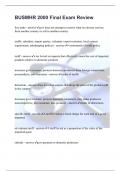
free trade - answer-✔govt does not attempt to restrict what its citizens can buy
from another country or sell to another country
tariffs, subsidies, import quotas, voluntary export restraints, local content
requirement, antidumping policies - answer-✔6 instruments of trade policy
tariff - answer-✔a tax levied on imports that effectively raises the cost of imported
products relative to domestic products
increases govt revenues, protects domestic producers from foreign competitors,
pro-producer, anti-consumer - answer-✔results of tariffs
detraction - answer-✔tax levied on exports that drops the price of the product sold
in the country
increases govt revenues, protects domestic consumers, may make producers
noncompetitive, pro-consumer, anti-producer - answer-✔results of detractions
specific tariff - answer-✔A tariff levied as a fixed charge for each unit of a good
imported
ad valorem tariff - answer-✔A tariff levied as a proportion of the value of the
imported good
subsidy - answer-✔govt payment to domestic producers
, help domestic producers compete against low cost foreign imports and gain export
markets, consumers absorb the costs - answer-✔results of subsidies
import quotas - answer-✔impose limit to quantity imported
tariff rate quote - answer-✔tax levied to imported products above quota
voluntary export restraints (VER) - answer-✔impose limits to exports from one
country
benefit domestic producers by limiting competition from abroad, increases prices
for consumers - answer-✔results of VER
local content requirement - answer-✔demands that some fraction of the product be
produced domestically
originally implemented to promote development of local industries, favor local
industries, create jobs - answer-✔results of local content requirement
antidumping policies - answer-✔designed to punish foreign firms that engage in
dumping
dumping - answer-✔selling goods in a foreign market below their cost of
production or below their "fair" market value
protects domestic producers - answer-✔results of antidumping policies
free trade - answer-✔govt does not attempt to restrict what its citizens can buy
from another country or sell to another country
tariffs, subsidies, import quotas, voluntary export restraints, local content
requirement, antidumping policies - answer-✔6 instruments of trade policy
tariff - answer-✔a tax levied on imports that effectively raises the cost of imported
products relative to domestic products
increases govt revenues, protects domestic producers from foreign competitors,
pro-producer, anti-consumer - answer-✔results of tariffs
detraction - answer-✔tax levied on exports that drops the price of the product sold
in the country
increases govt revenues, protects domestic consumers, may make producers
noncompetitive, pro-consumer, anti-producer - answer-✔results of detractions
specific tariff - answer-✔A tariff levied as a fixed charge for each unit of a good
imported
ad valorem tariff - answer-✔A tariff levied as a proportion of the value of the
imported good
subsidy - answer-✔govt payment to domestic producers
, help domestic producers compete against low cost foreign imports and gain export
markets, consumers absorb the costs - answer-✔results of subsidies
import quotas - answer-✔impose limit to quantity imported
tariff rate quote - answer-✔tax levied to imported products above quota
voluntary export restraints (VER) - answer-✔impose limits to exports from one
country
benefit domestic producers by limiting competition from abroad, increases prices
for consumers - answer-✔results of VER
local content requirement - answer-✔demands that some fraction of the product be
produced domestically
originally implemented to promote development of local industries, favor local
industries, create jobs - answer-✔results of local content requirement
antidumping policies - answer-✔designed to punish foreign firms that engage in
dumping
dumping - answer-✔selling goods in a foreign market below their cost of
production or below their "fair" market value
protects domestic producers - answer-✔results of antidumping policies