Advanced Health Assessment and Diagnostic
Reasoning #1
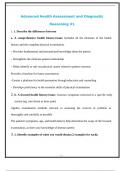
1. 1. Describe the differences between
a. A comprehensive health history/exam: Includes all the elements of the health
history and the complete physical examination.
- Provides fundamental and personalized knowledge about the patient
- Strengthens the clinician-patient relationship
- Helps identify or rule out physical causes related to patient concerns
Provides a baseline for future assessments
-Creates a platform for health promotion through education and counseling
- Develops proficiency in the essential skills of physical examination
2. b. A focused health history/exam: Assesses symptoms restricted to a specific body
system (eg. sore throat or knee pain)
Applies examination methods relevant to assessing the concern or problem as
thoroughly and carefully as possible
The patient's symptoms, age, and health history help determine the scope of the focused
examination, as does your knowledge of disease pattern
3. 2. Identify examples of when you would obtain (2 examples for each):
, a. A comprehensive health history/exam: Is appropriate for new patients in the office
or hospital
4. b. A focused health history/exam: Is appropriate for established patients, especially
during routine or urgent care visits
Addresses focused concerns or symptoms
( eg. sore throat or knee pain)
5. 3. Discuss the differences between subjective and objective data: Subjective data:
is what the patient tells you
Objective data: what you detect during the examination, laboratory information and test
data
6. a. Provide examples of what would constitute Subjective data: The symptoms and
history, from Chief Complaint through Review of Systems
Example: Mrs. G. is a 54-year-old hairdresser who reports pressure over her left chest
"like an elephant sitting there," which goes into her left neck and arm.
7. b. Provide examples of what would constitute Objective data: All physical
examination findings, or signs
Example: Mrs. G. is an older, overweight white female, who is pleasant and cooperative.
Height 52422, weight 150 lbs, BMI 26, BP 160/80, HR 96 and regular, respirator rate 24,
temperature 97.5 °F
8. 4. Identify what goes into each section of the comprehensive health history
Reasoning #1
1. 1. Describe the differences between
a. A comprehensive health history/exam: Includes all the elements of the health
history and the complete physical examination.
- Provides fundamental and personalized knowledge about the patient
- Strengthens the clinician-patient relationship
- Helps identify or rule out physical causes related to patient concerns
Provides a baseline for future assessments
-Creates a platform for health promotion through education and counseling
- Develops proficiency in the essential skills of physical examination
2. b. A focused health history/exam: Assesses symptoms restricted to a specific body
system (eg. sore throat or knee pain)
Applies examination methods relevant to assessing the concern or problem as
thoroughly and carefully as possible
The patient's symptoms, age, and health history help determine the scope of the focused
examination, as does your knowledge of disease pattern
3. 2. Identify examples of when you would obtain (2 examples for each):
, a. A comprehensive health history/exam: Is appropriate for new patients in the office
or hospital
4. b. A focused health history/exam: Is appropriate for established patients, especially
during routine or urgent care visits
Addresses focused concerns or symptoms
( eg. sore throat or knee pain)
5. 3. Discuss the differences between subjective and objective data: Subjective data:
is what the patient tells you
Objective data: what you detect during the examination, laboratory information and test
data
6. a. Provide examples of what would constitute Subjective data: The symptoms and
history, from Chief Complaint through Review of Systems
Example: Mrs. G. is a 54-year-old hairdresser who reports pressure over her left chest
"like an elephant sitting there," which goes into her left neck and arm.
7. b. Provide examples of what would constitute Objective data: All physical
examination findings, or signs
Example: Mrs. G. is an older, overweight white female, who is pleasant and cooperative.
Height 52422, weight 150 lbs, BMI 26, BP 160/80, HR 96 and regular, respirator rate 24,
temperature 97.5 °F
8. 4. Identify what goes into each section of the comprehensive health history