Lecture 6
Financial Management
Reimbursement schemes
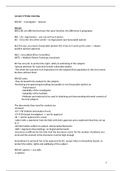
Agenda
- Reimbursement systems
o Global budget
o Fee-for-service
o Capitation
o Case-based
- Theory of yardstick competition
- Empirical examples
- Value-based hc delivery via integration of services
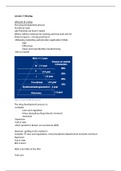
Definition and notation
- Profit (margin) = revenue – cost
- Revenue will be dependent on the reimbursement scheme
- Costs unrelated to treatment activity: F
- Costs related to treatment activity, which are dependent on:
o Volume (episodes, patients)
o Treatment intensity (services per episode)
o Cost of each service
Global budget formulae’s
Payment in global budget system is (mostly) unrelated with patients, it is determined by the
amount one has spent last year.
What happens if the organization treats more cases in global budget? Profit goes down
because revenue will remain similar but costs will increase because there are more cases.
An incentive for a company with a lumpsum payment: treat less patients.
What happens if the organization provides more services per case? (services / case)
Profit goes down again, because there are more services per case (these services are a cost
driver, goes up), the revenue stays the same (because it is a lumpsum payment).
When do we have to provide more services per case? – with more complex/difficult patient.
Incentive: reject these patients/cherry pick healthier patients.
1
, What happens if the services are more expensive? (cost / services) Revenue is still the
same so profit still goes down. Incentive: less treatments, less complicated treatments.
There is no incentive to waste resources.
Roughly the same incentives in the global budget, no matter what goal there is set (break-
even, make profit etc).
In NL different reimbursement schemes, connected to the set up. Not really reimbursed by
budget.
Fee for service
An organization is reimbursed per service that is provided
As long as fees are higher than the costs, then more services (cases) yield: higher income.
Treating more patients is the incentive here, more patients generate higher income. Also an
incentive: to lower the cost for the service, increase services/case, quantity of cases. They
might do risk selection too. Bc if they have sicker patients they can provide more services,
but it might also cost them so it is not clear whether the fee for service system has an
incentive to do cherry picking.
Capitation
Fixed amount (payment) per patient which is registered with them (e.g. GP), irrespective of
whether they come to get treatment. Incentive then: have patients which don’t need
treatment. Matters for them that patients are registered on paper. They do cherry picking.
Case-based
An organization receives payment by case (bundle of services per case). Incentive: want to
provide less services per case. Want to provide more cases. The more cases the higher the
income/revenue is going to be. Incentive for cherry-picking: yes, want to have healthier
patients because then less services (and costs) per patient is required.
2
Financial Management
Reimbursement schemes
Agenda
- Reimbursement systems
o Global budget
o Fee-for-service
o Capitation
o Case-based
- Theory of yardstick competition
- Empirical examples
- Value-based hc delivery via integration of services
Definition and notation
- Profit (margin) = revenue – cost
- Revenue will be dependent on the reimbursement scheme
- Costs unrelated to treatment activity: F
- Costs related to treatment activity, which are dependent on:
o Volume (episodes, patients)
o Treatment intensity (services per episode)
o Cost of each service
Global budget formulae’s
Payment in global budget system is (mostly) unrelated with patients, it is determined by the
amount one has spent last year.
What happens if the organization treats more cases in global budget? Profit goes down
because revenue will remain similar but costs will increase because there are more cases.
An incentive for a company with a lumpsum payment: treat less patients.
What happens if the organization provides more services per case? (services / case)
Profit goes down again, because there are more services per case (these services are a cost
driver, goes up), the revenue stays the same (because it is a lumpsum payment).
When do we have to provide more services per case? – with more complex/difficult patient.
Incentive: reject these patients/cherry pick healthier patients.
1
, What happens if the services are more expensive? (cost / services) Revenue is still the
same so profit still goes down. Incentive: less treatments, less complicated treatments.
There is no incentive to waste resources.
Roughly the same incentives in the global budget, no matter what goal there is set (break-
even, make profit etc).
In NL different reimbursement schemes, connected to the set up. Not really reimbursed by
budget.
Fee for service
An organization is reimbursed per service that is provided
As long as fees are higher than the costs, then more services (cases) yield: higher income.
Treating more patients is the incentive here, more patients generate higher income. Also an
incentive: to lower the cost for the service, increase services/case, quantity of cases. They
might do risk selection too. Bc if they have sicker patients they can provide more services,
but it might also cost them so it is not clear whether the fee for service system has an
incentive to do cherry picking.
Capitation
Fixed amount (payment) per patient which is registered with them (e.g. GP), irrespective of
whether they come to get treatment. Incentive then: have patients which don’t need
treatment. Matters for them that patients are registered on paper. They do cherry picking.
Case-based
An organization receives payment by case (bundle of services per case). Incentive: want to
provide less services per case. Want to provide more cases. The more cases the higher the
income/revenue is going to be. Incentive for cherry-picking: yes, want to have healthier
patients because then less services (and costs) per patient is required.
2