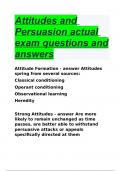
Attitudes and Persuasion actual exam questions and answers.
Attitude Formation Attitudes spring from several sources: Classical conditioning Operant conditioning Observational learning Heredity Strong Attitudes Are more likely to remain unchanged as time passes, are better able to withstand persuasive attacks or appeals specifically directed at them Two main reasons strong attitudes resist change Commitment Embeddedness Attitude-Behavior Consistency The following factors influence the likelihood that a person's attitude will be consistent with his behavior: Knowledge Personal relevance Attitude accessibility Theory of planned behavior Best predictor of behavior is one's behavioral intention, which is influenced by: -One's attitude toward specific behavior -Subjective norms regarding the behavior -One's perceived control over the behavior commitment - people are sure they are correct embeddedness -people have connected these attitudes to other features of their self-concept, values, and identity Attitude (Theory of Planned Behavior) One's evaluation of the specific behavior in question Subjective Norm (Theory of Planned Behavior) One's perception that important others will approve of the behavior Perceived Behavioral Control One's perception of how difficult it would be to perform the behavior Persuasion change in private attitude or belief as a result of receiving a message Nonreactive measurement measurement that does not change a subject's responses while recording them (Covert techniques are more nonreactive than self-reports) A before-and-after design Measures people's attitudes on a topic, Provides half of those people with a persuasive message, Measures the change in people's attitudes The after only design The after-only design assesses persuasion by measuring attitudes only after the persuasion attempt and it requires random assignment The after only design evidence If the attitudes on the after-measure alone are significantly more favorable to the message in the experimental group than in the control group, the message was probably effective Cognitive response model a theory that locates the most direct cause of persuasion in the self-talk of the persuasion target Counterarguments Counterarguments Inoculation procedure a technique for increasing individuals' resistance to an argument by first giving them weak, easily defeated versions of it. Bridging Theory The Tobacco Company In 1969 Tobacco companies argued in favor of a proposal to ban all advertising of their own products on radio and television. A previous ruling required television stations to allow equal airtime for opposing counterarguments on controversial topics This allowed anti-tobacco forces such as the American Cancer Society to air ads that punctured the tobacco ads The ruling made the tobacco companies unable to buy more airtime than anti-tobacco groups So, the tobacco companies decided to shift their advertising dollars elsewhere Dual process model of persuasion a model that accounts for the two ways that attitude change occurs—with and without much thought Elaboration likelihood model there are two routes to attitude change—the central route and the peripheral route Two Routes to Change Message recipients will consider a communication deeply when they have both the motivation the ability Factors that influence a person's motivation to process a message deeply: Personal relevance of the topic (does it matter to you?) Need for cognition - tendency to enjoy and engage in deliberate thought The Goals of Persuasion: Why People Change Their Attitudes and Beliefs Individuals may yield to a persuasive message in order to hold a more accurate view of the world be consistent with themselves gain social approval and acceptance Good Shortcuts to Accuracy When we can't make a thorough evaluation of a persuasive argument, we may rely on shortcuts, such as: Credibility of communicator Is the person an expert? Trustworthy? Others' responses Which side do other people seem to be taking? Ready ideas What side have I heard frequently or recently?
Geschreven voor
- Instelling
- Attitudes and Persuasion
- Vak
- Attitudes and Persuasion
Documentinformatie
- Geüpload op
- 11 juli 2024
- Aantal pagina's
- 15
- Geschreven in
- 2023/2024
- Type
- Tentamen (uitwerkingen)
- Bevat
- Vragen en antwoorden
Onderwerpen
-
attitudes and persuasion actual exam questions

Ook beschikbaar in voordeelbundel