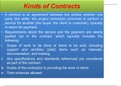
Kinds of Contracts
• A contract is an agreement between two parties wherein one
party (the seller, the project contractor) promises to perform a
service for another (the buyer, the client or customer), typically
in return for payment.
• Requirements about the service and the payment are clearly
spelled out in the contract, which typically includes the
following:
i. Scope of work to be done or items to be sold, including
support and ancillary (side) items such as manuals,
documentation, and training.
ii. Any specifications and standards referenced are considered
as part of the contract.
iii. Duties of the contractor in providing the work or items.
iv. Time schedule allowed.
, Cont`
i. Duties of the client regarding payments (including a schedule for milestones).
ii. How changes to the contract and disputes will be handled.
iii. How risks will be handled, including warranties, penalties, or bonuses/incentives.
• Different kinds of contracts provide different advantages to the client and the
contractor, depending on the project risk and difficulty in estimating costs.
• Each party tries to negotiate the kind of contract and the terms that best serve its
own interests.
• The two fundamental kinds of contacts are fixed price and cost-plus.
• In the fixed price contract, the price is agreed upon and remains fixed as long as
there are no changes to the project scope or provisions of the agreement.
• In the cost-plus (cost reimbursement) contract, the contractor is reimbursed for all or
some of the expenses incurred during the project, and as a result, the final price is
unknown until the project is completed.
• Within these two types are several variations including some with incentives for the
contractor to meet cost, time, or performance targets.
• Most projects involve multiple contractors and, hence, multiple contracts and a
combination of contract types, for example, cost plus for engineering and design, and
fixed price for construction.
• This is often a good way to contract project work, especially for large projects.
, Fixed Price Contracts
• Under a fixed price (FP) or “lump sum” agreement the
contractor agrees to perform all work at a fixed price.
• The contractor must be careful in estimating the target cost
because, once agreed upon, the price will not be adjusted.
• If the contractor in the bidding stage estimates the target cost
too low, he might win the job but make no profit; if he
overestimates, he may lose the job to a lower priced bidder.
• When project work is straightforward and can be specified in
detail, everyone prefers this kind of contract.
• Clients like it because they are less concerned about project
costs.
• Contractors like it because clients tend to request fewer
changes to the contract.
• The disadvantage of an FP contract is that it can be more
difficult and costly to prepare.
• A contract is an agreement between two parties wherein one
party (the seller, the project contractor) promises to perform a
service for another (the buyer, the client or customer), typically
in return for payment.
• Requirements about the service and the payment are clearly
spelled out in the contract, which typically includes the
following:
i. Scope of work to be done or items to be sold, including
support and ancillary (side) items such as manuals,
documentation, and training.
ii. Any specifications and standards referenced are considered
as part of the contract.
iii. Duties of the contractor in providing the work or items.
iv. Time schedule allowed.
, Cont`
i. Duties of the client regarding payments (including a schedule for milestones).
ii. How changes to the contract and disputes will be handled.
iii. How risks will be handled, including warranties, penalties, or bonuses/incentives.
• Different kinds of contracts provide different advantages to the client and the
contractor, depending on the project risk and difficulty in estimating costs.
• Each party tries to negotiate the kind of contract and the terms that best serve its
own interests.
• The two fundamental kinds of contacts are fixed price and cost-plus.
• In the fixed price contract, the price is agreed upon and remains fixed as long as
there are no changes to the project scope or provisions of the agreement.
• In the cost-plus (cost reimbursement) contract, the contractor is reimbursed for all or
some of the expenses incurred during the project, and as a result, the final price is
unknown until the project is completed.
• Within these two types are several variations including some with incentives for the
contractor to meet cost, time, or performance targets.
• Most projects involve multiple contractors and, hence, multiple contracts and a
combination of contract types, for example, cost plus for engineering and design, and
fixed price for construction.
• This is often a good way to contract project work, especially for large projects.
, Fixed Price Contracts
• Under a fixed price (FP) or “lump sum” agreement the
contractor agrees to perform all work at a fixed price.
• The contractor must be careful in estimating the target cost
because, once agreed upon, the price will not be adjusted.
• If the contractor in the bidding stage estimates the target cost
too low, he might win the job but make no profit; if he
overestimates, he may lose the job to a lower priced bidder.
• When project work is straightforward and can be specified in
detail, everyone prefers this kind of contract.
• Clients like it because they are less concerned about project
costs.
• Contractors like it because clients tend to request fewer
changes to the contract.
• The disadvantage of an FP contract is that it can be more
difficult and costly to prepare.