Network+ Port Numbers Latest 2023 Already Passed
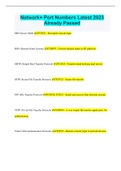
Network+ Port Numbers Latest 2023 Already Passed SSH (Secure Shell) TCP/22 - Encrypted console login DNS (Domain Name System) UDP/53 - Convert domain names to IP addresses SMTP (Simple Mail Transfer Protocol) TCP/25 - Transfer email between mail servers SFTP (Secure File Transfer Protocol) TCP/22 - Secure file transfer FTP (File Transfer Protocol) TCP/20, TCP/21 - Sends and receives files between systems TFTP (Trivial File Transfer Protocol) UDP/69 - A very simple file transfer application. No authentication Telnet (Telecommunication Network) TCP/23 - Remote console login to network devices DHCP (Dynamic Host Configuration Protocol) UDP/67, UDP/68 - Automated IP addressing and configuration HTTP (Hypertext Transfer Protocol) TCP/80 - Web server communication HTTPS (Hypertext Transfer Protocol Secure) TCp/443 - Web server communication with encryption SNMP (Simple Network Management Protocol) UDP/161 - Gather statistics and manage network devices RDP (Remote Desktop Protocol) TCP/3389 - Graphical display of remote device NTP UDP/123 - Synchronize clocks SIP (Session Initiation Protocol) TCP/5060, 5061 - Voice over IP signaling protocol SMB (Server Message Block) TCP/445 - Windows file transfers and printer sharing POP3 (Post Office Protocol version 3) TCP/110 - Receive mail into a mail client IMAP4 (Internet Message Access Protocol, version 4) TCP/143 - A newer mail client protocol LDAP (Lightweight Directory Access Protocol) TCP/389 - Communicate with network directories LDAPS (Lightweight Directory Access Protocol Secure) TCP/636 - LDAP over SSL H.323 - ITU Telecommunication H.32x protocol series TCP/1720 - Voice over IP signaling SCP (Secure Copy Protocol) TCP/22 - Used for secure copy Kerberos TCP,UDP/88 - Used for network authentication using a system of tickets within a Windows Domain NNTP (Network News Transfer Protocol) TCP/119 - Used to transport Usenet articles RPC/DCOM-scm (Remote Procedure Call) TCP,UDP/135 - Used to located DCOM ports request a service from a program on another computer on the network NetBIOS TCP,UDP/137-139 - Used to conduct name querying, sending of data, and other functions over a NetBIOS connection SNMPTRAP (Simple Network Management Protocol Trap) TCP,UDP 162 - Used to send Trap and InformRequests to the SNMP Manager on a network SMTP (with SSL/TLS) TCP/465,587 - Simple Mail Transfer Protocol used to send email over the Internet with an SSL and TLS secured connection Syslog UDP/514 - Used to conduct computer message logging, especially for routers and firewall logs LDAP (with SSL/TLS) TCP,UDP/636 - Used to maintain directories of users and other objects over an encrypted SSL/TLS connection iSCSI (Internet Small Computer Systems Interface) TCP/860 - Used for linking data storage facilities over IP FTPS (File Transfer Protocol Secure) TCP/989,990 - Used to transfer files from host to host over an encrypted connection IMAP4 (with SSL/TLS) TCP/993 - Used to receive email from a mail server over an SSL/TLS encrypted connection POP3 (with SSL/TLS) TCP/995 - Used to receive email from a mail server using an SSL/TLS encrypted connection MS-sql-s (Microsoft SQL Server) TCP/1433 - Used to receive SQL database queries from clients RADIUS (alternative) UDP/1645,1646 - Used for authentication and authorization (1645) and accounting (1646) RADIUS UDP/1812,1813 - Used for authentication and authorization (1812) and accounting (1813) FCIP (Fibre Channel over IP) TCP,UDP/3225 - Used to encapsulate Fibre Channel frames within TCP/IP packets iSCSI Target TCP/3260 - iSCSI Target is as the listening port for iSCSI-targeted devices when linking data storage facilities over IP Diameter TCP/3868 - A more advanced AAA protocol that is a replacement for RADIUS SYSLOG over TLS TCP/6514 - It is used to conduct computer message logging, especially for routers and firewall logs, over a TLS-encrypted connection
Written for
- Institution
- Network+ Port Numbers
- Course
- Network+ Port Numbers
Document information
- Uploaded on
- March 13, 2023
- Number of pages
- 6
- Written in
- 2022/2023
- Type
- Exam (elaborations)
- Contains
- Questions & answers
Subjects
-
network port numbers latest 2023 already passed
-
ssh secure shell tcp22 encrypted console login

Also available in package deal