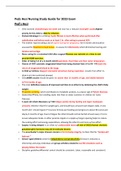
Peds Hesi Nursing Study Guide for 2023 Exam
Ped’s Hesi • Child received chemotherapy last week and now has a reduced neutrophil count highest priority for this child is Risk for infection. • Postural drainage for a child w/ Cystic fibrosis is most effective when performed after nebulization and before meals or at least 1 hr. after eating to prevent N/V. • The mother reports taking a lot of aspirin during her pregnancy, her 6 month old should be assessed for Reaction to loud noises --to assess for Ototoxicity which diminishes hearing and tinnitus and vertigo. • Nurse caring for a restrained child after surgery Remove one restraint at a time to and provide ROM exercises. • Order of taking V.S of a 4-month old Respirations, Heart Rate and then rectal temperature. • Closure of VSD’s prevents oxygenated blood from being shunted from LV to RV. Prevent the return of oxygenated blood to the lungs. • A Child w/ Asthma expect intercostal retractions during inspiration. (results from effort to draw in air into restricted airways) • CDC MMR vaccine should be given no sooner than 12 months of age, and ideally between 12~15 months of age. • The most definitive measure of improved nutrition in an infant is by obtaining the child’s Daily weight. • Projectile vomiting, which contributes to metabolic acidosis, is a classic sign of Pyloric Stenosis. • Steatorrhea Fatty, foul smelling stools that float on water (common in children w/ Cystic Fibrosis). • 3 week old infant Neonates w/ VSD fatigue quickly during feeding and ingest inadequate amounts. Monitor infant for weight gain, and should have at least 6 wet diapers daily. A one month old—should ingest 2~4 ounces formula per feeding and progress to about 30 ounces per day by 4 months of age. Due to fatigue the infant should rest but be fed at least every 2 hrs to ensure adequate intake. A softer preemie nipple or a nipple w/ larger opening helps to reduce the sucking effort and energy expenditure, allowing the infant to eat more w/ less effort. • Surgery is being delayed in an infant w/ undescended testes A trial of (HCG) Human chorionic gonadotrophic hormone may aid in testicular decent. • The preschooler’s major stressor concern is for his body integrity, he fears that his “insides will leak out.” • School- aged children strive for independence and productivity (Erickson’s Industry vs. Inferiority) and enjoy individual and group activities related to real life situations such as playing follow-the-leader. • Discipline guidelines Parental control should be consistent. (clear, reasonable and consistent) • Children aged 3 to 6yrs are in Erickson’s “Initiative vs. Guilt” stage, characterized by vigorous, intrusive behavior, enterprise and strong imagination. At this age, Children need to retain a sense of initiative without impinging on the rights and privileges of others. • A 4 year old is able to use a happy/sad face pain scale to indicate level of pain. • 5-yr old child w/ Diabetes, nurse should plan to teach first Process of glucose testing. (It can be helpful if it is presented as a game for them.) • Parents of a 3 week old infant report that child eats well but vomits after each feeding Most Important information for the nurse to get Is a Description of vomiting episodes in the past 24 hours. • Hirschsprung’s disease is a mechanical obstruction caused by inadequate motility in part of the intestines. The condition results from failure of the ganglion cells to migrate craniocaudally along the GI track during gestation. The lack of peristalsis in the affected bowel segment causes constipation and small diameter Ribbon like and brown colored stools. • Outcome of learning is best demonstrated when a client not only verbalizes understanding but can also provide return demonstration. • Nystatin (Myacostatin) Antifungal drug effective in treating thrush, an oral fungal infection. • The best approach for a toddler is to ignore the attention seeking behavior. • Posterior fontanels closes at 2 months and Anterior fontanels closes by 18 months. • Evaluating fluid status in an infant Weighing Diapers, checking skin turgor, and observing mucous membranes for moisture. • Sickle cell anemia S/S of abdominal pain, anemia and enlarged spleen and liver indicate a Sequestration crisis. • A 2 yr old w/ Gastro-esophageal reflux dx. Is afraid to eat Parents should consistently follow a set mealtime routine. • Altered daily schedules and loss of rituals can be upsetting to a child and increase separation anxiety, and active sensitivity to the needs to children can minimize the negative effects of hospitalization. Explain the hospital schedule to the child such as, mealtimes. • The nurse should provide factual and reassuring explanation that focuses on individual variations of menarche, which can normally occur between 12 and 18 years of age. • Those receiving Growth Hormone (GH) should be monitored to detect elevated blood sugars and glucose intolerance S/S include Polyuria and Polydipsia. • Intervention by a nurse for Wilms Tumor Sign above the bed in clear, large bold letters stating “DO NOT PALPATE ABDOMEN”. Which will minimize the risk of rupturing the encapsulated tumor and subsequent metastasis. • A toddler 1~3 years old is capable of making two to three word sentences. • Needs’ of siblings will be better met w/ factual information & contact w/ the ill child, so sibling visitation to the hospital should be encouraged. • Congenital Heart disease is the most common associated defect in children w/ Down syndrome. • Early indication of Hypothyroidism in children Growth cessation which was previously w/in normal range is the most common sign. • Use of a doll or other toys is the most helpful for a nurse when communicating w/ a pre-school aged child. • 4 year olds are aggressive in their behavior and enjoy “tale telling”. • Nurse should help reduce anxiety of a 3 year old who is about to undergo a cardiac catheterization by Familiarizing him/or her to the environment by Giving the child a ride on a gurney to visit the cardiac cath lab and meet a nurse who works there. 3 is a difficult age to undergo a procedure that requires cooperation. Restraints and possibly sedation maybe required. • Body image and peer acceptance are key concerns for adolescents. Nurse should help arrange for internet connection so the 16 yr old can have social interaction through email / peers. • A newborn born w/ PDA is under hood oxygenation of 35% (room air is 21%), parents visit the nursery and want to hold the baby, Nurse should tell them that baby need to stay under the hood to maintain the O2 level needed at this time, they can stroke, touch and talk to the baby but the baby cannot be removed from under the hood. • Vital Signs of a 4 years w/ Polyuria are: BP 80/40, Pulse 118, RR: 24, Pedal pulses: +1 and no edema is noted. The nurse should first Start an IV of NS. Fluid volume deficit due to polyuria. V.S and decreased peripheral pulse volume indicate this. • Nurse is having difficulty w/ communicating with a hospitalized 6 yr old, the nurse should Engage the child through drawing picture. • Most accurate dose of medication given to an infant by a parent should be through a syringe. • Therapeutic range for Theophylline is 10 to 20 mcg/dl. • S/S of Hyperthyroidism Nervousness, apprehension, hyperexcitability and palpitations. • Nifedipine (Procardia) sublingual lowers blood pressure quickly and should be done first in a pt w/ HTN. • Topical medication in infants they have a thin Stratum corneum (thin out layers of skin) that increases topical absorption. • Parent asks the nurse is its ok to give her child Pepto-Bismol when her child has a stomach ache Pepto-Bismol contains aspirin and should not be given to a child who has or recently had chickenpox, flu or any other viral infection due to the high risk of Reye’s syndrome.
Written for
- Institution
- Herzing University
- Course
- PN 126
Document information
- Uploaded on
- April 19, 2023
- Number of pages
- 10
- Written in
- 2022/2023
- Type
- OTHER
- Person
- Unknown
Subjects
-
peds hesi nursing study guide for 2023 exam

Also available in package deal