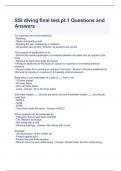
SSI diving final test pt.1 Questions and Answers
Ear squeeze can be prevented by: - Relaxing - Never diving with a cold - Rotating the jaw, swallowing or Valsalva - All answers are correct - Answer- all answers are correct The purpose of equalization is to: - Ensure the uneven application of pressure between the water and air spaces in the body - Remove all fluids from body air spaces -Introduce additional air into body air spaces in response to increasing external pressure - Prevent water from entering air spaces in the body - Answer- Introduce additional air into body air spaces in response to increasing external pressure Body heat is lost underwater at a rate of ___ than in air. - 10 times slower - 50 times faster - 25 to 30 times faster - same - Answer- 25 to 30 times faster Salt water weighs ___ pounds per cubic foot and freshwater weighs ___ pounds per cubic foot. - 64/62.5 - 54/50 - 65/68 - They both weigh the same - Answer- 64/62.5 Sinus squeeze can be prevented by: - Tilting the divers head back and forth - The Valsalva technique - Not diving with a cold - Wearing earplugs - Answer- Not diving with a cold Earplugs: - Aid equalization of the middle ear - Protect against cold - Protect the ears from squeeze - Should never be worn while diving - Answer- Should never be worn while diving The condition in which certain colors are diminished as depth increases is called: - Absorption - Turbidity - Refraction - Diffusion - Answer- Absorption The first symptom of a sinus squeeze is usually: - A sharp pain or wedging sensation above the eyes - A sharp pain at the base of the neck - A dull pain deep within the head - A crushing pain high in the chest - Answer- A sharp pain or wedging sensation above the eyes The greatest relative pressure change in sea water takes place between ____ and ____ feet. - 0/33 - 33/66 - 66/99 - 99/132 - Answer- 0/33 If you experience pain in the ear during descent: - Continue the descent while gently exhaling into the mask - Stop the descent and ascend until the pain stops - Abort the dive - Place a finger in the ear canal and gently massage the ear until the pain ceases - Answer- Stop the descent and ascend until the pain stops Proper equalization techniques must be learned in order to: - Prevent squeeze injuries - Prevent ear pain - Prevent sinus squeeze - All answers are correct - Answer- All answers are correct The absolute pressure expressed in terms of atmospheres absolute at 99 feet in salt water is: - 3.5 ata - 2.5 ata - 3 ata - 4 ata - Answer- 4 ata Gauge pressure is defined as: - The depth reading on a gauge - The pressure at the surface - Hydrostatic pressure minus 1 ata - Absolute pressure minus 1 ata - Answer- Absolute pressure minus 1 ata Underwater, the bending of light rays causes objects to appear to be: - Closer - Farther away - The same as the surface - At an angle consistent with the bend of the light - Answer- Closer Which of the statements concerning sound transmission underwater is correct? - Divers find it difficult to locate the direction of a sound producing source - All answers are correct - Sound will travel farther underwater than in air - Sound travels four times faster underwater than in air - Answer- All answers are correct Absolute pressure is defined as: - The pressure at the surface plus 1 ata - The weight of the water that surrounds a diver - The total pressure exerted on an object - All answers are correct - Answer- The total pressure exerted on an object If a flexible air-filled container has a volume of 40 cu ft on the surface, what would the volume be at 99 feet in sea water? (rounded off) - 60 cu ft - 25 cu ft - 10 cu ft - 20 cu ft - Answer- 10 cu ft The event that led to the use of the acronym SCUBA to describe diving was: - Post-WWII equipment refinements - The invention of the diving helmet in circa 1800 - The development of the demand regulator in 1943 - The development of air pumps in the 19th century - Answer- The development of the demand regulator in 1943 One atmosphere of pressure is defined as: - 1 ata - Each 33 feet of depth in sea water - Each 34 feet of depth in freshwater - All answers are correct - Answer- All answers are correct The absolute pressure expressed in terms of atmospheres absolute at 33 feet in sea water is: - 1 ata - 2 ata - 3 ata - 4 ata - Answer- 2 ata Assuming a consistent air consumption rate, diving at a pressure of 4 ata will use __ as much air as diving at 2 ata. - 4 times - 5 times - 2 times - 8 times - Answer- 2 times During normal diving activities, divers should never exceed an ascent rate of __ feet per minute. - 30 - 20 - 9 - 18 - Answer- 30 A high pressure scuba cylinder should be stored: - Lying flat with no air - With the valve slightly open to allow air expansion - Secured and with a minimum of 500 to 750 psi - Secured with the valve open - Answer- Secured and with a minimum of 500 to 750 psi The Information System components are: - Dive Computer, Analogue Instruments, if the Dive Computer does not supply all necessary information and SSI Total DiveLog - Dive Computer and SSI Total DiveLog - SSI Dive Tables and SSI Total DiveLog - Dive computer, SSI Total DiveLog, and written dive plan - Answer- Dive Computer, Analogue Instruments, if the Dive Computer does not supply all necessary information and SSI Total DiveLog An object immersed in water will be buoyed upward by a force ______ the weight of the water it displaces. - equal to - Greater than - Less than - 2 times - Answer- equal to A scuba cylinder must be hydrostatically tested: - A minimum of once a year - After 100 dives - Within fixed intervals set by local law - Never, no test is required - Answer- Within fixed intervals set by local law Which of the following Total Diving System subsystems best describes the SCUBA? - The Buoyancy System - The Delivery System - The Snorkeling System - The Information System - Answer- The Delivery System The purpose of a BC is to: - Control ascent and descent rates - Provide surface floatation - Maintain neutral buoyancy during the dive - All answers are correct - Answer- All answers are correct
Written for
- Institution
- SSI diving
- Course
- SSI diving
Document information
- Uploaded on
- June 21, 2023
- Number of pages
- 12
- Written in
- 2022/2023
- Type
- Exam (elaborations)
- Contains
- Questions & answers
Subjects
-
ssi diving final test pt1 questions and answers

Also available in package deal