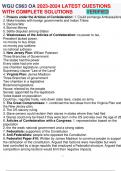
WGU C963 OA 2023-2024 LATEST QUESTIONS
WITH COMPLETE SOLUTIONS VERIFIED
1. Powers under the Articles of Confederation: 1. Could exchange Ambassadors
2. Make treaties with foreign governments and Indian Tribes
3. Declare War
4. Borrow Money
5. Settle disputes among States
2. Weaknesses of the Articles of Confederation: no power to tax,
President lacked power,
no money to buy ships
no money pay soldiers
no national judiciary
3. New Jersey Plan: William Paterson
Three Branches of Government
The states had the power
Every state had one vote
one chamber legislature, unicameral
Supremacy clause "Law of the Land"
4. Virginia Plan: James Madison
Three Branches of government
Two-chamber in a legislative
Bicameral legislature:
House: elected by the people
Senate: appointed by the legislature
Votes based on population
Could tax, regulate trade, veto down state laws, create an army
5. The Great Compromises: 1. combined the two ideas from the Virginia Plan and
the New Jersey plan.
2. The 3/5 slavery ruling
3. Slave owners could reclaim their slaves in states where they had fled.
4. Slaves could only be freed if they were born in the US and was over the age of 28
6. Articles of Confederation with a Congress: 1. representation based on the
population
2. the the weak national government and a strong states
7. Federalists: supporters of the Constitution
8. Anti-Federalists: people who opposed the Constitution
9. Federalist Paper #10: Written by James Madison to convince people to support
the ratification of the constitution. Argued that factions were inevitable but were
best controlled by a large republic that employed a Federalist structure. Argued that
competition among factions would limit their negative impacts.
1/6
WITH COMPLETE SOLUTIONS VERIFIED
1. Powers under the Articles of Confederation: 1. Could exchange Ambassadors
2. Make treaties with foreign governments and Indian Tribes
3. Declare War
4. Borrow Money
5. Settle disputes among States
2. Weaknesses of the Articles of Confederation: no power to tax,
President lacked power,
no money to buy ships
no money pay soldiers
no national judiciary
3. New Jersey Plan: William Paterson
Three Branches of Government
The states had the power
Every state had one vote
one chamber legislature, unicameral
Supremacy clause "Law of the Land"
4. Virginia Plan: James Madison
Three Branches of government
Two-chamber in a legislative
Bicameral legislature:
House: elected by the people
Senate: appointed by the legislature
Votes based on population
Could tax, regulate trade, veto down state laws, create an army
5. The Great Compromises: 1. combined the two ideas from the Virginia Plan and
the New Jersey plan.
2. The 3/5 slavery ruling
3. Slave owners could reclaim their slaves in states where they had fled.
4. Slaves could only be freed if they were born in the US and was over the age of 28
6. Articles of Confederation with a Congress: 1. representation based on the
population
2. the the weak national government and a strong states
7. Federalists: supporters of the Constitution
8. Anti-Federalists: people who opposed the Constitution
9. Federalist Paper #10: Written by James Madison to convince people to support
the ratification of the constitution. Argued that factions were inevitable but were
best controlled by a large republic that employed a Federalist structure. Argued that
competition among factions would limit their negative impacts.
1/6