US History Regents Review with the most important terms 2023
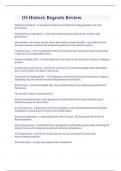
US History Regents Review Mayflower Compact - A document written by the Pilgrims setting guidelines for self-government Virginia House of Burgesses - First representative government in the colonies, self-government Mercantilism - Economic system where the mother country benefits - raw materials sent from the colonies, colonists buy finished products from the mother country. Common Sense - 1776: a pamphlet written by Thomas Paine that claimed the colonies had a right to be an independent nation French and Indian War - Caused England to raise taxes on the American colonies, leading to protests Proclamation Line of 1763 - British say colonists can't settle past Appalachian Mountains, don't want conflict with Native Americans. Declaration of Independence - 1776 statement, issued by the Second Continental Congress, explaining why the colonies wanted independence from Britain. British Taxes - Colonists thought they were unfair because they lacked representation in Parliament, "No taxation without representation." Articles of Confederation - First government of the United States that failed because it lacked the power to collect taxes U.S. Constitution - A document written by delegates at the Constitutional Convention that established a national government in the United States. Bicameral Legislature - a lawmaking body with 2 houses - the Senate and the House of Representatives Great Compromise - Created the House (population) and Senate (equal) while resolving the dispute between the large and small states. Bicameral legislature 3/5 Compromise - each slave would count for 3/5 of a person for taxation and representation purposes Anti-Federalists - People who opposed the constitution Federalists - Supporters of the Constitution during ratification. Bill of Rights - a statement of fundamental rights and privileges (first ten amendments to the United States Constitution) Strict vs. Loose interpretation - Strict interpretation: go exactly by what the constitution says- Thomas Jefferson Loose: have more liberal views-Alexander Hamilton Federalism - A system in which power is divided between the national and state governments Elastic Clause - Part of the Constitution which allows Congress to make all laws that are "necessary and proper" to carry out the powers of the Constitution. Separation of Powers - Constitutional division of powers among the legislative, executive, and judicial branches, with the legislative branch making law, the executive applying and enforcing the law, and the judiciary interpreting the law George Washington's Farewell address - He advised the nation: 1. to stay away from permanent alliances with foreign nations 2. stay away from political parties Louisiana Purchase - Made by Jefferson in 1803 that doubled the size of the US and gave it total control of the Mississippi River Marbury V. Madison - Established judicial review Andrew Jackson - President of the United States, first "regular guy" to be elected. Indian Removal Act - AKA "Trail of Tears" congressional act that authorized the removal of Native Americans who lived east of the Mississippi River Nullification Crisis - South Carolina tried to assert control over government, President Jackson stopped it. States rights issue Manifest Destiny - A notion held by a nineteenth-century Americans that the United States was destined to rule the continent, from the Atlantic the Pacific. Mexican Cession - Land taken by the US after the Mexican American War Mexican-American War - President Polk declared war on Mexico over the dispute of land in Texas. Missouri Compromise - An agreement between slave and free states resulting in Missouri becoming a slave state, Maine a free state and the rest of the Louisiana Purchase divided at the 36th Parallel Compromise of 1850 - An agreement between slave and free states resulting in California becoming a free state but the creation of the Fugitive Slave Act Fugitive Slave Act - A law that made it a crime to help runaway slaves; allowed for the arrest of escaped slaves in areas where slavery was illegal and required their return to slaveholders Kansas-Nebraska Act - Allowing new states to decide slavery by popular sovereignty Popular Sovereignty - The right of the people to decide if there would be slavery in their state or not. Sectionalism - Loyalty to one's own region of the country, rather than to the nation as a whole such as the North and South before and during the Civil War. Uncle Tom's Cabin - Popular book before the Civil War that made people aware of how harsh treatment was for slaves John Brown - Abolitionist (wanted to get rid of slavery) who tried to incite slaves in Virginia to rebel against their masters. Failed, was executed. Dred Scott v. Sanford (aka Dred Scott Decision) - Supreme Court case which ruled that slaves are not citizens but are property - made South happy, made abolitionists work harder Secession - A state withdraws from the Union. South Carolina was the first to secede Abraham Lincoln - President of the United States during the Civil War, his election in 1860 made the South want to secede.
Written for
- Institution
- US History Regents
- Course
- US History Regents
Document information
- Uploaded on
- August 30, 2023
- Number of pages
- 10
- Written in
- 2023/2024
- Type
- Exam (elaborations)
- Contains
- Questions & answers
Subjects
-
us history regents review with the most important
-
mercantilism economic system where the mother co
-
common sense 1776 a pamphlet written by thomas
-
french and indian war caused england to raise ta

Also available in package deal