CFA Level 1 - Quantitative Methods Questions and Answers Solved Correctly
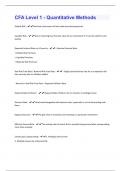
Default Risk - Risk that a borrower will not make promised payments Liquidity Risk - Risk of recieving less than fair value for an investment if it must be sold for cash quickly Required Interest Rate on A Security - = Nominal Interest Rate + Default Risk Premium + Liquidity Premium + Maturity Risk Premium Real Risk Free Rate / Nominal Risk Free Rate - - Single period interest rate for a completely riskfree security with no inflation added - Nominal = Real Risk Free Rate + Expected Inflation Rate Required Rate of Return - Required Rate of Return for an investor to willingly invest Discount Rate - Used interchangeably with interest rates, especially in use of discounting cash flows Opportunity Cost - The gain that is missed by not investing in a particular investment Effective Annual Rate - The actualy rate of interst that is actually being earned after compounding more than annually Continuous Compounding - 1. Multiply rate by time 2. Multiple answer by e (Second LN)3. Multiply by PV Present Value of Perpetuity - Financial instrument that pays a fixed amount of money at set intervals over an infinite period of time Present Value of a Projected Perpetuity - 1. Calculate PV of Perpetuity 2. Find present value of (N -1) PV of Uneven Cash Flows - 1. Clear Memory 2. Enter 0 in CF0 3. Enter Cash Flows in Sequence 4. NPV = Discount Rate 5. ComputeT NPV FV of Uneven Cash Flows -1. Calculate the FV of each individual Cash Flow 2: Then add the results together Calculating the Growth Rate - Or use TMV calculator 1. N = Periods, PV = PV, PMT = 0, FV = FV 2. Compute I/Y Annual Payments (Amortization) - 1. N = Years, I/Y = Interest, PV = Loan Amount, FV = 0 2. Compute Payments Calculate Amortization Schedule - 1. Calculate Loan Payment 2. Calculate Interest Component (Beginning balance x I/Y) 3. Calculate Principal component (Payment - Interest Component) 4.The following beginning balance is the first period balance - principal component only. (Interest goes to bank)Cash Flow Additivity Principle - Present value of any stream of cash flow equals the sum of the present values of the cash flows. Ex: Cash flows of $100 for 4 Years & a $300 payment that occurs in year 3. Calculate the PV of both and add them together. (Use the Unequal Cash flow method.) NPV - Present Value of expected cash inflows minus the present value of the expected outflows, discounted at the appropriate rate. Use the Calculator (Cash Flow): Set CF0 = 0 (for profit) Set CF0 = Initial negative outflow (for total NPV) IRR - Discount rate that makes NPV equal to zero Use Calculator (Cash Flows): 1.CF0 = Initial Cash Outlay 2.CF1.....CFn 3.Compute IRR Capital Budgeting - The allocation of funds to relatively long range projects or investments Capital Structure - The choice of long-term financial for the investments the company wants to make Working Capital Management - The management of the company's short-term assets (such as inventory) and short term liabilities (such as money owed to suppliers).
Written for
- Institution
- CFA Level 1 - Quantitative Methods
- Course
- CFA Level 1 - Quantitative Methods
Document information
- Uploaded on
- November 7, 2023
- Number of pages
- 7
- Written in
- 2023/2024
- Type
- Exam (elaborations)
- Contains
- Questions & answers
Subjects
-
cfa level 1 quantitative methods

Also available in package deal