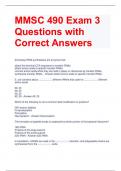
MMSC 490 Exam 3 Questions with Correct Answers
MMSC 490 Exam 3 Questions with Correct Answers Aminoacyl tRNA synthetases are enzymes that attach the terminal CCA sequence to transfer RNAs. attach amino acids to specific transfer RNAs. connect amino acids while they are held in place on ribosomes by transfer RNAs. synthesize transfer RNAs. - Answer-attach amino acids to specific transfer RNAs. E. coli contains about .................... different tRNAs that code for .................... different amino acids. 62; 40 40; 20 50; 20 62; 20 - Answer-40; 20 Which of the following is not a common lipid modification to proteins? GPI anchor addition N-myristoylation Prenylation Glycosylation - Answer-Glycosylation The formation of peptide bonds is catalyzed by which portion of the bacterial ribosome? 16S rRNA Proteins of the large subunit Proteins of the small subunit 23S rRNA - Answer-23S rRNA In translation, mRNAs are read in the .................... direction, and polypeptide chains are synthesized from the .................... ends. 3ʹ to 5ʹ; carboxyl to the amino 3ʹ to 5ʹ; amino to the carboxyl 5ʹ to 3ʹ; carboxyl to the amino 5ʹ to 3ʹ; amino to the carboxyl - Answer-5ʹ to 3ʹ; amino to the carboxyl During translation, the codons on the mRNA are recognized by complementary base pairing to the anticodon on the ribosome. small cytoplasmic RNA. aminoacyl tRNA synthetase transfer RNA. - Answer-transfer RNA. Translation of mRNAs starts at the 3ʹ end of the mRNA. the 5ʹ end of the mRNA. a site downstream of a 3ʹ untranslated region. a site downstream of a 5ʹ untranslated region. - Answer-a site downstream of a 5ʹ untranslated region. Eukaryotic ribosomes recognize and initially bind to what structure on the mRNA? The 7-methylguanosine cap A TATA sequence A Shine-Dalgarno sequence A CCAAT sequence - Answer-The 7-methylguanosine cap The first step in the initiation of protein synthesis is the binding of .................... to the .................... . initiation factors; initiation codon initiation factors; small ribosomal subunit the initiator tRNA; initiation codon the small ribosomal subunit; initiation codon - Answer-initiation factors; small ribosomal subunit The factor that escorts the amionacyl tRNA to the eukaryotic ribosome and then releases it with GTP hydrolysis following the correct codon-anticodon base pairing is eRF-1. eIF-1. eIF-2. eEF-1. - Answer-eEF-1. The first amino acid that initiates the eukaryotic polypeptide is glutamine. any amino acid. N-formylmethionine. methionine. - Answer-methionine. In translation, mRNAs are read in the .................... direction, and polypeptide chains are synthesized from the .................... ends. 5ʹ to 3ʹ; carboxyl to the amino 3ʹ to 5ʹ; amino to the carboxyl 5ʹ to 3ʹ; amino to the carboxyl 3ʹ to 5ʹ; carboxyl to the amino - Answer-5ʹ to 3ʹ; amino to the carboxyl The amount of a protein in a cell is regulated by the rate of translation of its mRNA. transcription of its gene. degradation of the protein. All of the above - Answer-All of the above Oocytes store mRNAs with .................... and activate them by .................... . long poly-A tails; shortening the tails bound siRNA; removing the siRNA short poly-A tails; lengthening the tails no cap; addition of a cap - Answer-short poly-A tails; lengthening the tails The correctly folded three-dimensional configuration of a protein is determined primarily by the chaperones with which it interacts. primary sequence of its amino acids. pathway by which it folds. sequence of nucleotides of its gene. - Answer-primary sequence of its amino acids. Proteins that facilitate the folding of other proteins are called foldases. chaperones. escorts. binding proteins. - Answer-chaperones. Many chaperones are called heat-shock proteins because they are expressed at higher levels after a heat shock than at normal growth conditions. denature at high temperatures. cause fever in mammals. misfold during a heat shock. - Answer-are expressed at higher levels after a heat shock than at normal growth conditions. A signal peptidase removes a signal sequence from a polypeptide chain after it passes through a channel into the rough ER. attaches an acetyl group to the 5′ end of a polypeptide after removal of the initial methionine. removes the initial methionine from a polypeptide chain. attaches a signal sequence to a growing polypeptide chain before it passes into the rough ER. - Answer-removes a signal sequence from a polypeptide chain after it passes through a channel into the rough ER. The signal sequence of a protein being translocated into the endoplasmic reticulum is cleaved off by a signal peptidase located on the amino terminal of the polypeptide being translocated. on the inner surface of the ER membrane. in the lumen of the ER. in the cytosol. - Answer-on the inner surface of the ER membrane. Prior to N-linked glycosylation of a protein, a complex oligosaccharide is assembled in the endoplasmic reticulum on a lipid carrier called phosphatidylinositol. a prenyl group. dolichol phosphate. myristic acid. - Answer-dolichol phosphate. N-linked glycosylation attaches a complex carbohydrate onto the free amino group at the amino terminal end of the polypeptide. carboxyl group of aspartic acid. amino group of lysine. amino group of asparagine. - Answer-amino group of asparagine.
Written for
- Institution
- MMSC 490
- Course
- MMSC 490
Document information
- Uploaded on
- January 18, 2024
- Number of pages
- 31
- Written in
- 2023/2024
- Type
- Exam (elaborations)
- Contains
- Questions & answers
Subjects
-
mmsc 490
-
mmsc 490 exam 3
-
mmsc 490 exam 3 questions
-
mmsc 490 exam 3 questions with correct answers

Also available in package deal