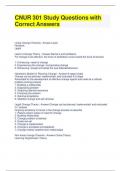
CNUR 301 Study Questions with Correct Answers
CNUR 301 Study Questions with Correct Answers Linear Change Theories - Answer-Lewin Havelock Lippitt Lewin's Change Theory - Answer-Barrier's and facilitators For change to be effective, the force of facilitators must exceed the force of barriers 1. Unfreezing- need for change 2. Experiencing the change- incorporating change 3. Refreezing- accept and adopt the new attitude/behaviour Havelock's Model for Planning Change - Answer-6 stage model Change can be planned, implemented, and evaluated in 6 steps Advocated for the development of effective change agents and used as a rational problem-solving process 1. Building a relationship 2. Diagnosing problem 3. Acquiring relevant resources 4. Choosing the solution 5. Gaining acceptance 6. Stabilize change and self-renewal Lippitt Change Theory - Answer-Change can be planned, implemented, and evaluated in 7 phases Ongoing sensitivity to forces in the change process is essential 1. Patient system aware of need for change 2. Building relationship 3. Change problem is defined 4. Goals are set 5. Change is implemented 6. Change is accepted and stabilized 7. Change entities redefine their relationships
Written for
- Institution
- CNUR 301
- Course
- CNUR 301
Document information
- Uploaded on
- January 20, 2024
- Number of pages
- 5
- Written in
- 2023/2024
- Type
- Exam (elaborations)
- Contains
- Questions & answers
Subjects
-
cnur 301
-
cnur 301 study questions
-
linear change theories
-
lewins change theory
-
cnur 301 study questions with correct answers

Also available in package deal