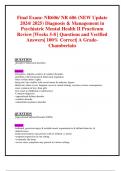
Final Exam: NR 606/ NR 606 (NEW Update 2024/ 2025) Diagnosis & Management in Psychiatric Mental Health II Practicum Review |Weeks 5-8 | Questions and Verified Answers| 100% Correct | A Grade - Chamberlain QUESTION disruptive behavioral disorders Answer: -Disruptive, impulse -control, & conduct disorders -problems with emotional & behavioral regulation -often violate others' rights -bring ind. into conflict with social norms & authority figures -Behaviors often severe, frequent, occur in varied settings, can have serious consequences -more common in boys than girls -first onset in childhood or adolescence -Common diagnosis: • oppositional defiant disorder • conduct disorder • intermittent explosive disorder QUESTION Oppositional Defiant Disorder (ODD) Answer: -hallmark: persistent angry & irritable mood, argumentative & defiant behavior, & vindictiveness -behavioral features may present with or without ( -) mood -symptom expression in one setting • commonly the home • severe cases symptoms may present in various settings -symptom expression impairs social functioning of the ind. • more evident, interactions with peers or adults they know -Onset: early childhood • symptoms commonly persist into adulthood -frequently occurs comorbidly with ADHD & often precedes development of conduct disorder -high co -occurrence rates with anxiety & MDDs -associated with increased risk for suicide ideation -Prevalence rates: 1% -11%, more prevalent in boys than girls QUESTION ODD diagnosis Answer: -behaviors must have ( -) consequences & must not be associated exclusively with a psychotic, substance use, depressive, or bipolar disorder. • must also not meet diagnostic criteria for DMDD -First, 4 or more of the following symptoms must have occurred during an interaction with one or more individuals that are not siblings within the last 6 months: • Angry/Irritable Mood ➣often loses temper ➣is often easily annoyed ➣is often angry and resentful • Argumentative/Defiant Behavior ➣argues with authority figures or adults ➣actively defies or refuses to follow rules or requests from authority figures ➣deliberately annoys others ➣blames others for their mistakes or misbehavior • Vindictiveness ➣has been spiteful or vindictive at least twice within the past 6 months -Second, symptom persistence & frequency must exceed typical developmental behaviors r/t the child's age, gender, & culture. • For children under age 5, behaviors must occur on most days for at least six months. • For people 5 and older, the behaviors must occur at least once per week for at least six months. QUESTION The severity of ODD is determined by: Answer: the number of settings in which the behaviors occurred. QUESTION ODD and DMDD Diagnosis Considerations Answer: -DMDD shares many symptoms with ODD, many individuals meet diagnostic criteria for both disorders • ODD cannot be diagnosed if criteria are also met for DMDD. ➣These circumstances, should receive a diagnosis of DMDD QUESTION ODD stigma Answer: -reactive behavior & trauma responses are mischaracterized as self -control issues -Some mental health providers are calling for a revision of the DSM -5-TR ODD • use neutral terminology, behavior (reactive) or state (dysregulated) rather than a disposition (oppositional and defiant) QUESTION Conduct disorder Answer: -severe behaviors that violate societal norms or the rights of others, may involve aggression towards others, animals, theft, &/or the destruction of property -developmental relationship between ODD & conduct disorder -Behaviors may present as early as pre -school, though more serious symptoms tend to appear later in childhood or adolescence before age 16 • occur in multiple settings, freq cause significant dysfunction -increased risk of: • criminal behaviors & substance -related disorders ➣especially those with childhood -onset type • mood & anxiety disorders • impulse -control disorders • psychotic disorders • PTSD -prevalence: 1.5% -3.4% in the U.S., occurs more in males QUESTION risk factors for conduct disorder Answer: -Temperamental • Difficult infant temperament • lower -than-average intelligence -Environmental: Family -Level • caregiver abuse and neglect • varying caregivers or child -rearing practices • harsh discipline • family criminality • substance -related disorders -Environmental: Community -Level • rejection by peers • participation in a delinquent peer group • poverty • exposure to violence -Genetic or Physiological • Family members with conduct disorder • depressive & bipolar disorders • schizophrenia • ADHD • substance use disorders QUESTION Conduct Disorder DSM -5-TR Diagnosis Answer: 3 or more of the following symptoms in the past 12 months with one symptom occurring within the last 6 months: -Aggression to People and Animals • Bullies, threatens, or intimidates others
Exam (elaborations)
Final Exam: NR606/ NR 606 (NEW Update 2024/ 2025) Diagnosis & Management in Psychiatric Mental Health II Practicum Review |Weeks 5-8 | Questions and Verified Answers| 100% Correct| A Grade- Chamberlain
Final Exam: NR606/ NR 606 (NEW Update 2024/ 2025) Diagnosis & Management in Psychiatric Mental Health II Practicum Review |Weeks 5-8 | Questions and Verified Answers| 100% Correct| A Grade- Chamberlain QUESTION disruptive behavioral disorders Answer: -Disruptive, impulse-control, & conduct disorders -problems with emotional & behavioral regulation -often violate others' rights -bring ind. into conflict with social norms & authority figures -Behaviors often severe, frequent, occur in varied settings, can have serious consequences -more common in boys than girls -first onset in childhood or adolescence -Common diagnosis: • oppositional defiant disorder • conduct disorder • intermittent explosive disorder QUESTION Oppositional Defiant Disorder (ODD) Answer: -hallmark: persistent angry & irritable mood, argumentative & defiant behavior, & vindictiveness -behavioral features may present with or without (-) mood -symptom expression in one setting • commonly the home • severe cases symptoms may present in various settings -symptom expression impairs social functioning of the ind. • more evident, interactions with peers or adults they know -Onset: early childhood • symptoms commonly persist into adulthood -frequently occurs comorbidly with ADHD & often precedes development of conduct disorder -high co-occurrence rates with anxiety & MDDs -associated with increased risk for suicide ideation -Prevalence rates: 1%-11%, more prevalent in boys than girls QUESTION ODD diagnosis Answer: -behaviors must have (-) consequences & must not be associated exclusively with a psychotic, substance use, depressive, or bipolar disorder. • must also not meet diagnostic criteria for DMDD -First, 4 or more of the following symptoms must have occurred during an interaction with one or more individuals that are not siblings within the last 6 months: • Angry/Irritable Mood often loses temper is often easily annoyed is often angry and resentful • Argumentative/Defiant Behavior argues with authority figures or adults actively defies or refuses to follow rules or requests from authority figures deliberately annoys others blames others for their mistakes or misbehavior • Vindictiveness has been spiteful or vindictive at least twice within the past 6 months -Second, symptom persistence & frequency must exceed typical developmental behaviors r/t the child's age, gender, & culture. • For children under age 5, behaviors must occur on most days for at least six months. • For people 5 and older, the behaviors must occur at least once per week for at least six months. QUESTION The severity of ODD is determined by: Answer: the number of settings in which the behaviors occurred. QUESTION ODD and DMDD Diagnosis Considerations Answer: -DMDD shares many symptoms with ODD, many individuals meet diagnostic criteria for both disorders • ODD cannot be diagnosed if criteria are also met for DMDD. These circumstances, should receive a diagnosis of DMDD QUESTION ODD stigma Answer: -reactive behavior & trauma responses are mischaracterized as self-control issues -Some mental health providers are calling for a revision of the DSM-5-TR ODD • use neutral terminology, behavior (reactive) or state (dysregulated) rather than a disposition (oppositional and defiant) QUESTION Conduct disorder -severe behaviors that violate societal norms or the rights of others, may involve aggression towards others, animals, theft, &/or the destruction of property -developmental relationship between ODD & conduct disorder -Behaviors may present as early as pre-school, though more serious symptoms tend to appear later in childhood or adolescence before age 16 • occur in multiple settings, freq cause significant dysfunction
Show more
Read less
Institution
Course
Content preview
Written for
- Institution
- Chamberlain College Of Nursing
- Course
- NR606/ NR 606 (NR606)
All documents for this subject (59)
Document information
- Uploaded on
- January 30, 2024
- Number of pages
- 90
- Written in
- 2023/2024
- Type
- Exam (elaborations)
- Contains
- Questions & answers
Subjects
-
nr 606
-
final exam nr606 nr 606 new update
-
conduct disorder severe behaviors that violate s
-
final exam nr606 nr 606 new update
-
final exam nr606 nr 606 new update
-
nr 606nr606nr606 nr 606 final exam
CA$19.18
Get access to the full document:

Wrong document? Swap it for free
Within 14 days of purchase and before downloading, you can choose a different document. You can simply spend the amount again.
Written by students who passed
Immediately available after payment
Read online or as PDF
Also available in package deal
Package deal
Week 5,6,7,8 & Final Exam: NR606/ NR 606 (NEW Updates 2024/ 2025 BUNDLED TOGETHER WITH COMPLETE SOLUTIONS) Diagnosis & Management in Psychiatric Mental Health II |Reviews with Questions and Verified Answers| 100% Correct| A Grade- Chamberlain
1
5
2024
CA$ 38.36
More info