Arrt ct registry Proctored exam 2024
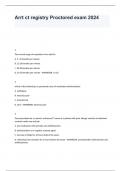
1. The normal range of respiration of an adult is A. 5- 10 breaths per minute B. 12-20 breaths per minute c. 20-30 breaths per minute D. 35-50 breaths per minute - ANSWERSB. 12-20 2 which of the following is a parenteral route of medication administration A. sublingual B. Intramuscular C. transdermal D. Oral - ANSWERSB. Intramuscular 3 The preperation for a contrast- enhanced CT exam of a patient with prior allergic reaction to iodinated contrast media may include A. pre medication with steroids and antihistamines B. administration of a negative contrast agent C. increase in fluids for 24 hours before the exam D. refraining from urination for 2 hours before the exam - ANSWERSA. premedication with Steroids and antihistamines 4 A patient in shock may exhibit which of the following symptoms: A. tachycardia B. rapid, shallow breathing C. cyanosis D. all the above - ANSWERSD. all the above 5 which of the following infection control techniques is required at the site of an intravenous injection of iodinated contrast media? A. contact Isolation B. surgical asepsis C. medical asepsis D. enteric precautions - ANSWERSB. surgical asepsis 6 A common site for the intravenous injection of iodinated contrast media is the A. cephalic vein B. antecubitlal vein C. basilic vein D. all the above - ANSWERSD. all the above 7 which of the following technical factors exhibits a direct effect on patient dose? a. matrix size b. algorithm c. milliampere-seconds (mAs) d window level - ANSWERSc. milliampere-seconds (mAs) 8 prior to an intravenous injection of iodinated contrast material, the patient should be questioned regarding 1. renal function 2. allergic history 3. cardiac history a. 1 only b. 2 only c. 3 only d. 1, 2, and 3 - ANSWERSd. 1, 2, and 3 9 used in determining the biologic effect of iodinated contrast media, the term ___________refers to the number of ions formed when a substance dissociates in solution. a. solubility b. osmolality c. concentration d. iodination - ANSWERSb. osmolality 10 which of the following laboratory values can be used to evaluate the renal function of a patient. a. blood urea nitrogen (BUN) b. partial thromboplastin time c. creatinine d. both a and c - ANSWERSd. both a and c 11 a(n) ________________ infection is one that patients acquire during their stay in a health care institution. a. blood-borne b. nosocomial c. iatrogenic d. staphylococcal - ANSWERSb. nosocomial 12 during CT examinations, patients should be shielded above and below because of a. the rotational nature of the xray tube b. extremely high kilo volt peak (kVp) techniques c. lack of filtration of the CT beam d. reduced collimation of the CT beam - ANSWERSa. the rotational nature of the xray tube 13 which of the following would be best suited for intravenous injection of contrast material with a power injector? a. a butterfly needle b. a central venous line c. a 23-gauge spinal needle d. an angiocatheter - ANSWERSd. angiocatheter 14 a(n) __________________ contrast material may be described as one that does not dissociate into charged particles in solution. a. neutral b. non-ionic c. osmolar d. ionic - ANSWERSb. non-ionic 15 thorough explanation of the CT procedure and proper communication with the patient is vital in ensuring that 1. breathing instructions are properly followed 2. misregistration does not occur 3. patient anxiety is kept at a minimum a. 1 and 2 only b. 1 and 3 only c. 2 and 3 only d. 1, 2, and 3 - ANSWERSd. 1, 2, and 3 16 the lumen of needles used for the injection of contrast media varies in diameter. the unit used to describe this diameter is called a. length b. cubic centimeter (cc) c. gauge d. pounds per square inch (psi) - ANSWERSc. gauge 17 direct contraindications to iodinated contrast material administration include 1. prior life threatening reaction to iodinated contrast material 2. multiple myeloma 3. allergies to penicillin a. 1 only b. 1 and 2 only c. 1 and 3 only d. 1,, 2, and 3 - ANSWERSb. 1 only 18. which of the following is an accurate method of verifying patient identity? a. calling patients by their full name b. checking the name listed on the medical record c. examining the patient's wrist identification band d. all of the above - ANSWERSc. examining the patient's wrist identification band 19. advantages of automatic power injectors over the manual bolus method of intravenous contrast administration include 1. increased tissue enhancement due to faster injection times 2. uniform contrast administration over the entire length of the study 3 decreased volume of contrast administered a. 1 only b. 3 only c. 1 and 2 only d. 2 and 3 only - ANSWERSC. l and 2 only 20 the average range for normal adult blood urea nitrogen (BUN) levels is approximately a. 1-4 mg/dL b. 5-20 mg/dL c. 23-30 mg/dL d. 45-60 mg/dL - ANSWERSB. 5-20 mg/dL 21 which of the following terms describes a condition in which cerebral ischemia is caused by systemic hypotension? a. vasovagal reaction b. myocardial infarction c. transient ischemic attack d. hydrocephalus - ANSWERSa. vasovagal reaction 22 which of the following interactions between x-ray beam and matter results in the largest amount of patient dose? a. characteristic b. Comptom scatter c. bremsstrahlung d. photoelectric effect - ANSWERSd. photoelectric effect 23 examples of mild adverse reactions to iodinated intravenous contrast media may include 1. nausea 2. dypsnea 3. warm, flushed sensation a. 1 only b. 1 and 2 only c. 1 and 3 only d. 2 and 3 only - ANSWERSc. 1 and 3 only 24 during which of the following CT procedures is the patient required to give informed consent? a. noncontrast chest examination b. radiation planning study of the prostate c. three-dimensional reconstruction of the hip d. abdomen scan with intravenous contrast - ANSWERSd. abdomen scan with intravenous contrast 25 ________________ is a medication commonly administered to sedate small children undergoing CT examinations. a. chloral hydrate b. lithium c. diazepam (valium) d. secobarbital stadium (sectional sadium) - ANSWERSa. chloral hydrate 26. which of the following are included as basic types of iodinated contrast media? 1. iothalmate 2. diatrizoate 3. metrizoate a. 2 only b. 3 only c. 1 and 3 only d. 1, 2, and 3 - ANSWERSd. 1, 2, and 3 27 which of the following is not a category of isolation technique? a. enteric precautions b. gram-negative isolation c. contact isolation d. strict isolation - ANSWERSb. gram-negative isolation 28 which of the following correctly states the difference between ionic and non-ionic iodinated contrast material? a. non-ionic contrast media have a higher osmolality than ionic media b. ionic contrast media contain iodine, whereas non-ionic contrast media do not c. non-ionic contrast media have a lower osmolality than ionic media d. ionic contrast media involve a lower incidence of adverse reactions than non-ionic contrast media - ANSWERSc. non-ionic contrast media have a lower osmolality than ionic media 29. which of the following terms is used to describe the intravenous injection of medication or contrast agent in one complete dose over a short period of time? a. infusion b. bolus c. intravenous drip d. infuse-a-port - ANSWERSb. bolus 30. an intrathecal injection before a CT examination of the lumbar spine places iodinated contrast material directly into the a. subarachnoid space b. dura mater c. vertebral foramen d. subdural space - ANSWERSa. subarachnoid space 31. accurate demonstration of _______________ would most likely require the intravenous injection of an iodinated contrast medium during a CT study of the chest. a. bronchiectasis b. pneumonia c. mediastinal lymphadenopathy d. pulmonary nodule - ANSWERSc. mediastinal lymphadenopathy 32 abnormalities of the middle and inner ear may be best demonstrated using ct sections of a. 1-2 mm b. 3-4 mm c. 5 mm d. 10 mm - ANSWERSa. 1-2 mm 33 which of the following is not a portion of the small bowel? a. duodenum b. jejunum c. ileum d. cecum - ANSWERSd. cecum 34 axial ct sections of the lumbar spine for intervertebral disk evaluation should be acquired with the plane of imaging a. perpendicular to the transverse plane of the patient b. parallel to the plane of the intervertebral disk spaces c. parallel to the transverse plane of the patient d. perpendicular to the coronal plane of the patient - ANSWERSb. parallel to the plane of the intervertebral disk spaces 37 which of the following is a typical protocol for a ct study of the brain for a patient with a history of dizziness? a. 10- x 10 mm sections from the skull base to the vertex b. 10 x 10 mm sections from the skull base to the posterior fossa c. 5 x 5 mm sections through the posterior fossa, 10 mm x 10 mm to the vertex d. 1.5 x 1.5 mm sections from the skull base to the vertex - ANSWERSc. 5 x 5 mm sections through the posterior fossa, 10 mm x 10 mm to the vertex An average range for activated PTT is: a. 10-12 seconds b. 17-21 seconds c. 25-35 seconds d. 43-55 seconds - ANSWERS25-35 seconds which of the following is the correct angle of insertion for placing a butterfly needle into a vein for intravenous administration of a contrast agent. - ANSWERS15 degrees A total volume of 125 ml of an iodinated contrast agent is administered intravenously via automatic injector in 50 seconds. The flow rate for this injection is: - ANSWERS2.5 ml/sec The acronym CTDI is used to describe which of the following? - ANSWERSthe radiation dose to the patient during a ct scan While one is obtaining a thorough history from a patient prior to the intravenous injection of an iodinated contrast material, these topics should be included - ANSWERSany prior allergic reactions to contrast media, history of asthma. Which of the following factors may affect a patients calculated glomerular rate (GFR) - ANSWERSage, sex, race Which of the following intravenous contrast agent administration methods provides the greatest overall plasma iodine concentration. - ANSWERSbolus technique A patient in shock may exhibit which of the following symptoms? - ANSWERStachycardia, rapid shallow breathing, cyanosis The drug SOLU-CORTEF may be classified as which of the following? - ANSWERScorticosteroid Which of the following technical factors has a direct effect on patient dose. - ANSWERSmAs
Written for
- Institution
- ARRT
- Course
- ARRT
Document information
- Uploaded on
- March 20, 2024
- Number of pages
- 45
- Written in
- 2023/2024
- Type
- Exam (elaborations)
- Contains
- Questions & answers
Subjects
-
arrt ct registry proctored exam 2024

Also available in package deal