RBC 1 Study Guide Questions With Complete Solutions, Graded A+
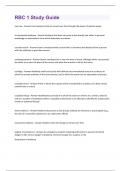
case law - Answer-Court opinions that are issued over time through the power of judicial review circumstantial evidence - Answer-Evidence that does not prove a fact directly, but rather is personal knowledge or observations from which deductions are drawn consent search - Answer-Search conducted with consent that is voluntary and obtained from a person with the authority to give that consent contemporaneous - Answer-Search conducted at or near the time of arrest, although either can precede the other, at or near the place of the arrest, and while the arrestee is still on the scene curtilage - Answer-Relatively small and usually well-defined area immediately around a residence to which the private activities of the home extend, and in which the owner has an expectation of privacy custodial arrest - Answer-Arrest in which the suspect will be transported to a station, jail, detox center, juvenile hall, or school custodial lineup - Answer-Identification procedure in which the victim or witness to a crime is asked to look at a number of individuals within a custodial environment in an attempt to identify the suspect (also known as a physical lineup) direct evidence - Answer-Evidence that proves a fact directly, without an inference or presumption (e.g., the sale of a controlled substance to an undercover officer) evanescent evidence - Answer-Evidence that will change or be lost over time exigent circumstances - Answer-An emergency situation requiring swift action to prevent imminent danger to life, serious danger to property, imminent escape of a suspect, or the destruction of evidencefield showup - Answer-Viewing of a suspect by the victim or witness that commonly occurs in the field shortly after a crime has been committed implied consent - Answer-By obtaining a driver's license in California a person has agreed to chemical testing without a warrant (i.e., blood, breath, urine) knock and notice - Answer-Before entering a dwelling to serve a search warrant, officers must give notice to persons inside through certain actions motor vehicle - Answer-Self-propelled vehicle (e.g., automobiles, airplanes, buses, recreational vehicles, carts, etc.) nexus - Answer-A reasonable connection or link between two or more items objective reasonableness - Answer-Whether society is prepared to recognize an individual's expectation of privacy as reasonable open fields - Answer-Outdoor real property, outside the curtilage of the residence overflight - Answer-Flight of a plane or helicopter over a given area parole - Answer-Extension of a felon's sentence, that is, an additional specific period of time (usually three years) which a person must serve on the "outside" after having completed the actual prison sentence passenger compartment - Answer-Passenger Compartment can be considered to include all areas accessible to occupants within the vehicle photographic spread - Answer-Identification procedure in which the victim or witness to a crime is asked to look at a number of photographs in an attempt to identify the suspect (also known as a photographic lineup)plain view - Answer-Objects in the line of sight of an officer who has the right to be in that position are subject to seizure without a warrant if the officer has lawful access to the object(s)
Written for
- Institution
- RBC 1
- Course
- RBC 1
Document information
- Uploaded on
- April 24, 2024
- Number of pages
- 42
- Written in
- 2023/2024
- Type
- Exam (elaborations)
- Contains
- Questions & answers
Subjects
-
rbc 1

Also available in package deal