Patho Exam 1 Modules 1-3 Guide Study Questions Answered CorrectlyA+ Score.
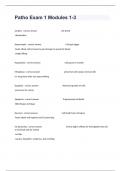
atrophy - correct answer cell shrink -dehydration Hypertrophy - correct answer Cells get bigger -heart attack cells increase to get stronger to pump the blood -weight lifting Hyperplasia - correct answer Cells grow in number Metaplasia - correct answer abnormal cells replace normal cells ex- lung tissue after you stop smoking Dysplasia - correct answer Abnormal growth of cells -precursor for cancer Apoptosis - correct answer Programmed cell death -RBC lifespan 120 days Necrosis - correct answer Cell death from cell injury -heart attack and hypoxia and CO poisoning CO poisoning - correct answer CO has higher affinity for hemoglobin than O2 so CO binds and O2 cannot -red lips -nausea, headache, weakness, and vomiting Free radicals - correct answer -molecule with an unpaired electron - causes oxidation which leads to aging Antioxidants - correct answer Vitamin A,C,E and beta carotene, albumin, transferrin Karyotype - correct answer -complete set of chromosomes -this explains patients having a mild or very extreme form of a disease trisomy - correct answer Extra copy of a chromosome Penetrance - correct answer -percentage of individuals with a genotype who exhibit the phenotype - Retinoblastoma Deficiency of Niacin creates - correct answer Pellegra Deficiency of Thiamin - correct answer Beriberi Vitamin D deficiency - correct answer Rickets Vit c deficiency - correct answer Scurvy Reperfusion injury occurs as a result of - correct answer Free radical formation Physiologic atrophy - correct answer shrinkage of thymus gland Pathologic atrophy - correct answer Disuse atrophy How to kill a cell - correct answer deprive of oxygen, nutrients, injure it, alter environment, impair excretion of waste Ischemia - correct answer Not enough blood flow Pathologic Hypertrophy - correct answer Cardiac hypertrophy in HTN Physiologic Hypertrophy - correct answer weight training Physiologic vs pathologic - correct answer physiologic- body tissue physiologic-intracellular events or adverse stimuli Muscle stiffening within 6-14 hours after death - correct answer Rigor mortis Four types of necrosis - correct answer coagulative, liquefactive, caseous, and fatty Sodium and water accumulation in an injured cell are a direct result of: - correct answer Decreased ATP production -causes failure of sodium-potassium pump and sodium-calcium exchange. therefore the cell swells and may rupture anoxia vs ischemia - correct answer complete loss of blood supply=anoxia ex: stroke, MI reduced blood supply=ischemia ex: coronary artery disease common pathway of irreversible cell injury involves increased intracellular - correct answer Calcium Polygenic trait - correct answer Multiple genes must work together for it to show What mutation has the most significant effect on protein synthesis - correct answer Frameshift mutations
Written for
- Institution
- PATHO.
- Course
- PATHO.
Document information
- Uploaded on
- April 26, 2024
- Number of pages
- 16
- Written in
- 2023/2024
- Type
- Exam (elaborations)
- Contains
- Questions & answers
Subjects
-
patho exam 1 modules 1 3

Also available in package deal