Kines 100 Study Questions with Answers.docx
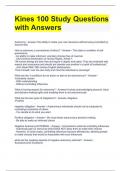
Kines 100 Study Questions with A Autonomy - Answer-The ability to make your own decisions without being controlled by anyone else How is autonomy a cornerstone of ethics? - Answer-- The state or condition of self governance -An ability to make informed, voluntary choices free of coercion -UN Universal Declaration of Human Rights, Article 1: "All human beings are born free and equal in dignity and rights. They are endowed with reason and conscience and should act towards one another in a spirit of brotherhood." -John Stuart Mill (19th century English philosopher) "Over himself, over his own body and mind the individual is sovereign" What are the 3 conditions for an action or plan to be autonomous? - Answer-- Voluntarily chosen -With understanding -Without controlling influences What is having respect for autonomy? - Answer-Involves acknowledging persons' value and decision making rights and enabling them to act autonomously What are the two types of obligations? - Answer--Negative -Positive negative obligation - Answer-- Autonomous individuals should not be subjected to controlling constraints of others -You decide to do what you want Positive obligation - Answer-- We must foster autonomous decision-making -Be able to make an informed choice Negative Autonomy EXTERNAL - Answer-- Connected to external controlling influences -Individuals gain by removing what DOES NOT allow them to make their choices -However, in some cases, controlling influences become affordances, allowing people to make choices that would be impossible with such influences what are the negative aspects of negative autonomy external? - Answer-- Socioeconomic conditions -Environmental threats -Other people's choice (injury or communicable disease) Positive Autonomy INTERNAL - Answer-- Individuals' internal capacities for action -Individuals gain autonomy by enhancing their decision making capacities what are the positive aspects of positive autonomy internal? - Answer-- Movement -Read and think critically -Understand one's situation Key difference between freedom and autonomy - Answer-- Freedom concerns the ability to act, without external or internal constraints and with sufficient resources and power to make one's desires effective vs. -Autonomy takes into account level of authentic independence that underpins those desires Common misconception of autonomy - Answer-- Individual as one who does as one pleases -This is why they call it "independence" "self sufficiency" and "self-reliance" or refer to it as "taking care of one's own" and "standing on one's own two feet" Conflict arises when: - Answer-- Individuals autonomy is entirely negated -Individuals don't enjoy a substantial degree of autonomy Intrinsic value of physical activity - Answer-- Fun -Movement as transportation Extrinsic value of physical activity - Answer-- Physiological benefits -Mental health How does engagement in physical activity and exercise positively affect children's capacities at every life stage? - Answer-increases self esteem and cognitive capacities How does engagement in physical activity and exercise positively affect young and middle aged adult's capacities at every life stage? - Answer-Helps develop life skills, improve health, and strengthen social networks How does engagement in physical activity and exercise positively affect older adults's capacities at every life stage? - Answer-independence, health, and social relationships Quality of life - Answer-- having the capacity to pursue the goods that one had good reasons to value -one crucial factor: autonomy Three Key aspects of paternalism - Answer-1. Interference by A over B 2.Interference against B's will 3.Interference by A over B is justified as a protective measure Who bears the cost of inactivity? - Answer-- Individuals -Families -Social Groups -Society at large? Public health intervention - Answer-effort that promotes behavior that improves mental and physical health, or discourages or reframes those with health risks, as part of a public health promotion program Which form of paternalism does Kniess believe is more easily justifiable from a liberal standpoint? - Answer-Soft paternalism On what grounds might hard paternalism be justified? - Answer-To protect those who cannot protect themselves What is physical culture an important part of living a good life? - Answer-- Flourishing life -Intrinsic and Extrinsic benefits of physical activity -Physical culture as a space for forming both individual and cultural meaning Social barrier to accessing physical culture - Answer-- Race and class -Gender Identity -Disability -Sex Ability athletics - Answer-- Varsity program at PSU in athletic department -Obligation to look for para athletes and give them same opportunities Utilitarianism - Answer-- A system of ethics founded by an English philosophers Jeremy Bentham that is grounded in a responsibility to increase happiness and decrease pain and suffering -Modeled on scientific principles that turn ethical decision making into a math problem based around the relative contributions of various actions toward promoting happiness on the widest scale possible -Calculus presupposes that what provides the most happiness for greatest number of people is the morally superior decision Issues with utilitarianism - Answer-- Privileges the happiness of the majority over the rights of individuals -Judges all pleasures as equally valid in calculating the greatest good -Doesn't provide for real time decision making when confronted with ethical dilemmas Phenomenology - Answer-- metaphysical counterpoint -Holistic in nature -First person pov Embodiment - Answer-Challenges the concept of mind-body dualism→ Implies that the body isn't merely an object but also our subjective perspective on the world→ Three universal features of embodiment as a concept - Answer-- Open possibilities for variation and difference in human bodies -Can develop skills, habits, and dispositions to experience world differently -Has a cultural and social dimension The life world - Answer-The prerelective world with which we are intimately familiar Phenomenology as methodology - Answer-The importance of listening to and honoring the experiences of insiders Phenomenology as pedagogy - Answer-The need for a professional practice that had its genesis in the participants lived experiences Applying tact in practice involves... - Answer-grasping the context of a situation, becoming attuned to the experience of others around you, and acting with care Tact - Answer-- Tool kit of phenomenology as methodology -Becoming attuned to the world around us -Understanding and grasp of situation -Acting with care (sensitive) Max van Manen - Answer-focuses on practical application of phenomenology in pedagogical (classroom) settings Max van Manen argues that "tact" is central to phenological pedagogy: - Answer-- Being in touch -Orchestration of instruments -Ability to handle delicate situations carefully Applying phenomenology as pedagogy in movement settings - Answer-- Requires sensitivity to lived experiences of patients/clients/participants -Opening avenues for individuals to freely explore one's own potential -Focusing attention on first person qualitative analysis rather than third person quantitative analysis -Centering voices of clients/patients rather than assuming one understands the needs of those people Physical activity as a key ingredient of a good life - Answer-- Better physical and mental life -Provides entertainment in its own right -Space for socialization and meaning making System of ethics founded by Jeremy Bentham that is... - Answer-grounded in a responsibility to increase happiness and decrease pain and suffering Paternalism - Answer-Interference of a state/individual with another person, against their will, to be protected from harm Soft paternalism - Answer-Only justified to step in if the person doesn't know the risks and dangers Hard paternalism - Answer-Stepping in even if the person knows the risks and the position they are in How is meaning constructed? - Answer-Denotative and Connotative identities
Written for
- Institution
- Kines 100
- Course
- Kines 100
Document information
- Uploaded on
- June 7, 2024
- Number of pages
- 7
- Written in
- 2023/2024
- Type
- Exam (elaborations)
- Contains
- Questions & answers
Subjects
-
kines 100
-
kines 100 study questions
-
kines 100 study questions with answers

Also available in package deal