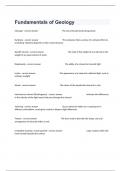
Fundamentals of Geology Real Exam Actual Questions And Complete Answers| Graded A+.
Cleavage - correct answer The way minerals break along planes Hardness - correct answer The resistance that a surface of a mineral offers to scratching. Hardness depends on the crystal structure Specific Gravity - correct answer The ratio of the weight of any mineral to the weight of an equal volume of water Diaphaneity - correct answer The ability of a mineral to transmit light Lustre - correct answer The appearance of a mineral in reflected light, such as ordinary sunlight Streak - correct answer The colour of the powdered mineral in a rock Interference colours (Birefringence) - correct answer Indicates the differences in the velocity of the light waves that pass through the mineral Twinning - correct answer Occurs when the lattice of a crystal grow in different orientations, causing the crystal to disperse light differently Texture - correct answer The term used to describe the shape, size and arrangement of minerals within a rock Crystalline Granular, coarse-grained - correct answer Large crystals which will have formed beneath the surface Crystalline Granular, fine-grained - correct answer Small crystals and/or glass that have formed when magma erupts and cools quickly Prophyrititc - correct answer Large crystals (phenocrysts) that occur in a fine grained to glassy matrix (groundmass) Glassy - correct answer Rocks formed from magmas which quench to glass instantly on eruption Fragmental - correct answer Some volcanic rocks, such as Tephra and Ash form from the exploded fragments of magma Vesicular - correct answer In other volcanic rocks some of the gas contained in the magma may have been trapped, producing bubbles in the cooled rock Contact Metamorphism - correct answer Heat Regional Metamorphism - correct answer Heat and Pressure Contact Metamorphism - correct answer Caused by heat of an igneous intrusion Regional Metamorphism - correct answer Occurs over a large area and is caused mainly by the burial and mountain-building forces, which provide both heat and pressure Foliation - correct answer Used to describe rocks that are composed of layers of mineral grains Low temperature minerals - correct answer Will be far from the igneous intrusion High temperature minerals - correct answer Will be close to the igneous intrusion Pleochroism - correct answer Minerals that show colour changes with rotation under plane-polarised light Facies - correct answer A mass of rock that can be recognised by its composition, structures or fossil content and mapped on the basis of those characteristics Earths volume - correct answer Core = 16% Mantle = 80% Lithosphere 4-5% What is the depth to the core - mantle boundary - correct answer 2700km - 2900km What is the major rock type of the mantle - correct answer Peridotite What is the bulk composition of the core - correct answer Iron and Nickel What is the physical state of the outercore - correct answer Molten What is the physical state of the mantle - correct answer Plastic P-Waves (Primary Waves) - correct answer Travels through solids and liquids S-Waves (Secondary Waves) - correct answer Travels through solids only What two components make up the lithosphere - correct answer Continental Crust Oceanic Crust Plate Boundaries - correct answer Divergent - Pulling apart from each other Transform - 2 plates sliding past one and other Convergent - Plates pushing together Cleavage - correct answer The degree or quality of the cleavage The number of cleavage directions The angle between the intersecting cleavage planes Magnetism - correct answer Minerals that are attracted to an iron magnet, or deflect the needle of a compass, are said to be magnetic Effervescence - correct answer Minerals that react with dilute hydrochloric acid (HCI) Optical Properties - correct answer Some transparent can have optical properties (i.e they have an effect on the image you see though them) Mafic Rocks - correct answer Rich in Magnesium and Iron Felsic Rocks - correct answer Rich in Iron and Silica Thin sections - correct answer Cut to a thickness of 0.03mm Common Mafic minerals - correct answer Olivine, Pyroxene, Amphibole and Biotite Common Felsic minerals - correct answer Quartz, Feldspars and muscovite Polariser - correct answer Constrains light passing through to vibrate in one direction. Polariser makes light vibrate East-West, which only allows light vibrating North-South to pass through our eyes Isotropic minerals - correct answer Minerals that are transparent under plane-polarised light and remain dark through a 360 degree rotation under cross-polarised light Natural Colours - correct answer Colours you can see without any other light Pleochroic Colours - correct answer Colours which are at their maximum when light is polarised parallel Interference Colours - correct answer Interference colours is exhibited by a section of an anisotropic mineral under cross polarised light Types of twinning - correct answer Simple Twinning Cross-hatch Twinning Multiple Twinning Types of Igneous rocks - correct answer Intrusive/Plutonic Extrusive/Volcanic Which minerals would you not expect to see in these rock types - Mafic - Felsic - correct answer Mafic - Ca-plagioclase, Na-plagioclase, Labadorite Felsic - Olivine, Pyroxene, Amphibole, Biotite, Mica Using Bowen's Reaction Series, what temperature range would you expect Gabbro or Basalt to form at - correct answer 800 - 1200 Degrees Celsius What temperature range would you expect a Granite or Rhyolite to crystallise at - correct answer 600 - 850 Degrees Celsius What temperature range would you expect a Diorite or Andesite to crystallise at - correct answer 800 - 1000 Degrees Cesius Which mineral might you expect to see in both a Felsic and Mafic igneous rock - correct answer Alkali Feldspar Causes of Metamorphism - correct answer Heat and Pressure Deforming stresses within the Earth Chemically active fluids, especially hot water solutions Stratigraphy - correct answer The study of rock layers (strata) and layering (stratification) New Zealands continental crust - correct answer Below sea level = 70% Above sea level = 30% Primary factors controlling eruption - correct answer Magma Composition Magma Temperature The amount of dissolved gas in the magma What does the fact that the contact is sharp mean? - correct answer Fast, sudden deposition of sediment, contact of new sediment is sometimes different angle to the old stuff What do horizontal layers represent - correct answer Build up of different sediment, in different time periods Metamorphism occurs at - correct answer 100 Degrees Celsius 1000 bars pressure (1 kilobar) About 3km depth The metamorphic rock that forms depends on the following - correct answer Starting material Nature of the new conditions Relative timing and duration of the events that have affected the rock Metamorphism - correct answer Sometimes only results in small effects, such as a change in grainsize Metamorphic changes - correct answer Minerals present in the precursor may react chemically with one another during metamorphism to produce new combinations of minerals that are stable at the new conditions Metamorphic Pressure - correct answer Can cause the new minerals that grow to develop a preferred orientation Metamorphic Grainsizes - correct answer As the grade of metamorphism goes up so does the grainsize of that rock Slate - correct answer Fine-grained, splits into thin sheet-like pieces with parallel upper and lower surfaces Phyllite - correct answer New Chlorite makes rocks greenish, new granular minerals cause surfaces to become uneven and no longer parallel Schist - correct answer Coarse-grained; individual light and dark mineral grains visible. Abundant Biotite and Muscovite from strong foliation Gneiss - correct answer Light and Dark minerals separate into distinct layers, giving the rock a coarsely banded appearance. Layers often contorted, may show miniature folds and discontinuties What sort of texture would you expect to find in a contact metamorphic rock? - correct answer Crystalline Granular Put the following rocks in order of increasing (regional) metamorphic grade - correct answer 1) Mudstone 2) Slate 3) Schist 4) Gneiss Geothermal Gradient - correct answer The rate of increasing temperature with respect to increasing depth in the earth's interior Slate is of higher metamorphic grade than schist - correct answer False Gneiss is of higher metamorphic grade than schist - correct answer True The protolith of marble is limestone - correct answer True Grainsize increases as metamorphic grade decreases - correct answer False What conditions form Hornfels - correct answer Contact Metamorphism Name a mineral that has simple twinning - correct answer Plagioclase Name a pleochroic mineral - correct answer Orthoclase
Written for
- Institution
- GEOLOGY.
- Course
- GEOLOGY.
Document information
- Uploaded on
- July 25, 2024
- Number of pages
- 9
- Written in
- 2023/2024
- Type
- Exam (elaborations)
- Contains
- Questions & answers
Subjects
-
fundamentals of geology

Also available in package deal