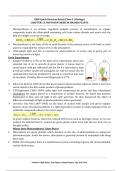
CBSE Quick Revision Notes (Class-11 Biology)
CHAPTER-13 PHOTOSYNTHESIS IN HIGHER PLANTS
Photosynthesis is an enzyme regulated anabolic process of manufacture of organic
compounds inside the chlorophyll containing cells from carbon dioxide and water with the
help of sunlight as source of energy.
Photosynthesis is the basis of life on earth because it the primary source of all food on earth
and it is responsible for release of O2 in the atmosphere.
Chlorophyll, light and CO2 is required for photosynthesis. It occurs only in green part of
leaves in presence of light.
Early Experiments
Joseph Priestley in 1770, on the basis of his experiments shows the
essential role of air in growth of green plants. A mouse kept in
closed space could get suffocated and die but if a mint plant is kept
in bell jar neither candle will extinguish nor will the mouse die. He
concluded that foul air produced by animal is converted into pure
air by plants. Priestley discovered Oxygen gas in 1774.
Julius Van Sachs in 1854 shows that green plant in plants produces glucose which is stored as
starch. Starch is the first visible product of photosynthesis.
T.W.Engelmann (1843-19090 splits light into components by prism and then illuminated
Cladophora (an algae) placed in a suspension of aerobic bacteria. He found that bacteria
illuminated in blue and red light of the split spectrum. He thus discovered the effect of
different wavelength of light on photosynthesis (action spectrum).
Cornelius Van Neil (1897-1985) on the basis of studies with purple and green sulphur
bacteria shows that photosynthesis is a light dependent reaction in which hydrogen from an
oxidisable compound reduces CO2 to form sugar.
In green sulphur bacteria, when H2S, instead of H2O was used as hydrogen donor, no O2 was
evolved. He inferred that O2 evolved by green plants comes from H2O but not from CO2 as
thought earlier.
Where Does Photosynthesis Takes Place?
• Chloroplasts are green plastids which function as the site of photosynthesis in eukaryotic
photoautotrophs. Inside the leaves, chloroplast is generally present in mesophyll cells along
their walls.
• Within the chloroplast there is a membranous system consisting of grana, the stroma lamellae
and the fluid stroma.
Portal for CBSE Notes, Test Papers, Sample Papers, Tips and Tricks
, • The membrane system is responsible for synthesizing light energy for the synthesis of ATP
and NADPH. In stroma enzymatic reactions incorporate CO2 in plants leading to synthesis of
sugar.
• The reaction in which light energy is absorbed by grana to synthesis ATP and NADPH is
called light reaction. The later part of photosynthesis in which CO2 is reduced to sugar, in
which light is not necessary is called dark reaction.
Pigments involved in Photosynthesis – Chromatographic separation of leaf pigments are as
follows-
Photosynthetic
Pigments
Chlorophyll a Carotenoids
Chlorophyll b Xanthophylls
(bright or blue (yellow or
(yellow green) (yellow) yellow-orange)
green)
• Maximum absorption by chlorophyll a occurs in blue and red regions having higher rate of
photosynthesis. So, chlorophyll a is the chief pigment.
• Other thylakoid pigments like chlorophyll b, xanthophyll and carotenoids are called accessary
pigments that absorb light and transfer energy to chlorophyll a and protect them from photo-
oxidation.
Light reaction
Light reaction(photochemical phase) includes
a. Light absorption
Portal for CBSE Notes, Test Papers, Sample Papers, Tips and Tricks
CHAPTER-13 PHOTOSYNTHESIS IN HIGHER PLANTS
Photosynthesis is an enzyme regulated anabolic process of manufacture of organic
compounds inside the chlorophyll containing cells from carbon dioxide and water with the
help of sunlight as source of energy.
Photosynthesis is the basis of life on earth because it the primary source of all food on earth
and it is responsible for release of O2 in the atmosphere.
Chlorophyll, light and CO2 is required for photosynthesis. It occurs only in green part of
leaves in presence of light.
Early Experiments
Joseph Priestley in 1770, on the basis of his experiments shows the
essential role of air in growth of green plants. A mouse kept in
closed space could get suffocated and die but if a mint plant is kept
in bell jar neither candle will extinguish nor will the mouse die. He
concluded that foul air produced by animal is converted into pure
air by plants. Priestley discovered Oxygen gas in 1774.
Julius Van Sachs in 1854 shows that green plant in plants produces glucose which is stored as
starch. Starch is the first visible product of photosynthesis.
T.W.Engelmann (1843-19090 splits light into components by prism and then illuminated
Cladophora (an algae) placed in a suspension of aerobic bacteria. He found that bacteria
illuminated in blue and red light of the split spectrum. He thus discovered the effect of
different wavelength of light on photosynthesis (action spectrum).
Cornelius Van Neil (1897-1985) on the basis of studies with purple and green sulphur
bacteria shows that photosynthesis is a light dependent reaction in which hydrogen from an
oxidisable compound reduces CO2 to form sugar.
In green sulphur bacteria, when H2S, instead of H2O was used as hydrogen donor, no O2 was
evolved. He inferred that O2 evolved by green plants comes from H2O but not from CO2 as
thought earlier.
Where Does Photosynthesis Takes Place?
• Chloroplasts are green plastids which function as the site of photosynthesis in eukaryotic
photoautotrophs. Inside the leaves, chloroplast is generally present in mesophyll cells along
their walls.
• Within the chloroplast there is a membranous system consisting of grana, the stroma lamellae
and the fluid stroma.
Portal for CBSE Notes, Test Papers, Sample Papers, Tips and Tricks
, • The membrane system is responsible for synthesizing light energy for the synthesis of ATP
and NADPH. In stroma enzymatic reactions incorporate CO2 in plants leading to synthesis of
sugar.
• The reaction in which light energy is absorbed by grana to synthesis ATP and NADPH is
called light reaction. The later part of photosynthesis in which CO2 is reduced to sugar, in
which light is not necessary is called dark reaction.
Pigments involved in Photosynthesis – Chromatographic separation of leaf pigments are as
follows-
Photosynthetic
Pigments
Chlorophyll a Carotenoids
Chlorophyll b Xanthophylls
(bright or blue (yellow or
(yellow green) (yellow) yellow-orange)
green)
• Maximum absorption by chlorophyll a occurs in blue and red regions having higher rate of
photosynthesis. So, chlorophyll a is the chief pigment.
• Other thylakoid pigments like chlorophyll b, xanthophyll and carotenoids are called accessary
pigments that absorb light and transfer energy to chlorophyll a and protect them from photo-
oxidation.
Light reaction
Light reaction(photochemical phase) includes
a. Light absorption
Portal for CBSE Notes, Test Papers, Sample Papers, Tips and Tricks