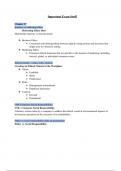
Important Exam Stuff
Chapter 17
Business vs marketing ethics
Marketing Ethics Deal
Shareholder interests vs Societal needs
❖ Business Ethics
➢ Concerned with distinguishing between right & wrong actions and decisions that
might arise in a business setting
❖ Marketing Ethics
➢ Examines ethical situations that are specific to the domain of marketing, including
societal, global, or individual consumer issues
Ethical climate - values, rules, controls
Creating an Ethical Climate in the Workplace
❖ Values
➢ Establish
➢ Share
➢ Understand
❖ Rules
➢ Management commitment
➢ Employee dedication
❖ Controls
➢ Reward
➢ Punishment
CSR (Corporate Social Responsibility)
CSR - Corporate Social Responsibility
Voluntary actions taken by a company to address the ethical, social & environmental impacts of
its business operations & the concerns of its stakeholders.
Ethics vs social responsibility chart on presentation
Ethics vs. Social Responsibility
,Framework for ethical decision making
Framework for Ethical Decision Making
1. Identify Issues
- Using results to mislead or even harm the public
- Hiding the real purpose of the study
- Data collection methods
2. Gather Information & Identify Stakeholders
- Identify all ethical issues & relevant legal information
- Identify all relevant stakeholders & get their input on any identified ethical issues
3. Brainstorm & Evaluate Alternatives
- Halt the market research project?
- Make responses anonymous?
, - Instituting training on the CMA Code of Ethics for all researchers
4. Choose a Course of Action
- Weigh the alternatives
- Take a course of action
Ethical Decision Making Metric
Chapter 16
Components of a country market assessment
Globalization
The increased flow of goods, services, people, technology, capital, information & ideas around
the world; has economic, political, social, cultural & environmental impacts.
Assessing Global Markets
4 sets of factors are often used to assess a countries market PEST:
❖ Political
➢ Tariffs
■ Duty/tax
■ Artificially raises prices
■ Lowers demand
➢ Quotas
■ Max limit
■ Reduces availability of imported goods
➢ Boycotts
Chapter 17
Business vs marketing ethics
Marketing Ethics Deal
Shareholder interests vs Societal needs
❖ Business Ethics
➢ Concerned with distinguishing between right & wrong actions and decisions that
might arise in a business setting
❖ Marketing Ethics
➢ Examines ethical situations that are specific to the domain of marketing, including
societal, global, or individual consumer issues
Ethical climate - values, rules, controls
Creating an Ethical Climate in the Workplace
❖ Values
➢ Establish
➢ Share
➢ Understand
❖ Rules
➢ Management commitment
➢ Employee dedication
❖ Controls
➢ Reward
➢ Punishment
CSR (Corporate Social Responsibility)
CSR - Corporate Social Responsibility
Voluntary actions taken by a company to address the ethical, social & environmental impacts of
its business operations & the concerns of its stakeholders.
Ethics vs social responsibility chart on presentation
Ethics vs. Social Responsibility
,Framework for ethical decision making
Framework for Ethical Decision Making
1. Identify Issues
- Using results to mislead or even harm the public
- Hiding the real purpose of the study
- Data collection methods
2. Gather Information & Identify Stakeholders
- Identify all ethical issues & relevant legal information
- Identify all relevant stakeholders & get their input on any identified ethical issues
3. Brainstorm & Evaluate Alternatives
- Halt the market research project?
- Make responses anonymous?
, - Instituting training on the CMA Code of Ethics for all researchers
4. Choose a Course of Action
- Weigh the alternatives
- Take a course of action
Ethical Decision Making Metric
Chapter 16
Components of a country market assessment
Globalization
The increased flow of goods, services, people, technology, capital, information & ideas around
the world; has economic, political, social, cultural & environmental impacts.
Assessing Global Markets
4 sets of factors are often used to assess a countries market PEST:
❖ Political
➢ Tariffs
■ Duty/tax
■ Artificially raises prices
■ Lowers demand
➢ Quotas
■ Max limit
■ Reduces availability of imported goods
➢ Boycotts