Evaluate the economic impact of a significant increase in income inequality within a
country.
Income inequality exists when income is unevenly distributed throughout a population. The
more unequal the distribution, the higher income inequality is. Income inequality can be
measured by using either the Lorenz curve or the Gini coefficient. South Africa is currently
the country with the highest income inequality in the world, with a Gini coefficient of 0.63.
A significant increase in income
inequality within a country is likely to
result in increased entrepreneurship.
Certain economists argue that an
increase in income inequality
incentivises entrepreneurship. This is
because if profits that were made by
entrepreneurs were redistributed, in
order to maintain equality within an
economy, this would take away the
incentive of going into business as high-
risk enterprises would not reap high rewards. Therefore, higher income inequality motivates
individuals to invest and innovate more in order to benefit from higher monetary returns. As
a result of this, living standards may improve for entrepreneurs but income inequality within
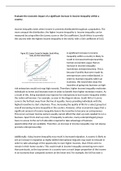
the nation will worsen. For example, as seen in the diagram above. South Africa’s Lorenz
curve is the furthest away from the line of equality, hence providing individuals with the
highest incentive to start a business. Thus, increasing the quality of life for a select group but
overall worsening income inequality in the country. However, other economists argue that a
significant amount of income inequality lowers the incentive to become an entrepreneur.
This occurs as lower income earners usually cannot afford the start-up costs needed to run a
business. Apart from start-up costs, if inequality is extreme, many underprivileged groups
have no access to the sort of education required to take advantage of business
opportunities that are available. Therefore, an increase in income inequality may not always
promote entrepreneurship.
Additionally, rising income inequality may result in increased migration. A country is likely to
see an increase in migration as highly skilled international migrants may want to relocate in
order to take advantage of the opportunity to earn higher incomes, than if they were to
remain in their home country. This could result in income inequality worsening even more
than previously, as the top earners in a country earn a much larger proportion of the income
in an economy than compared earners on the lower end. For example, the UK has seen a
country.
Income inequality exists when income is unevenly distributed throughout a population. The
more unequal the distribution, the higher income inequality is. Income inequality can be
measured by using either the Lorenz curve or the Gini coefficient. South Africa is currently
the country with the highest income inequality in the world, with a Gini coefficient of 0.63.
A significant increase in income
inequality within a country is likely to
result in increased entrepreneurship.
Certain economists argue that an
increase in income inequality
incentivises entrepreneurship. This is
because if profits that were made by
entrepreneurs were redistributed, in
order to maintain equality within an
economy, this would take away the
incentive of going into business as high-
risk enterprises would not reap high rewards. Therefore, higher income inequality motivates
individuals to invest and innovate more in order to benefit from higher monetary returns. As
a result of this, living standards may improve for entrepreneurs but income inequality within
the nation will worsen. For example, as seen in the diagram above. South Africa’s Lorenz
curve is the furthest away from the line of equality, hence providing individuals with the
highest incentive to start a business. Thus, increasing the quality of life for a select group but
overall worsening income inequality in the country. However, other economists argue that a
significant amount of income inequality lowers the incentive to become an entrepreneur.
This occurs as lower income earners usually cannot afford the start-up costs needed to run a
business. Apart from start-up costs, if inequality is extreme, many underprivileged groups
have no access to the sort of education required to take advantage of business
opportunities that are available. Therefore, an increase in income inequality may not always
promote entrepreneurship.
Additionally, rising income inequality may result in increased migration. A country is likely to
see an increase in migration as highly skilled international migrants may want to relocate in
order to take advantage of the opportunity to earn higher incomes, than if they were to
remain in their home country. This could result in income inequality worsening even more
than previously, as the top earners in a country earn a much larger proportion of the income
in an economy than compared earners on the lower end. For example, the UK has seen a