FL04 – Capital Budgeting 15/10/15 Prof. Michael Shillig
CAPITAL BUDGETING: NET PRESENT VALUE/EXPECTED VALUE/CAPM
CAPITAL BUDGETING
Methods to decide which projects to invest in and which to reject
o NPV rule
o Internal Rate of Return
o Other methods – Ivo Welch, Chapter 4
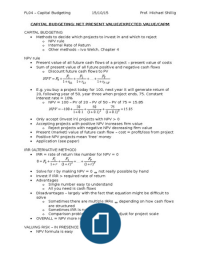
NPV rule
Present value of all future cash flows of a project – present value of costs
Sum of present value of all future positive and negative cash flows
o Discount future cash flows to PV
F1 F FT
NPV F0 2 ....
1 r0,1 1 r1, 2 1 rT 1,T
E.g. you buy a project today for 100, next year it will generate return of
20, following year of 50, year three when project ends, 75. Constant
interest rate = 10%
o NPV = 100 – PV of 20 – PV of 50 – PV of 75 = 15.85
20 50 75
NPV 100 15.85
1 0.1 (1 0.1) 2
(1 0.1) 3
Only accept (invest in) projects with NPV > 0
Accepting projects with positive NPV increases firm value
o Reject projects with negative NPV decreasing firm value
Present (market) value of future cash flow – cost = profit/loss from project
Positive NPV projects mean ‘free’ money
Application (see paper)
IRR (ALTERNATIVE METHOD)
IRR = rate of return like number for NPV = 0
F1 F2 FT
0 F0 ....
1 r (1 r ) 2
(1 r )T
Solve for r by making NPV = 0 not really possible by hand
Invest if IRR > required rate of return
Advantages
o Single number easy to understand
o All you need is cash flows
Disadvantages – largely with the fact that equation might be difficult to
solve
o Sometimes there are multiple IRRs depending on how cash flows
are structured
o Sometimes IRR is not defined
o Comparison problems as it does not adjust for project scale
OVERALL = NPV more reliable
VALUING RISK – IN PRESENCE OF UNCERTAINTY
NPV formula is easy
CAPITAL BUDGETING: NET PRESENT VALUE/EXPECTED VALUE/CAPM
CAPITAL BUDGETING
Methods to decide which projects to invest in and which to reject
o NPV rule
o Internal Rate of Return
o Other methods – Ivo Welch, Chapter 4
NPV rule
Present value of all future cash flows of a project – present value of costs
Sum of present value of all future positive and negative cash flows
o Discount future cash flows to PV
F1 F FT
NPV F0 2 ....
1 r0,1 1 r1, 2 1 rT 1,T
E.g. you buy a project today for 100, next year it will generate return of
20, following year of 50, year three when project ends, 75. Constant
interest rate = 10%
o NPV = 100 – PV of 20 – PV of 50 – PV of 75 = 15.85
20 50 75
NPV 100 15.85
1 0.1 (1 0.1) 2
(1 0.1) 3
Only accept (invest in) projects with NPV > 0
Accepting projects with positive NPV increases firm value
o Reject projects with negative NPV decreasing firm value
Present (market) value of future cash flow – cost = profit/loss from project
Positive NPV projects mean ‘free’ money
Application (see paper)
IRR (ALTERNATIVE METHOD)
IRR = rate of return like number for NPV = 0
F1 F2 FT
0 F0 ....
1 r (1 r ) 2
(1 r )T
Solve for r by making NPV = 0 not really possible by hand
Invest if IRR > required rate of return
Advantages
o Single number easy to understand
o All you need is cash flows
Disadvantages – largely with the fact that equation might be difficult to
solve
o Sometimes there are multiple IRRs depending on how cash flows
are structured
o Sometimes IRR is not defined
o Comparison problems as it does not adjust for project scale
OVERALL = NPV more reliable
VALUING RISK – IN PRESENCE OF UNCERTAINTY
NPV formula is easy