Malignant Hyperthermia | Questions and Answers(A+ Solution guide)
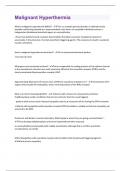
What is malignant hyperthermia (MHS)? - This is a complex genetic disorder of skeletal muscle typically manifesting clinically as a hypermetabolic crisis when a susceptible individual receives a halogenated inhalational anesthetic agent or succinylcholine -They have skeletal muscle receptor abnormalities that allow excessive myoplasmic calcium to accumulate in the presence of certain anesthetic triggering agents. This excessive Ca lead to sustained muscle contraction How is malignant hyperthermia inherited? - In an autosomal dominant pattern -Can arise de novo What genes are commonly involved? - Genes responsible for coding proteins of the calcium channel in the sarcoplasmic reticulum are most commonly affected: the ryanodine receptor (RYR1) and the closely associated dihydropyridine receptor (DHP Approximately 50 percent of known cases of MH are caused by mutations on? - chromosome 19 in regions that encode the hydrophilic, amino-terminal portion of the RYR1 receptor Who is at risk for developing MHS? - -Patients with a history of unexpected exertional rhabdomyolysis (under conditions that are less extreme than the usual triggers) - patients with severe statin-induced myopathy may be at increased risk for having the RYR1 mutation -Patients with myopathies with ryanodine receptor (RYR1) mutations, notably central core myopathy, are assumed to be MHS Duchenne and Becker muscular dystrophy: What happens when they are giving succinylcholine? - They develop rhabdomyolysis and severe hyperkalemia when exposed to succinylcholine (and possibly with volatile anesthetics); although this is not MH, anesthetic considerations are simila
Written for
- Institution
- Malignant Hyperthermia
- Module
- Malignant Hyperthermia
Document information
- Uploaded on
- August 10, 2023
- Number of pages
- 9
- Written in
- 2023/2024
- Type
- Exam (elaborations)
- Contains
- Questions & answers
Subjects
-
malignant hyperthermia

Also available in package deal