BSN 346 Chapter 10 Alterations in Immune Function Questions With Complete Solutions
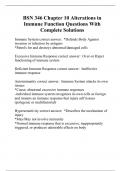
Immune System correct answer: *Defends Body Against invasion or infection by antigens *Patrols for and destroys abnormal/damaged cells Excessive Immune Response correct answer: Over-or Hyper functioning of immune system Deficient Immune Response correct answer: Ineffective immune response Autoimmunity correct answer: Immune System attacks its own tissues *Cause: abnormal excessive immune responses -individual immune system recognizes its own cells as foreign and mounts an immune response that injurs self tissues (polygenic or multifactorial) Hypersensitivity correct answer: *Describes the mechanism of injury *May/May not involve immunity *Normal immune response that is excessive, inappropriately triggered, or produces udesirable effects on body Antigenic Mimicry Theory (autoimmunity) correct answer: Self/foreign antigens made of same materials, so small alterations in self tissue lead to attack Release of Sequestered Antigens Theory (autoimmunity) correct answer: Self antigens not in direct contact w/ lymphocytes during fetal development Other possible Theories (autoimmunity) correct answer: T-Cell Theories: -Thymus gland defects Decreased suppressor T-Cell Function -Altered T-Helper cell function Treatment (autoimmunity) correct answer: Immunosuppressive Therapy -corticosteroids/cytotoxins -tumor necrosis factor inhibitors -therapeutic plasmapheresis Which genetic aspect is associated w/ development of autoimmune diseases? correct answer: MHC Genes Basic Mechanism (Hypersensitivity) correct answer: Specific antigen-antibody reaction or specific antigen-lymphocyte interaction Hypersensitivity Type I, II, III correct answer: Mediated by antibodies produced by B-Lymphocytes Hypersensitivity Type IV correct answer: Mediated by T Cells Type I Hypersensitivity correct answer: Strong genetic or hereditary linkage regarding IgE Response to antigens (ALLERGENS) *Involves inability to respond to antigen and to produce an IgE antibody response **High IgE levels Known as "Immediate Hypersensitivity" (15-30 Minutes after exposure to antigen or allergen) Mast Cells/Basophils principle effector cells **IgE is the principle mediating antibody** Histamine (T1Hypersensitiviy) correct answer: Most important mediator (H1-H4 receptors) *increased vascular permeability *Vasodialation *Urticaria *Smooth muscle contraction *increased mucus secretion *Pruritus H1 Receptor stimulated Clinical Manifestations of T1Hypersensitivity correct answer: Mild: Hives, Eczema, Seasonal allergic rhinitis Medial: Throat constriction Localized edema Wheezing Tachycardia Anaphylaxis: LIFE THREATENING Treatment of T1Hypersensitivity correct answer: ANTIHISTAMINE: blocks effect of histamine BETA-ADRENERGICS: decrease bronchoconstriction CORTICOSTEROID decrease inflammatory response ANTICHOLINERGICS block parasympathetic system IgE Therapy: inhibits binding of IgE to mast cells Epinepherine: -Adrenergic agent given SubQ or IV during acute allergic reactions -Highly allergic people can carry an Epipen Type II Hypersensitivity correct answer: AKA: Tissue-Specific, Cytotoxic, or Cytolytic Hypersensitivity *Immediate Reaction **Antibodies attack antigens on surface of specific cells or tissues causing lysis ***Cell Lysis may be mediated by activated complement fragments Transfusion Reaction (T2Hypersensitivity) correct answer: Transfusion Reaction: Recipient antibodies attach to the donor's RBC Antigens Hemolytic disease of the newborn correct answer: Erythroblastosis fetalis -Rh-Neg mom sensitized to her fetus's Rh-Pos RBC group antigens -Mother's exposure occurs when fetal and maternal blood are mixed **Rh NEG mother received RHOGAM Myasthenia Gravis (T2Hypersensitivity) correct answer: Affects neuromuscular junction, primarily the acetylcholine receptor (AChR) Graves disease and lymphocytic thryroiditis (T2Hypersensitivity) correct answer: Neutrophils bind to target cells, block receptos from normal functioning, causing injury to or malfunction of involved tissue Hyper Acute Graft Rejection (T2H) correct answer: *Transplanted donor tissue has an antigen to which recipient has preformed antibodies *Can occur quickly w/ revascularization *Rarely occurs Type III Hypersensitivity correct answer: Immune Complex Reaction Phagocytic cells lyse and destroy tissue from cytokines, and inflammatory response -tissue destruction, scarring, and further reaction of the immune system against the damaged tissue **Immune and phagocytic systems fail to effectively remove antigen-antibody immune complexes *Not tissue specific *Activation on complement *Self sustaining inflammation (ongoing) Immune complex glomerulonephritis (T3H) correct answer: inflammatory renal disorder -10days- 2 weeks after Streptococcus or staphylococcal infection -Complex deposited in glomerular capillary wall Systemic Lupus Erythematosus correct answer: -more frequent in women -Individual develops antibodies against nuclear antigens such as DNA, DNH, and RNA -Variety of s/s Type IV Hypersensitivity correct answer: Delayed hypersensitivity No primary antibody involvement Principle Mediator: Lymphocytes Cutaneous basophil hypersensitivity (T4H) correct answer: most rapid type skin swelling skin graft reactions and rejection Contact Hypersensitivity (t4H) correct answer: Most familiar type Epidermal phenomenon Peaks in 48-72 hours Slow reaction, hapten very small, incomplete antigen, becomes complete antigen when attaches to a carrier Tuberculin-type hypersensitivity (T4H) correct answer: Reddness, induration, inflammation at intradermal injection site granulomatous hypersensitivity (T4H) correct answer: -primary defense against intracellular infections -represents a chronic type IV hypersensitivity reation -protective defense reaction that eventually causes tissue destruction -antigen not destroyed within the macrophages Which disorder displays these characteristics: -failure to remove antigen-antibody complex -is not tissue specific -includes antibodies -occurs over several hrs or days -also called immune complex reaction correct answer: Type III Hypersensitivity 2 types of deficient immune responses correct answer: primary and secondary Primary deficient immune responses correct answer: Congenital Predisposed to multiple deficiencies *rare often sex-linked **first clinical indicators: s/s of infection Secondary deficient immune responses correct answer: Non-immune system disorders tx that secondarily affect immune function deficient immune response can effect correct answer: Lymphocytes Antibodies Phagocytes Complement proteins B-Cell & T-Cell Combined Disorders correct answer: SCID -inherited disorder -impairment in T/B Cells -Severe immune system dysfunction -most severe form: reticular dysgenesis Wiskott-Aldrich Syndrome correct answer: X-Linked immunodeficiency disorder that affects both T/B Cells DiGeorge Syndrome (thymic hypoplasia 22q11.2 deletion syndrome) correct answer: Total or partial loss of thymus gland function Chronic mucocutaneous candidiasis correct answer: Autosomal recessive deficiency of cytokine receptor Autosomal dominant deficiency of cytokine IgA Deficiency correct answer: most common B-Cell primary disorder -IgA Bearing lymphocytes fail to become plasma cells resulting in lack of serum and secretory IgA Bruton X-Linked agammaglobulinemia correct answer: Congenital hypogammaglobulinemia Lack of normal b-Cell development in bone marrow Transient hypogammaglobulinemia correct answer: Self Limiting condition infant slow to acquire normal immunoglobulin levels Common Variable immunodeficiency correct answer: Low titers of immunoglobulines IgG, IgA, and IgM B cells cant differentiate into plasma cells Digeorge syndrome is a deficiency of correct answer: T-Cells Secondary immunodeficiency Disorder correct answer: excessive or defectiveneuroendocrine response FATORS: poor nutrition stress drugs surgery Excessive neuroendocrine Response correct answer: increased corticosteroid increases susceptibility to infection Defective Neuroendocrine Response correct answer: Low corticosteroid increased susceptibility to autoimmunity
Written for
- Institution
- BSN 346
- Module
- BSN 346
Document information
- Uploaded on
- October 31, 2023
- Number of pages
- 10
- Written in
- 2023/2024
- Type
- Exam (elaborations)
- Contains
- Questions & answers
Subjects
-
immune system
-
excessive immune response
-
deficient immune response
-
autoimmunity
-
hypersensitivity
-
antigenic mim
-
bsn 346 chapter 10 alterations in immune function
-
bsn 346 chapter 10 alterations in immune

Also available in package deal