NURS 3321: Knowledge Check #1 2024
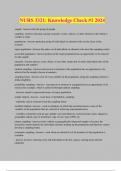
NURS 3321: Knowledge Check #1 2024 sample -Answer-selected group of people sampling -Answer-selecting a group of people, events, objects, or other elements with which to conduct a study populations -Answer-particular group of individuals or elements who are the focus of the research target population -Answer-the entire set of individuals or elements who meet the sampling critera accessible population -Answer-portion of the target population has an opportunity to be selected for the sample elements -Answer-person, event, object, or any other single unit of study (individual units of the population and sample) random sampling -Answer-each person or element in the population has an opportunity to be selected for the sample (chosen at random) sampling frame -Answer-a list of every member of the population, using the sampling criteria to define eligibility probability sampling -Answer-- each person or element in a population has an opportunity to be selected for a sample, which is achieved through random sampling - increase sample's representativeness of target population simple random -Answer-- most basic of probability sampling - randomly selects elements from the sampling frame stratified random -Answer-- used in situations in which the researcher knows some of the variables in the population that are critical for achieving representativeness - variables commonly used are age, gender, race and ethnicity, socioeconomic status, diagnosis, geographic region, type of institution, type of care, type of RN, etc. cluster sampling -Answer-used to obtain a geographically dispersed sample or because the researcher cannot identify the individual elements making up the population and therefore cannot develop a sampling frame systematic sampling -Answer-- used when an ordered list of all members of the population is available - process involves selecting every nth individual on the list, using a starting point selected randomly nonprobabilty sampling -Answer-- not every element of a population has an opportunity to be selected for a study sample - commonly used in nursing studies because of the limited number of patients available for research convenience sampling -Answer-- also known as accidental sampling, is a weak approach because it provides little opportunity to control for biases - subjects are included in the study merely because they happen to be in the right place at the right time quota sampling -Answer-convenience sampling + inclusion of subject types likely to be underrepresented in the convenience sample purposeful or purposive sampling -Answer-- also known as "judgmental" or "selective" sampling - the researcher consciously selects certain participants, elements, events, or incidents to include in the study network sampling -Answer-- also known as "snowball", "chain", or "nominated" sampling - holds promise for locating participants who would be difficult or impossible to obtain in other ways or who have not been previously identifie
Written for
- Institution
- NURS 3321
- Module
- NURS 3321
Document information
- Uploaded on
- February 5, 2024
- Number of pages
- 7
- Written in
- 2023/2024
- Type
- Exam (elaborations)
- Contains
- Questions & answers
Subjects
-
nurs 3321 knowledge check 1 2024