Science Praxis 5155 Latest Version Already Passed
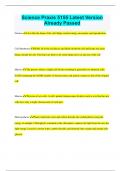
Already Passed Nucleus Acts like the brain of the cell. Helps control eating, movement, and reproduction. Cell Membrane Holds all of the cell pieces and fluids inside the cell and keeps any nasty things outside the cell. The holes are there to let some things move in and out of the cell Mitosis The process where a single cell divides resulting in generally two identical cells, EACH containing the SAME number of chromosomes and genetic content as that of the original cell. Meiosis Division of sex cells. A cell's paired chromosomes divide in such a way that the new cells have only a single chromosome of each pair. Photosynthesis Plants transform water and carbon dioxide into carbohydrates using the energy of sunlight. Chlorophyll, contained in the chloroplast, captures the light from the sun; the light energy is used to convert water, carbon dioxide, and minerals into oxygen and energy-rich glucose. Proteins Organic compounds made up of building blocks called "amino acids." The building material for our skin, bones, muscles and other tissues in the body. Function as regulators of fluid balance and acid-base balance. Also act as transporters in the body, carrying important nutrients Fats The body uses this as a fuel source, and this is the major storage form of energy in the body. Come in several forms, including saturated, monounsaturated, and polyunsaturated. Carbohydrates Large group of organic compounds occurring in foods and living tissues and including sugars, starch, and cellulose. They contain hydrogen and oxygen in the same ratio as water (2:1) and typically can be broken down to release energy in the animal body. Dominant Alleles Expressed in the phenotype. The stronger allele. Written as a capital letter. Show their effect even if the individual only has one copy of the allele. (Aa) (AA) Recessive Alleles The weaker allele. Written as a lower case letter. Only show their effect if the individual has two copies of the allele (aa) Genes Made up of DNA. Carry the plans for constructing cells, tissues, organs, and bodies. Traits A feature of an organism. May also be known as phenotype. Natural Selection Over time, more and more individuals in the population will bea Mutation A change to the organisms genetic code Evolution Earth changed over time and organisms changed to adapt to their changing environments Kingdom First and broadest category for classification. Includes protista, fungi, bacteria, archaebacteria, plantae, and animalia. Phylum Second classification category. Example: whether or not animals have a backbone. Animals who have a backbone belong to the Chordata Class Third classification category.
Written for
- Institution
- Science Praxis 5155
- Module
- Science Praxis 5155
Document information
- Uploaded on
- April 11, 2024
- Number of pages
- 17
- Written in
- 2023/2024
- Type
- Exam (elaborations)
- Contains
- Questions & answers
Subjects
-
science praxis 5155 latest version already passed
Also available in package deal