Fire Detection, Suppression, and Smoke Control Systems Chapter 26 with Complete Solutions
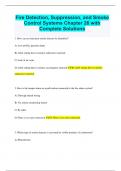
Fire Detection, Suppression, and Smoke Control Systems Chapter 26 with Complete Solutions 1. How can an ionization smoke detector be identified? A) Low-profile, pancake shape B) Label stating that it contains radioactive material C) Lack of air vents D) Label stating that it contains carcinogenic material B) Label stating that it contains radioactive material 2. How is the tamper alarm on a pull-station connected to the fire alarm system? A) Through shared wiring B) Via remote monitoring station C) By radio D) There is no such connection D) There is no such connection 3. Which type of smoke detector is activated by visible products of combustion? A) Photoelectric B) Infrared C) Ultraviolet D) Ionization A) Photoelectric 4. Which fire alarm system requires fire fighters to search the entire building to locate the activated initiation device? A) Master-coded B) Noncoded C) Zoned noncoded D) Zoned coded B) Noncoded 5. Which part of a fire alarm system causes the system to indicate an alarm? A) Initiating device B) Sensor C) Annunciator D) Indicator A) Initiating device 6. Which fire-extinguishing agent listed here is best suited for use in areas housing computers or electronic equipment? A) Urea-potassium bicarbonate B) Carbon dioxide C) High-expansion foam D) Monoammonium phosphate B) Carbon dioxide 7. Fire alarm systems in most high-rise buildings are programmed to alert the occupants located: A) on the alarm floor only.
Written for
- Institution
- Fire Detection, Suppression, and Smoke Control
- Module
- Fire Detection, Suppression, and Smoke Control
Document information
- Uploaded on
- May 26, 2024
- Number of pages
- 33
- Written in
- 2023/2024
- Type
- Exam (elaborations)
- Contains
- Questions & answers
Subjects
-
fire detection suppression and smoke control sys

Also available in package deal