Topic: Psychology- Experimental Design
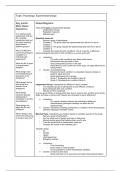
Key points/ Notes/Diagrams:
Main Ideas/
There are 3 types of experimental designs:
Questions: - Independent Groups
- Repeated measures
In a matched pairs - Matched pairs
experiment what are
the variables Repeated measures
researchers look out - Recruit a group of participants
for when matching - Condition 1: The group does the experimental task with the IV set for
participants in condition 1.
different groups? - Condition 2: The group repeats the experimental task with the IV set for
condition 2.
Why is it difficult to - Compare the results for both conditions. This is to test for a difference.
control all participant (same participants take part in both conditions- e.g noisy and loud)
variables in a
matched pairs ● Limitations:
experiment? - The order of the conditions may affect performance
- Participants may get bored or tired
What are the 3 types - Gives participants practice on the task
of experimental - Allows them to work out the aim of the study, all might affect the DV
designs? measurement
● Solution- Counterbalancing:
What design uses - Ensures that each condition in a repeated measures design is
counterbalancing as tested in equal amounts
its solution to its - Divide participants into 2 groups
limitations? - Group 1: Participants do condition A then B
- Group 2: Participants do condition B then A
What design uses a
pilot study as a Independent Group- Participants are different in each condition.
solution for its - Two separate groups of participants do two different conditions
limitations? - Each participant does one condition
- Results are then compared
What design (e.g one group drinks an energy drink then does a memory test. Another group drinks
randomly allocate water and does a memory test. Results are compared to see a difference).
participants to
conditions to combat ● Limitations:
its limitations? - The natural variation between the individual’s ability and
characteristics (participant variable) can affect the DV
What design can measurements.
affect the DV as a ● Solution: Randomly allocating participants to conditions which (theoretically)
limitation? distribute participant variables evenly.
Which design is the Matched Pairs- Participants are matched based on variables relevant to the study.
most time consuming - Recruit a group of participants
to conduct and why? - Find out what sorts of people you have in that group
- Recruit another group that matches them one for one
- Treat the experiment as independent measures
- Compare the results of the matched pairs
Variables being:
- IQ
- Gender
- Height
- Life Experiences
- Biological matches
● Limitations:
- Time consuming
- Exact match is rarely possible
- It's not possible to control all participant variables
● Solution: Conduct a pilot study
- Small scale trial run to see errors and make improvements before
Key points/ Notes/Diagrams:
Main Ideas/
There are 3 types of experimental designs:
Questions: - Independent Groups
- Repeated measures
In a matched pairs - Matched pairs
experiment what are
the variables Repeated measures
researchers look out - Recruit a group of participants
for when matching - Condition 1: The group does the experimental task with the IV set for
participants in condition 1.
different groups? - Condition 2: The group repeats the experimental task with the IV set for
condition 2.
Why is it difficult to - Compare the results for both conditions. This is to test for a difference.
control all participant (same participants take part in both conditions- e.g noisy and loud)
variables in a
matched pairs ● Limitations:
experiment? - The order of the conditions may affect performance
- Participants may get bored or tired
What are the 3 types - Gives participants practice on the task
of experimental - Allows them to work out the aim of the study, all might affect the DV
designs? measurement
● Solution- Counterbalancing:
What design uses - Ensures that each condition in a repeated measures design is
counterbalancing as tested in equal amounts
its solution to its - Divide participants into 2 groups
limitations? - Group 1: Participants do condition A then B
- Group 2: Participants do condition B then A
What design uses a
pilot study as a Independent Group- Participants are different in each condition.
solution for its - Two separate groups of participants do two different conditions
limitations? - Each participant does one condition
- Results are then compared
What design (e.g one group drinks an energy drink then does a memory test. Another group drinks
randomly allocate water and does a memory test. Results are compared to see a difference).
participants to
conditions to combat ● Limitations:
its limitations? - The natural variation between the individual’s ability and
characteristics (participant variable) can affect the DV
What design can measurements.
affect the DV as a ● Solution: Randomly allocating participants to conditions which (theoretically)
limitation? distribute participant variables evenly.
Which design is the Matched Pairs- Participants are matched based on variables relevant to the study.
most time consuming - Recruit a group of participants
to conduct and why? - Find out what sorts of people you have in that group
- Recruit another group that matches them one for one
- Treat the experiment as independent measures
- Compare the results of the matched pairs
Variables being:
- IQ
- Gender
- Height
- Life Experiences
- Biological matches
● Limitations:
- Time consuming
- Exact match is rarely possible
- It's not possible to control all participant variables
● Solution: Conduct a pilot study
- Small scale trial run to see errors and make improvements before