Plant transport
B! one
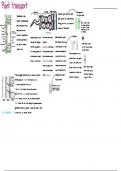
root hair cell
*
·
W
O Stalls
Translocation ·
G
2
L
is the
-
Cy
G ·
-- 2
00 0
~
S
transport of dissolved sucrose
er
-
S ~
·↳O
N ·
V
to avow
-
S
and amino acids
. At the sink for latteral moument
- to avoid
of water
obsticles such as
cells , sucrose is either
air bubbles
Plasmodesmata
converted to glucose(resp) or > Evidence
specialised epidermal Water moves down Y grad
. Water moves up the xylem
cells
⑧
starch (storage) . Phloem is
⑭
-
with a
high SA
.
Cytoplasm by osmosis :
by the cohesion-tension
theory -
= water does not leak
also used to transport
·
esap have many solutes to ↳ Water evaporates , it in leaf
Apoplast pathway moves through out as it would if pushed
inorganic ions
.
by root pressure
Lots the cell walls and to adjacent osmosis into mesophyll cells
↓ ↓ to maintain
gradient .
When transpiration rate is
ofMitochondrea to provide cells via .↳ more water drawn up
intercellular spaces
by
greatest ,
there is the
highest
It
#
ATP for A T of mineral ions
. .
symplast pathway moves transpiration pull as water
tension in the Xylem and the
to each
through the cytoplasm and molecules are cohesive
diameter is drawn in At .
night ,
after being ringed
,
between cells via pathways other it is also
,
drawn by more water cannot
transpiration is lower and
be drawn above the
Theories suggest movement down a pressure gradient . called plasmodesmata capillary action e pushed
diameter greater it will die
n
is
ring so
.
by root pressure
V
Adhesion to walls
·
cohesion to other
,
·
Hand sucrose co-transport into sieve tube elements water molecules
·
sucrose actively pumped into sink cells decreasing theirY
water moves into sink cells creating a low
hydrostatic pressure
leads
Hydrostatic pressure gradient across the phloem
to mass flow of sucrose solution
B! one
root hair cell
*
·
W
O Stalls
Translocation ·
G
2
L
is the
-
Cy
G ·
-- 2
00 0
~
S
transport of dissolved sucrose
er
-
S ~
·↳O
N ·
V
to avow
-
S
and amino acids
. At the sink for latteral moument
- to avoid
of water
obsticles such as
cells , sucrose is either
air bubbles
Plasmodesmata
converted to glucose(resp) or > Evidence
specialised epidermal Water moves down Y grad
. Water moves up the xylem
cells
⑧
starch (storage) . Phloem is
⑭
-
with a
high SA
.
Cytoplasm by osmosis :
by the cohesion-tension
theory -
= water does not leak
also used to transport
·
esap have many solutes to ↳ Water evaporates , it in leaf
Apoplast pathway moves through out as it would if pushed
inorganic ions
.
by root pressure
Lots the cell walls and to adjacent osmosis into mesophyll cells
↓ ↓ to maintain
gradient .
When transpiration rate is
ofMitochondrea to provide cells via .↳ more water drawn up
intercellular spaces
by
greatest ,
there is the
highest
It
#
ATP for A T of mineral ions
. .
symplast pathway moves transpiration pull as water
tension in the Xylem and the
to each
through the cytoplasm and molecules are cohesive
diameter is drawn in At .
night ,
after being ringed
,
between cells via pathways other it is also
,
drawn by more water cannot
transpiration is lower and
be drawn above the
Theories suggest movement down a pressure gradient . called plasmodesmata capillary action e pushed
diameter greater it will die
n
is
ring so
.
by root pressure
V
Adhesion to walls
·
cohesion to other
,
·
Hand sucrose co-transport into sieve tube elements water molecules
·
sucrose actively pumped into sink cells decreasing theirY
water moves into sink cells creating a low
hydrostatic pressure
leads
Hydrostatic pressure gradient across the phloem
to mass flow of sucrose solution