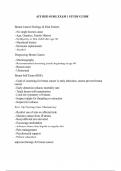
ATI MED SURG EXAM 1 STUDY GUIDE
Breast Cancer Etiology & Risk Factors - No single known cause - Age, Genetics, Family History - Nulliparity or first child after age 30 - Menstrual history - Hormone replacement - Alcohol Diagnosing Breast Cancer - Mammography - Recommended screening yearly beginning at age 40 - Breast exam - Ultrasound Breast Self Exam (BSE) - Goal of screening for breast cancer is early detection, cannot prevent breast cancer - Early detection reduces mortality rate - Teach breast self-examination - Look for symmetry of breasts - Inspect nipple for dimpling or retraction - Inspect for redness Post- Op Nursing Care: Mastectomy - Restrict use of arm on affected side - Monitor output from JP drains - Keep affected arm elevated - Encourage ambulation - Advance from clear liquids to regular diet - Pain management - Psychosocial support - Patient education adjuvant therapy for breast cancer - In addition to surgical removal of breast, patients may receive radiation or chemotherapy - Chemo standard of care for pts who have nodal involvement Lung Cancer - Leading cause of cancer deaths worldwide - Poor long-term survival due to late-stage diagnosis - 5 year survival rate is 56% if detected early and localized - Most diagnosed late - If metastasis, 5 year survival rate is 5% Lung Cancer Etiology - Smoking, causes 85% of lung cancers - Inhaled substances: asbestos, radon, coal, iron, tar, air pollution - Genetics Lung Cancer S/s • Hoarseness • Persistent cough • Blood tinged sputum • Hemoptysis • Chest pain • Dyspnea • Recurring episodes of pleural effusion • Wheezing • Weight loss • Anorexia • Dysphagia Lung Cancer Diagnosis • Patient history • Chest X Ray • Chest CT scan • Bronchoscopy Lung Cancer Treatment - Chemotherapy or Radiation therapy - Surgery: Wedge Resection, Lobectomy, or Pneumonectomy Chest Tubes - Drain placed in pleural space to restore intrapleural pressure - Allows for re-expansion of lung - Drains air and fluid - Connected to 6 feet of tubing Nursing Considerations for Chest Tubes • Monitor output • Monitor vital signs, pulse ox • Auscultate lungs • Assess dressing for bleeding, integrity • Assess tubing, making sure no kinks • Do not strip or "milk" the tubing • Keep vaseline gauze and clamps at bedside Nursing Interventions for Lung Cancer Patients • Pain management • Lung assessment, respiratory assessment • Administration of chemotherapy if ordered • Psychosocial support • Patient education Colorectal Cancer - Adenocarcinoma of the colon or rectum, or both - Etiology: Age 50 yr, genes, Personal/family history of cancer, Familial adenomatous polyposis, Smoking, Obesity, High fat diet, Low fiber diet - 2nd leading cause of cancer deaths Colorectal Cancer S/s • Depends on location of tumor • Rectal bleeding • Anemia • Change in stool consistency or shape • Tumors in transverse or descending colon may cause obstruction • Abdominal pain Colorectal Cancer Diagnosis • Abdominal assessment • Labs - CBC, fecal occult blood • Abdomen, pelvic CT • Colonoscopy • Barium enema Colorectal Cancer Treatment • Radiation, chemotherapy • Surgical removal of tumor and intestine - colon resection or colectomy • Patients may need temporary or permanent colostomy Nursing Interventions for Colon Cancer Patients • Patient education • Patient prep for colonoscopy: Bowel cleansing, clear liquid diet/NPO • Assessment of surgical incision, routine post-op care • Assessment of stoma if colostomy present • Psychosocial support Pancreatic Cancer - Tumors often discovered late, Adenocarcinoma - Rapid growing, quick metastasis Pancreatic Cancer Etiology • Age • Smoker • Diabetes • Chronic pancreatitis • High intake of red meat or processed meat (bacon) • Obesity Pancreatic Cancer S/s • Abdominal pain • Jaundice + Hepatomegaly • Weight loss • Clay colored stool • Ascites • Weakness, fatigue • Metastasis to retroperitoneum, liver, spine, colon, stomach • DVT/ PE related to necrotic products produced by the tumor, causing hypercoagulability Pancreatic Cancer Diagnosis • Patient history • Abdominal assessment • Pain intensity, quality, location • Lab values - amylase, lipase, alk phos, bilirubin • Ultrasound abdomen • Abdomen/pelvis CT • ERCP - Endoscopic retrograde cholangiopancreatography Pancreatic Cancer Treatment • Treatment geared at prevention of further metastasis, not cure - Chemotherapy, radiation - Biliary stents - Whipple Procedure Pre-Op Nursing Care for Whipple • Initiation of TPN for nutritional support • Pt is NPO • Pain management • Patient education • Psychosocial support
Written for
- Institution
- ATI MED SURG
- Module
- ATI MED SURG
Document information
- Uploaded on
- September 20, 2024
- Number of pages
- 24
- Written in
- 2024/2025
- Type
- Exam (elaborations)
- Contains
- Questions & answers
Subjects
-
ati med surg
-
ati med surg exam 1
-
ati med surg exam 1 study guide

Also available in package deal