Vivaldi- Concerto for 2 Mandolins Mvt 1
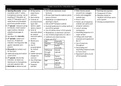
Texture Timbre Harmony Melody Rhythm
• Opening Ritornello- unison • String ripieno, • Use of tonic-dominant, tonal • Main themes based • Running semi quavers
mandolins with 1st violins, organ basso harmony around tonic arpeggio • Compound 2/2 time
homophonic accomp. Use of continuo • Phrases lead towards cadence points • Scalic and arpeggiotic • Melodies based on
doubling (1st Mandolin nd • Dual soloists (sense of drive) melodic bass rhythmic cell of two semis
violin/ 2nd Mandolin and 2nd • Contrast of • Modulation to subdominant in • Piece in GM and a quaver
violin) both set of doubled accompaniment opening (C major) • Potent use of sequence, • Driving accompaniments
parts have parallel motion types (full • 3rds and 6 between soloists
ths
ostinato (acc parts) and
• 1st episode- reduced scoring ripieno, upper • Inverted pedal point in soloist parts at imitation (soloists)
(no basso), unison quaver ripieno, basso) end of first episode • Lots of running
upper ripieno, imitative • Form of • Use of relative minor in first episode semiquavers
antiphonal passages in ritornello allows • Modulations to dominant common • Ascending Sequence in C
soloists for timbral • Use of stock progressions ie I-IIb-V-I major section
• See above for ritornello contrasts within • Cadences pre-empt new key • Falling sixth motif idea
• 2nd episode- soloist and sections • Some use of V7 inverted and repeated at
basso acc. Antiphonal • Mainly arco GM Ritornello bb. 6-7
imitation. Contrapuntal trills strings GM/DM 1st episode • Use of anacrusis
against repeated semi • Use of DM Partial throughout
quavers ornamentation ritornello • Descending and
• Ritornello but soloists rest for timbral DM/(pivot Second Ascending sequence leads
for four bars colour through episode to Tonic minor
• Subtle phrasing and motivic • Sudden dynamic Bm) Em • Repeated A pitch at end
construction changes for Em/GM Partial of first episode
• 3rd episode- Stretto like contrast ritornello
imitation, no basso acc. • Use of baroque GM Third
Soloists join to homophony running bass episode
and add cadential trills. • Frequent GM Partial
• Ritornello as above to end ostinato ritornello
Texture Timbre Harmony Melody Rhythm
• Opening Ritornello- unison • String ripieno, • Use of tonic-dominant, tonal • Main themes based • Running semi quavers
mandolins with 1st violins, organ basso harmony around tonic arpeggio • Compound 2/2 time
homophonic accomp. Use of continuo • Phrases lead towards cadence points • Scalic and arpeggiotic • Melodies based on
doubling (1st Mandolin nd • Dual soloists (sense of drive) melodic bass rhythmic cell of two semis
violin/ 2nd Mandolin and 2nd • Contrast of • Modulation to subdominant in • Piece in GM and a quaver
violin) both set of doubled accompaniment opening (C major) • Potent use of sequence, • Driving accompaniments
parts have parallel motion types (full • 3rds and 6 between soloists
ths
ostinato (acc parts) and
• 1st episode- reduced scoring ripieno, upper • Inverted pedal point in soloist parts at imitation (soloists)
(no basso), unison quaver ripieno, basso) end of first episode • Lots of running
upper ripieno, imitative • Form of • Use of relative minor in first episode semiquavers
antiphonal passages in ritornello allows • Modulations to dominant common • Ascending Sequence in C
soloists for timbral • Use of stock progressions ie I-IIb-V-I major section
• See above for ritornello contrasts within • Cadences pre-empt new key • Falling sixth motif idea
• 2nd episode- soloist and sections • Some use of V7 inverted and repeated at
basso acc. Antiphonal • Mainly arco GM Ritornello bb. 6-7
imitation. Contrapuntal trills strings GM/DM 1st episode • Use of anacrusis
against repeated semi • Use of DM Partial throughout
quavers ornamentation ritornello • Descending and
• Ritornello but soloists rest for timbral DM/(pivot Second Ascending sequence leads
for four bars colour through episode to Tonic minor
• Subtle phrasing and motivic • Sudden dynamic Bm) Em • Repeated A pitch at end
construction changes for Em/GM Partial of first episode
• 3rd episode- Stretto like contrast ritornello
imitation, no basso acc. • Use of baroque GM Third
Soloists join to homophony running bass episode
and add cadential trills. • Frequent GM Partial
• Ritornello as above to end ostinato ritornello