Bio 235 Assignment 3 - Athabasca University
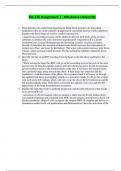
1. Some patients who suffer from hypertension (high blood pressure) are prescribed medications that are in the category of angiotensin-converting enzyme (ACE) inhibitors. Explain why these drugs are used to combat hypertension. - angiotensin-converting enzyme (ACE) inhibitors prevent ACE from acting on their substrates to produce the active hormone angiotensin II. Angiotensin II is a potent vasoconstrictor; it raises blood pressure by increasing systemic vascular resistance. Second, it stimulates the secretion of aldosterone, which increases the reabsorption of sodium ions (Na+) and water by the kidneys. The water reabsorption increases total blood volume, which increases blood pressure. By this method the inhibitors indirectly lower blood pressure. 2. Describe the fate of an RBC traveling from the heart to the left elbow and back to the heart. - When leaving the heart this RBC will go up the ascending aorta to the arch of the aorta and exit into the Brachiocephalic trunk to the Left subclavian artery. It will descend into the left auxiliary down to the brachial artery of the arm. It will leave the brachial artery into a posterior deep artery towards the elbow. It then feeds into arterioles and the capillaries to feed the tissues of the elbow. On its journey back it will carry on through the capillary bed into a postcapillary venule, to a muscular venule. It will go into a larger vein such as the left cephalic which will carry it up the arm to the left subclavian and the left brachiocephalic trunk. From there it descends the superior vena cava and into the right atrium of the heart for pulmonary circulation. 3. Explain the steps that result in antibody production and describe the process that results in an activated B-cell. - activation of a B cell happens when an antigen is taken into the B cell, broken down into peptide fragments and combined with MHC-II self-antigens, and moved to the B cell plasma membrane. Helper T cells recognize the antigen–MHC-II complex and deliver costimulation needed for B cell proliferation and differentiation. Once this activation of theB cell occurs it begins the clonal process, the cloned cells differentiate into memory B cells and plasma cells. Those plasma cells then secrete millions of antibodies a day, until they die (4-5 days). 4. State Boyle’s Law and explain how it relates to the process of pulmonary ventilation. - Boyle’s law states that the pressure of a gas in a closed container is inversely proportional to the volume of the container. Increasing the container size means decreasing the pressure, and vice versa. Changing container size is how inhalation and exhalation work. Just before inhalation, the pressure inside the lungs is slightly lower than in the atmosphere; there is no movement of gases. To cause ventilation, the size of the container must change. As the intercostal muscles and diaphragm contract, the chest expands increasing the space and decreasing the pressure inside the lungs relative to the atmosphere outside. This decrease in pressure causes air to flow into the lungs (inhalation). When those muscles relax the size volume of the lungs contracts increasing pressure and forcing air to move back out (exhalation)until the pressures are again equal. This repeated process is pulmonary ventilation. 5. Describe the Bohr Effect. Explain how PO2 in the lungs and tissue cells determines whether oxygen binding or dissociation occurs with hemoglobin. - Oxygen binding to hemoglobin exists on a curve, the higher the PO2 (pressure of oxygen dissolved in the blood) the higher the saturation of oxygen in hemoglobin. The Bohr effect describes how a change in acidity affects hemoglobin’s affinity for oxygen. As acidity increases, the affinity for oxygen in hemoglobin decreases no matter the PO2. This is a result of amino acids in the hemoglobin molecule binding with hydrogen, altering the structure so it can no longer bind with 4 O2 molecules. As tissues metabolize, they produce lactic and carbonic acids increasing the amount of hydrogen in the tissue that then binds to the hemoglobin. When blood flows into the tissue areas with higher acid levels (low PH) the affinity curve shifts meaning more oxygen unbinds from the hemoglobin and is therefore dissolved in the blood plasma. As blood flows back to the pulmonary tissue when the PH is higher the curve shifts back to reflect the PO2.
Written for
- Institution
- BIOL 235
- Course
- BIOL 235
Document information
- Uploaded on
- May 12, 2023
- Number of pages
- 8
- Written in
- 2022/2023
- Type
- OTHER
- Person
- Unknown
Subjects
-
bio 235 assignment 3 athabasca university
-
1 some patients who suffer from hypertension high blood pressure are prescribed medications that are in the category of angiotensin converting enzyme ac

Also available in package deal