Chapter 1 Scientific Thinking in Psychology
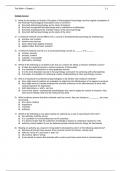
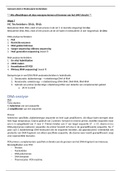
1) What do the preface to Wundt’s Principles of Physiological Psychology and the original constitution of the American Psychological Association have in common? a) they both defined psychology as the study of behavior b) they both recognized that psychology was a subdivision of philosophy c) they both emphasized the scientific nature of the new psychology d) they both defined psychology as the study of the mind 2) A research methods course differs from a course in developmental psychology by emphasizing a) process over content b) content over process c) basic rather than applied research d) applied rather than basic research 3) A research methods course is to a social psychology course as ______ is to ______. a) content; process b) process; content c) scientific; nonscientific d) philosophy; sociology 4) Which of the following is not listed in the text as a reason for taking a research methods course? a) it helps the student become a critical consumer of information b) it is essential for admission to most graduate schools c) it is the most important course in the psychology curriculum for achieving self-understanding d) it provides a foundation for achieving a better understanding of other psychology courses 5) Why is it important for professional psychologists to be familiar with research methods? a) they might need to perform an evaluation to determine the effectiveness of an agency’s program b) they might need to critically evaluate the scientific evidence for the effectiveness of some new clinical treatment for depression c) both alternatives a. and b. are true d) none of the above—professional psychologists only need to apply the results of research; they need not be familiar with how the research was done 6) When students assume that their textbook must be correct, they are relying on _________ as a way of knowing. a) the a priori method b) experience c) creativity d) authority 7) Which of the following is true about relying on authority as a way of searching for the truth? a) the authority could be wrong b) it is a problem for nonscientists but not for scientists c) it is almost certain that the authority’s knowledge is based on subjective experience only d) authority should seldom if ever be believed–people should discover things for themselves 8) Relying on authority as a basis for fixing belief is illustrated by which of the following statements? a) Because all events have causes, there must be some First Cause, namely God b) Why do I know it? I just know it, that’s all c) My country, right or wrong d) It just stands to reason that animals with a cortex must have some level of consciousness 9) Ted argues that the mind equals the brain. His argument is based on the assertion that the mind ceases to function when the brain ceases to function. This illustrates which of Peirce’s ways of fixing belief? a) the a priori method b) the method of direct experience c) the scientific method d) the method of authority 10) As a way of fixing belief, Peirce’s a priori method relies heavily on a) belief perseverance b) drawing conclusions from making systematic observations of nature c) relying on the expertise of others d) convincing others through logical arguments 11) Peirce was critical about the a priori method as a way of fixing belief because a) it was especially prone to a confirmation bias b) the use of logic is not really needed for arriving at truth c) it really meant nothing more than relying on authority d) carefully reasoned arguments can produce opposite conclusions 12) The problem with relying on a belief that “experience is the best teacher” is that a) our experiences might be limited and influenced by bias b) our experiences seldom provide any information about what life is like c) relying on experience makes us overlook the most important source of knowledge—authorities d) none of the above—personal experience is the only reliable way to truth 13) If our experiences include some unforgettable events, we might overestimate how often those kinds of events occur. This is called a) belief perseverance b) a confirmation bias c) the availability heuristic d) the a priori heuristic 14) Our experiences can be a valuable guide to the truth, but drawing firm conclusions from experience can be affected by our tendencies to ignore events that don’t support our beliefs. That is, we sometimes a) use the availability heuristic b) have a confirmation bias c) decide on the truth on the basis of logic rather than direct experience d) rely too much on introspection 15) According to Thomas Kuhn, it is generally a good thing for scientists to hang on to their pet theories tenaciously. Why? a) they seem more human that way b) by seeking out controversies with other scientists, they keep their aging minds sharp c) by vigorously advocating their theory, it won’t be abandoned without a thorough test d) none of the above—because they are objective, dispassionate, and ruled only by data, “tenacity” is not a term that characterizes scientists 16) Relying on Peirce’s a priori method as a way of fixing belief is illustrated by which of the following statements? a) Because all events have causes, there must be some First Cause greater than all the rest b) My country, right or wrong c) Nothing will ever convince me that men have been on the moon d) Of course it’s right—it was in the book
Geschreven voor
- Instelling
- Research in Psychology
- Vak
- Research in Psychology
Documentinformatie
- Geüpload op
- 19 september 2023
- Aantal pagina's
- 12
- Geschreven in
- 2023/2024
- Type
- Tentamen (uitwerkingen)
- Bevat
- Vragen en antwoorden
Onderwerpen
-
chapter 1 scientific thinking in psychology

Ook beschikbaar in voordeelbundel