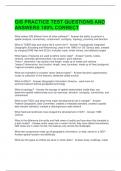
SCNM Q6 BOTM 6020 Final Exam With Verified Solution 2024
The study of chemical drugs, their chemistry, effects on the body, actions, toxicities, and dosages includes research into newly discovered chemicals - Pharmacology The science encompassing those phases of knowledge relating to natural products that are generally of medicinal value and primarily of plant origin. - Pharmacognosy Science of preparing, compounding, dispensing herbal or chemical medicines. - Pharmacy Used with herbs of potential toxicity, whereby the amount of liquid herb per dose is administered in a # of drops instead of a larger quantity like mls/cc or tsp. - Drop dosage The herbal preparation that is most suitable to administer (consider the best way to extract the plant and the best method of delivery for the patient). - Delivery system What are 6 reason why we make plant extracts? - 1. To concentrate the plants' constituents 2. To increase the shelf life 3. To make the constituents more bio-available 4. To create standardized products 5. To help with compliance / make them more convenient 6. To better reach certain areas of the body What are 4 ways to understand an herb - 1. Actions: one useful way we categorize plants is by understanding their actions. 2. Active Constituent: plant chemicals that have a physiological action on the body. These active constituents have predictable actions in ISOLATION in the laboratory. 3. Affinity: some plants have an organ or tissue affinity 4. Energetics: plants also have specific properties that should always be considered along with the patient's energetic picture.We use our senses of smell, sight, touch, and taste to help determine the quality of plants. - Organoleptic Assessment Specific constituents which are used to identify one plant from another. These, like active constituents, are sometimes used to standardize preparations. - Biomarker Identifies compounds in a plant (fingerprint); fast and inexpensive, but doesn't quantify compounds - Thin Layer Chromatography (TLC) Separates, identifies, and quantifies constituents in the plant; used for identification and to assess quality. - High Performance Liquid Chromatography (HPLC) What are two types of assessment for quality? - 1. Organoleptic Assessment 2. Chemical Assay When harvesting wildcraft herbs, what percentage should you use no more than? - 10% Remove impurities as you harvest. Keep the plant parts in large pieces. - Garble Break down into small pieces to increase contact with menstruum or solvent just before you are ready to make medicine. - Comminute Flowers are usually best harvested when? - Very new, barely open. Leaves are best harvested when? - Before the plant flowers Roots are best harvested when? - In the fall, or when the energy moves back down into the roots Berries are usually harvested when? - RipeBark should be harvested when? - Sap isn't running, but ideally from pruned branches or felled branches from storm damage. What temperature should you dry fresh plant materia
Geschreven voor
- Instelling
- SCNM Q6 BOTM 6020
- Vak
- SCNM Q6 BOTM 6020
Documentinformatie
- Geüpload op
- 27 april 2024
- Aantal pagina's
- 33
- Geschreven in
- 2023/2024
- Type
- Tentamen (uitwerkingen)
- Bevat
- Vragen en antwoorden
Onderwerpen
-
scnm q6 botm 6020 final exam with verified solutio