Intro to law: Private Law
Unit 1: Introduction
Approach of this course
Not: one legislation (Belgium, France, Switzerland, etc)
o Disadvantage: highly specialized knowledge
Not: European Code of Private law
o Not yet established
But:
o Mixture of some more general remarks on private law
( which are based on “Draft Common Frame of
Reference)
o Focus on selected problems and their different solutions
in national jurisdictions
o Course aims at raising understanding for (factual)
problems and their (divergent) legal solutions
Method: Comparison of Law
Different legal families in the world= groups of national laws
o Legal families similar to “human families”: differences,
but many similarities
Criteria used to establish legal families:
o History/ historical development
o Distinctive mode of legal thinking (well-articulated,
abstract systems vs concrete precedents)
o Education (academic, practical) of jurists and selection
‘by exams, by career) of judges/lawyers
o Kind of legal sources accepted (written codes,
precedents)
o Legal practice (E.G organization of courts)
o Existence of specific legal institutions (like “trust” in
England
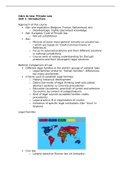
Legal Families
Civil law
o Largely based on Roman law (of Antiquity)
, o Written systematics codifications
o Can be found in continental Europe and former colonies,
and Russia, Latin America and Turkey
o Attention: civil law means, codified private law; not
opposite of criminal law
Common law
o Based on English Common law = case law (no
codification of private law)
o Can be found in England and former colonies, Ireland,
US, Canada, Australia
Muslim law (Islamic Law)
o Of religious nature
o Predominantly based on the Koran
o Can be found in Afghanistan, Saudi Arabia
And mixed with common law in Pakistan,
Bangladesh
And mixed with civil law in Iran, Iraq, Jordan, Syria,
Morocco, Egypt, Tunisia, Algeria
o Attention: another country with religious law is Israel
Customary law
o Orally traded
o Rooted in wisdom or great spiritual or philosophical
traditions
o Can often be found in Africa, and often mixed with other
systems
Namely with common law in Africa and India
And mixed with civil law in Africa, China, Mongolia
o But also, on Guernsey and on Jersey, and in Andorra
Attention:
o One country has often more than one legal system,
E.G.: UK - civil law in Scotland and common law in
England; therefore “Law of the UK” doesn’t exist
E.G.: Canada - mixed system of civil and common
law in Quebec
o Some law has cross-border effect
E.G.: French Civil Code also applicable in Belgium
(some modifications)
Criteria of how to constitute a family under discussion
o Different criteria-different legal families
o Legal families based on private law, not penal law or
constitutional law
Result of another grouping distinguishes:
o Roman family
o German family
o Common law family
, o Nordic family
o Family of the laws of the Far East (China and Japan)
o Religious family (Jewish, Muslim, and Hindu law)
Now abolished: Family of socialistic law (period of time
important!)
History
Antiquity: Roman law
o Differentiated in public law, penal law, and private law
o Flourishing culture of (private) law: “law of Twelve
Tables” around 450 BC
o After 300 AD, decline of “Roman Vulgar Law” in the
Western Roman Empire
o In the Eastern part: ‘Corpus iuris civilis’- “body of private
law” compiled by Emperor Justinian in 533 AD
Early middle ages (Western part of Europe, 400-1100)
o Roman law survived in Lex Romana Visigothorum esp. in
Southern France
Culture of writing
o Customary law (tribal law in Northern France/Belgium
and Germany)
Oral culture, no written law
Precedents important (wise man knew the law)
o Law of the Church (“canon law”) based on conciliar
decisions and decisions of bishops of Rome (popes)
Culture of writing
Rules esp. for clerics, but also impact on laymen
High middle ages (Western part of Europe, 1100-1500)
o Reception of Roman law (corpus iuris civilis)
o Foundation of universities (since 1150): Bologna, Paris,
Cologne, Leuven
o Law became an academic discipline (before: “Law
without lawyers”)
o Development of Ius Commune
Common law of Europe
Based on Roman law and canon law
, o Two examples:
Marriage law influenced by canon law
“agreements must be kept” (“pacta sunt
servanda”)
High Middle Ages and Early Modern Times (1200-1800)
o Customary law “non-learned law” becomes important
important
Town law (Munich, Paris, Leuven)
Law of the land (Coutumes de Beauvaisis, Saxon
Mirror, 13th century)
Early legislation of evolving states: Ordonnances
in France, Eeuwig Edict in Belgium (1611)
o Often: overlap or even conflict of Ius Commune and
customary/local/regional law: difficulties led to idea to
create a unified law for a state (codification)
Codifications (around 1800)
o Term coined by Jeremy Bentham (1748-1832), British
philosopher and jurist
o “code of law that encompasses an entire field of law in a
clear, systematic and comprehensive manner which
claims exclusive validity”
Entire field of law: E.G. private law
Clear, systematic, comprehensive: no gaps, not
supplementary sources of law necessary
(Bentham: “Whatever is not in the code of law,
ought not to be the law”)
Written in vernacular, not in Latin
Exclusive validity: derogation of older legislation
Must be promulgated/published
Codifications (around 1800): EXAMPLES
o General state laws for the Prussian States, 1794
o Code Civil, France, 1804
o Civil Code, Austria, 1811
o Civil Code, Germany, 1900
o Swiss Civil Code and Code of Obligations, 1912
The French Civil Code
“Code Civil”
In force in 1804
Project started in 1799; drafted by four practitioners from
Southern and Northern France (“droit écrit” - “written law”,
“droit coutumier” - “customary law”)
Legislative process influenced by Napoleon “It is not in
winning 40 battles that my real glory lies, for all those
victories will be eclipsed by Waterloo. But my Code Civil will
not be forgotten, it will live forever.”
Code Civil as compromise: partly modern
Unit 1: Introduction
Approach of this course
Not: one legislation (Belgium, France, Switzerland, etc)
o Disadvantage: highly specialized knowledge
Not: European Code of Private law
o Not yet established
But:
o Mixture of some more general remarks on private law
( which are based on “Draft Common Frame of
Reference)
o Focus on selected problems and their different solutions
in national jurisdictions
o Course aims at raising understanding for (factual)
problems and their (divergent) legal solutions
Method: Comparison of Law
Different legal families in the world= groups of national laws
o Legal families similar to “human families”: differences,
but many similarities
Criteria used to establish legal families:
o History/ historical development
o Distinctive mode of legal thinking (well-articulated,
abstract systems vs concrete precedents)
o Education (academic, practical) of jurists and selection
‘by exams, by career) of judges/lawyers
o Kind of legal sources accepted (written codes,
precedents)
o Legal practice (E.G organization of courts)
o Existence of specific legal institutions (like “trust” in
England
Legal Families
Civil law
o Largely based on Roman law (of Antiquity)
, o Written systematics codifications
o Can be found in continental Europe and former colonies,
and Russia, Latin America and Turkey
o Attention: civil law means, codified private law; not
opposite of criminal law
Common law
o Based on English Common law = case law (no
codification of private law)
o Can be found in England and former colonies, Ireland,
US, Canada, Australia
Muslim law (Islamic Law)
o Of religious nature
o Predominantly based on the Koran
o Can be found in Afghanistan, Saudi Arabia
And mixed with common law in Pakistan,
Bangladesh
And mixed with civil law in Iran, Iraq, Jordan, Syria,
Morocco, Egypt, Tunisia, Algeria
o Attention: another country with religious law is Israel
Customary law
o Orally traded
o Rooted in wisdom or great spiritual or philosophical
traditions
o Can often be found in Africa, and often mixed with other
systems
Namely with common law in Africa and India
And mixed with civil law in Africa, China, Mongolia
o But also, on Guernsey and on Jersey, and in Andorra
Attention:
o One country has often more than one legal system,
E.G.: UK - civil law in Scotland and common law in
England; therefore “Law of the UK” doesn’t exist
E.G.: Canada - mixed system of civil and common
law in Quebec
o Some law has cross-border effect
E.G.: French Civil Code also applicable in Belgium
(some modifications)
Criteria of how to constitute a family under discussion
o Different criteria-different legal families
o Legal families based on private law, not penal law or
constitutional law
Result of another grouping distinguishes:
o Roman family
o German family
o Common law family
, o Nordic family
o Family of the laws of the Far East (China and Japan)
o Religious family (Jewish, Muslim, and Hindu law)
Now abolished: Family of socialistic law (period of time
important!)
History
Antiquity: Roman law
o Differentiated in public law, penal law, and private law
o Flourishing culture of (private) law: “law of Twelve
Tables” around 450 BC
o After 300 AD, decline of “Roman Vulgar Law” in the
Western Roman Empire
o In the Eastern part: ‘Corpus iuris civilis’- “body of private
law” compiled by Emperor Justinian in 533 AD
Early middle ages (Western part of Europe, 400-1100)
o Roman law survived in Lex Romana Visigothorum esp. in
Southern France
Culture of writing
o Customary law (tribal law in Northern France/Belgium
and Germany)
Oral culture, no written law
Precedents important (wise man knew the law)
o Law of the Church (“canon law”) based on conciliar
decisions and decisions of bishops of Rome (popes)
Culture of writing
Rules esp. for clerics, but also impact on laymen
High middle ages (Western part of Europe, 1100-1500)
o Reception of Roman law (corpus iuris civilis)
o Foundation of universities (since 1150): Bologna, Paris,
Cologne, Leuven
o Law became an academic discipline (before: “Law
without lawyers”)
o Development of Ius Commune
Common law of Europe
Based on Roman law and canon law
, o Two examples:
Marriage law influenced by canon law
“agreements must be kept” (“pacta sunt
servanda”)
High Middle Ages and Early Modern Times (1200-1800)
o Customary law “non-learned law” becomes important
important
Town law (Munich, Paris, Leuven)
Law of the land (Coutumes de Beauvaisis, Saxon
Mirror, 13th century)
Early legislation of evolving states: Ordonnances
in France, Eeuwig Edict in Belgium (1611)
o Often: overlap or even conflict of Ius Commune and
customary/local/regional law: difficulties led to idea to
create a unified law for a state (codification)
Codifications (around 1800)
o Term coined by Jeremy Bentham (1748-1832), British
philosopher and jurist
o “code of law that encompasses an entire field of law in a
clear, systematic and comprehensive manner which
claims exclusive validity”
Entire field of law: E.G. private law
Clear, systematic, comprehensive: no gaps, not
supplementary sources of law necessary
(Bentham: “Whatever is not in the code of law,
ought not to be the law”)
Written in vernacular, not in Latin
Exclusive validity: derogation of older legislation
Must be promulgated/published
Codifications (around 1800): EXAMPLES
o General state laws for the Prussian States, 1794
o Code Civil, France, 1804
o Civil Code, Austria, 1811
o Civil Code, Germany, 1900
o Swiss Civil Code and Code of Obligations, 1912
The French Civil Code
“Code Civil”
In force in 1804
Project started in 1799; drafted by four practitioners from
Southern and Northern France (“droit écrit” - “written law”,
“droit coutumier” - “customary law”)
Legislative process influenced by Napoleon “It is not in
winning 40 battles that my real glory lies, for all those
victories will be eclipsed by Waterloo. But my Code Civil will
not be forgotten, it will live forever.”
Code Civil as compromise: partly modern