100% tevredenheidsgarantie Direct beschikbaar na je betaling Lees online óf als PDF Geen vaste maandelijkse kosten 4,6 TrustPilot
logo-home
Tentamen (uitwerkingen)

CMN 142 Exam 1 Basic Questions and Answers

Beoordeling
-
Verkocht
-
Pagina's
24
Cijfer
A+
Geüpload op
21-03-2022
Geschreven in
2021/2022

When and where was the first newspaper published? Correct answer- Strasbourg, Germany 1605 (Printed by Johann Carolus) Four italicized characteristics of a newspaper Correct answer- 1. published 2. periodical 3. printed 4. present-centered Four italicized characteristics of a newspaper: Published Correct answer- Meaning intended to be circulated to multiple persons, many of whom may be unknown to the publisher (unlike a personal letter) Four italicized characteristics of a newspaper: Periodical Correct answer- Unlike a broadside publication published to communicate news about a specific occasion without any promise or expectation of further publication Four italicized characteristics of a newspaper: Printed Correct answer- Thereby making possible a general circulation much more difficult and expensive to achieve in handwritten form Four italicized characteristics of a newspaper: Present-centered Correct answer- in its subject matter When and where was the first American newspaper published? Correct answer- Boston 1690 (Publick Occurrences Both Foreign and Domestick, published by Benjamin Harris) And there was no such thing as journalism until the 1600s? Correct answer- No, but that doesn't mean there wasn't news There was no such thing as newspapers (published, periodical, printed, and present- centered) There was no such thing as journalism: an arena of human activities differentiated from others, with its own definition; a social domain that people might understand themselves vocationally or avocationally a part of; a set of ideas and practices at least partially distinct from other fields. A field centered on regularly disseminating notice of and commentary about [topical events] has been organized as an intentional pursuit for only around four hundred years What were the early newspapers like? Who started them and why? Correct answer- all early newspapers were published for a general audience, printed, periodical, and for the most part present-minded in content Four 18th century models: 1. The official state-issued news vehicle 2. The advertiser 3. The propaganda journal or publication guided by a strong political position 4. Literary and satirical journals and magazines Who? The government (London Gazette), City Mercury (advertiser), The Spectator by Joseph Addison (literary journal) What were early newspapers in the American colonies like? Who started them and why? Correct answer- There were very few of them Newspapers were primarily located in population centers (Boston, New York, etc.) They were four page weekly publications generally organized like the London journals before them in two or three columns on a page Their contents: -An assortment of local advertising -Some paragraphs on local gossip -Large amounts of European political and economic intelligence reprinted directly from London newspapers In any given colonial newspaper, political news of other American colonies rarely appeared Local political news was rarely noted or discussed Printers did not typically see their newspapers as either political instruments or professional agencies for gathering news The first to be sustained beyond one issue was the Boston Newsletter What does the First Amendment mean? Correct answer- "Congress shall make no law respecting an establishment of religion, or prohibiting the free exercise thereof; or abridging the freedom of speech; or of the press; or the right of the people to peacefully assemble, and to petition the government for a redress of grievances" To the founders: -Prohibition of federal laws abridging freedom of the press, not state laws -To Jefferson, this meant it was the exclusive right of the states to control the press Gitlow v. New York: (1925) first amendment applies to states Note the significance of the Sullivan case Correct answer- Supreme Court view emerged that the first amendment permits a distinction between "high" value and "low" value speech High value speech: speech about elections, politics, and public policy, including speech critical of the government or government officials; this is the kind of speech that was most on the mind of the founders Supreme court has determined that it's very important to protect political speech but some kinds of speech are clearly unprotected (false advertising, libelous speech/defamation, speech enacting a criminal conspiracy, "fighting words") the decision certified that libel suits against news organizations by public officials would be very difficult to win. The public official would have to show not only that news organizations published false and damaging statements but also did so knowingly with "malice" how is the US different from other countries in this (Sullivan case) regard? Correct answer- The U.S. judicial doctrine about freedom of the press, for all its variations, is less likely to approve government regulation of or limitations on wide-open free speech and free press than any other contemporary democratic country, even countries with substantial and seriously defended liberty of the press How is the US tradition of the free press different from traditions in other democracies? Correct answer- Most democracies enforce right to reply statutes where news organizations that have critical remarks about an individual must provide a forum for the individual to respond; The U.S. supreme court has declared that such laws violate the 1st amendment Many European democracies prohibit hate speech by law; US law does not The Postal Act Correct answer- Newspapers circulated through mail (as most newspapers were) would have a reduced postal rate Newspapers that were mailed to other newspapers could be done so for free (remember, newspapers at this time were aggregators) Postal act was thus in a way a direct government subsidy of the primary means of newspaper gathering for early American press The Sedition Act (1798) Correct answer- By any plausible reasoning, it abridged Freedom of the press It authorized fines or imprisonment for editors who printed "any false, scandalous, and malicious writing...against the government of the United States" How could the American founding fathers have approved the First Amendment and also supported federal subsidies for newspapers and also passed the Sedition Act of 1798 that made criticizing the federal government a crime? Correct answer- The Sedition Act came at a time of undeclared war with France when government was understood to be a vulnerable institution The founders truly believed that calling into question the government or its individual officeholders genuinely threatened the survival of an untested republican government "How did the founders reconcile the Sedition Act with the first amendment? They didn't. The Act passed narrowly" -Madison and Jefferson strongly opposed it -there wasn't yet a standard of judicial review to strike it down Contemporary understandings of the 1st amendment would not have made much sense to the founders Why were European visitors to the US in the 19th Century so often astonished—and sometimes appalled—by the American press? Correct answer- Astonished: there were just so many newspapers, and they could be found not only in urban areas far from political capitals but even in very small towns -Government subsidies -Newspapers as an emblem of the community Appalling: the arrogance, vitriol, and hyperbole of partisan papers of the 19th century -de Tocqueville was worried about the power of the press but also was impressed by the spread of information How did newspapers become mass market media? Correct answer- This was not an inevitable development and it did not happen everywhere note the 2 stages discussed in the section (mass market media) Correct answer- 1. the penny press 2. Came in the last decades of the nineteenth century when several news entrepreneurs found ways to cut costs or draw in new readers or both The penny press Correct answer- Took off in 1830s and 1840s in the major Atlantic seaboard cities (Boston, NYC, Philly, Baltimore) Cheap Sold on the streets by newsboys rather than being sold only by subscription through the mail Leading penny papers emphasized local news, including coverage of crime and the courts Proprietors of penny papers hoped that high circulation and the advertising it would attract would make them successful enterprises This proved to be a very effective business model up until the digital age stage 2 of newspapers becoming mass market media (cutting costs and drawing in readers) Correct answer- Joseph Pulitzer's pioneering leadership of the New York World in the 1880s and 1890s provided larger headlines, more illustrations, more lively news coverage, and more attention to topics of general interest (like sports) and topics that would draw in nontraditional newspaper readers, notably women and immigrants Publisher James Scripp cut the size of the newspaper page, reducing the cost of newsprint, and cut investment in news relayed by telegraph to reduce reporting costs (formula for reaching people of modest means) when did the number of newspapers published in the US peak? Correct answer- 1910 (2600 daily newspapers in the U.S.) Did Karl Marx write regularly for Horace Greeley's New York Tribune? Correct answer- YES Began when tribune editor Charles Dana was traveling in Germany and met Marx in cologne (1848) Asked Marx to write about the influence of the revolutions of 1848 in Europe on Germany Majority of Marx's columns concern European political affairs; Marx's own observations not based on interviews with sources (normal journalism of the day) Why did Abraham Lincoln spend so many hours in the telegraph office during the Civil War? Correct answer- In 1862, the war department opened its own telegraph office right next to the white house After this, Lincoln went from sending about one telegram a month to up to 9 in a day He got into the habit of walking over the the telegraph office several times a day and reading whatever telegrams came in During major battles he even slept in the telegraph office "With the nation's very existence at stake during the war, Lincoln wanted to be as close to the front lines as he could--he wanted news as quickly as possible and he wanted his unruly general in the field to know he was watching them closely" When was the first interview? And how did interviewing become a standard practice in newsgathering? Correct answer- Interviews did not become part of journalism until the 19th century and then in the U.S. before anywhere else It may have been James Gordon Bennett's in New York for the New York Harold in 1836 (story about the murder of Helen Jewett) OR it may have been Horace Greeley's interview with Brigham Young in 1859 (printed in the New York Tribune in Q&A format) what was the American role in the rise of interviewing? Correct answer- The interview was a distinctly American invention Overtime interviewing became standard practice for all American journalists and increasingly many abroad -Ready acceptance is U.S. likely had to do with relative egalitarianism But interviewing was an early American export in the same informalizing direction why (and where) was there resistance to interviewing? Correct answer- For a long time, interviewing was viewed as undignified "It was just plain unseemly" It was so impertinent (showing no respect, rude) ("public men" were normally of high status and social pedigree, journalists weren't) -Relative classlessness of America (when compared to Europe) made resistance to interviewing more feeble in the U.S. Where? Probably Europe For European critics of interviewing, journalism was a calling to be practiced by people with high literary ambitions The model form of the newspaper article was an essay, it was normally an analysis of current political and economic events Took place in private study rather than a newsroom Journalists aspired to literary flair... "Interviewing, in contrast, ironed out these high-minded intellectual and literary aspirations..." What were immigrants reading as they flocked to the US in the late 19th Century and since? Correct answer- As immigration to the U.S. expanded, so did the foreign language press By WWI there were close to 1300 dailies and weeklies The largest foreign language press was German (but the German language press was wiped out after WWI) A foreign language press survived into the 1940s, but didn't regain the same prominence in 1910 Still with immigration reform of the 1960s and the influx of Asian and LatinX immigrants, foreign language papers serving new immigrant communities began to expand Notable is the emergence of Spanish Language broadcasting How did slaves and later free African Americans get their news? Correct answer- Not easy for AA slaves to get news; many slaves were illiterate and in the 1830s laws in many Southern states made it illegal to teach AA's to read (5-10% literacy rate on eve of civil war) After emancipation schools began to spring up and literacy rates rose After emancipation, there was a corps of literate African Americans equipped to help former slaves The "Great Migration" was encouraged by the circulation in the south of African American newspapers from the North The Chicago Defender (widely circulated in the south, posted job notices, and opened clubs to help migrants make the transition to Urban life) The Pittsburgh Courier was also a prominent African American newspaper (promoted the "Double V campaign" Last paragraph about how African Americans got their news Correct answer- The black press grew for a few years after WWII but in the 1950s faltered badly By the 1960s, a once thriving part of American journalism had become a ghost in itself It did not secure the same kinds of advertising base that sustained the mainstream press In many AA homes, black newspapers were the "second paper" (could still reach advertising base by advertising in general circulation newspapers; black businesses were not inspired to support the black press) As civil rights became increasingly a top news story in the mid-1950s, and even after the mainstream press had long neglected the black community, it became more possible for readers to follow this important news in the general media and for advertisers to reach AA's without buying space in AA newspapers Did the "yellow press" drive America into war with Spain in 1898? Correct answer- Short answer: no (the textbooks are wrong) Pulitzer (New York World) and Hearst (New York Journal) both published comic strips called "The Yellow Kid," hence the name yellow journalism Sensationalism in news Puffing up news of Spanish atrocities/alleged atrocities in Cuba Relevant facts for determining if these papers would have had any influence: Both papers were ardent supporters of the democratic party, while in the run up to the Spanish-American war, both the white house and congress were controlled by Republicans Senators (who at the time were elected by state legislatures) had little reason to worry about public opinion, and although the president had perhaps slightly more reason to worry, Republicans had controlled the white house basically from and president McKinley carried NY, the only places where these papers had influence, by a large margin President McKinley's staff prepared news summaries for him, but it rarely included anything from the World and the Journal (neither paper was taken seriously in Washington). Simply no historical evidence that suggest that enthusiasm to go to war had any impact on the decision to go to war So where does this myth come from? It appears to have become consensus position after WWI Lots of propaganda coming out, people read their suspicions about propaganda forcing people into war back onto the Spanish American War Pulitzer and Hearst had no detectable influence on American foreign policy How did American newspapers, largely identified with political parties for most of the 19th Century, come to pride themselves on "objectivity"? Correct answer- Honestly, see study guide The War (WWI) brought waves of propaganda activity, and at about the same time and increasingly in the years following the war, "public relations" became an industry Reporters quickly felt themselves deluged by outsiders eager to have their perspectives on events recognized directly or indirectly in the pages of the newspaper Journalists complained that journalism schools were churning out more PR specialists than reporters It was at this point that journalists, recognizing the efforts of governments, businesses, and others to plant stories in the press to enhance their reputation, power, or profit, asserted they would not be swayed by any of it This new model of professional journalism, often called "objective" reporting at the time and after, was further institutionalized and maintained because it served newspaper editors as a kind of discipline for directing and controlling their increasingly large staffs of young reporters learning the trade on the job Is adherence to the value of "objectivity" the heart of what it means to be a "professional" in journalism? Correct answer- No, although U.S. journalists and scholars of journalism often speak as if these terms are inseparable In journalism, it is possible to institute norms of objectivity without establishing a pervasive culture in news organizations that encourages them EX: Brazil in the 1950s Controlled news reporters by placing authority at the copy desk, not the autonomy of individual reporters "Authoritarian modernization": a kind of revolution from above that produced "professionalization without professionalism" In other words, it enabled newspapers to establish practices of objectivity without instill in reporters urgency about it If "objectivity" is not the heart of professionalism in journalism, what (if anything) is? Three characteristics of professionalism Correct answer- 1. Members have a high degree of autonomy in their work and in judgements about the quality of their work, uncoerced by the state or marketplace 2. Members have formal codes of ethics they take seriously or informal values that orient them to public service 3. While not all occupations

Meer zien Lees minder
Instelling
Vak

Voorbeeld van de inhoud

CMN 142 Exam 1 Basic Questions and
Answers

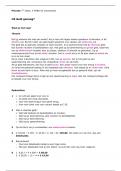
When and where was the first newspaper published? Correct answer- Strasbourg,
Germany
1605
(Printed by Johann Carolus)

Four italicized characteristics of a newspaper Correct answer- 1. published
2. periodical
3. printed
4. present-centered

Four italicized characteristics of a newspaper: Published Correct answer- Meaning
intended to be circulated to multiple persons, many of whom may be unknown to the
publisher (unlike a personal letter)

Four italicized characteristics of a newspaper: Periodical Correct answer- Unlike a
broadside publication published to communicate news about a specific occasion without
any promise or expectation of further publication

Four italicized characteristics of a newspaper: Printed Correct answer- Thereby making
possible a general circulation much more difficult and expensive to achieve in
handwritten form

Four italicized characteristics of a newspaper: Present-centered Correct answer- in its
subject matter

When and where was the first American newspaper published? Correct answer- Boston
1690
(Publick Occurrences Both Foreign and Domestick, published by Benjamin Harris)

And there was no such thing as journalism until the 1600s? Correct answer- No, but that
doesn't mean there wasn't news

There was no such thing as newspapers (published, periodical, printed, and present-
centered)

There was no such thing as journalism: an arena of human activities differentiated from
others, with its own definition; a social domain that people might understand themselves

,vocationally or avocationally a part of; a set of ideas and practices at least partially
distinct from other fields.

A field centered on regularly disseminating notice of and commentary about [topical
events] has been organized as an intentional pursuit for only around four hundred years

What were the early newspapers like? Who started them and why? Correct answer- all
early newspapers were published for a general audience, printed, periodical, and for the
most part present-minded in content

Four 18th century models:
1. The official state-issued news vehicle
2. The advertiser
3. The propaganda journal or publication guided by a strong political position
4. Literary and satirical journals and magazines

Who?
The government (London Gazette), City Mercury (advertiser), The Spectator by Joseph
Addison (literary journal)

What were early newspapers in the American colonies like? Who started them and
why? Correct answer- There were very few of them

Newspapers were primarily located in population centers (Boston, New York, etc.)

They were four page weekly publications generally organized like the London journals
before them in two or three columns on a page

Their contents:
-An assortment of local advertising
-Some paragraphs on local gossip
-Large amounts of European political and economic intelligence reprinted directly from
London newspapers

In any given colonial newspaper, political news of other American colonies rarely
appeared

Local political news was rarely noted or discussed

Printers did not typically see their newspapers as either political instruments or
professional agencies for gathering news

The first to be sustained beyond one issue was the Boston Newsletter

What does the First Amendment mean? Correct answer- "Congress shall make no law
respecting an establishment of religion, or prohibiting the free exercise thereof; or

, abridging the freedom of speech; or of the press; or the right of the people to peacefully
assemble, and to petition the government for a redress of grievances"

To the founders:
-Prohibition of federal laws abridging freedom of the press, not state laws
-To Jefferson, this meant it was the exclusive right of the states to control the press

Gitlow v. New York: (1925) first amendment applies to states

Note the significance of the Sullivan case Correct answer- Supreme Court view
emerged that the first amendment permits a distinction between "high" value and "low"
value speech

High value speech: speech about elections, politics, and public policy, including speech
critical of the government or government officials; this is the kind of speech that was
most on the mind of the founders

Supreme court has determined that it's very important to protect political speech but
some kinds of speech are clearly unprotected (false advertising, libelous
speech/defamation, speech enacting a criminal conspiracy, "fighting words")

the decision certified that libel suits against news organizations by public officials would
be very difficult to win. The public official would have to show not only that news
organizations published false and damaging statements but also did so knowingly with
"malice"

how is the US different from other countries in this (Sullivan case) regard? Correct
answer- The U.S. judicial doctrine about freedom of the press, for all its variations, is
less likely to approve government regulation of or limitations on wide-open free speech
and free press than any other contemporary democratic country, even countries with
substantial and seriously defended liberty of the press

How is the US tradition of the free press different from traditions in other democracies?
Correct answer- Most democracies enforce right to reply statutes where news
organizations that have critical remarks about an individual must provide a forum for the
individual to respond; The U.S. supreme court has declared that such laws violate the
1st amendment

Many European democracies prohibit hate speech by law; US law does not

The Postal Act Correct answer- Newspapers circulated through mail (as most
newspapers were) would have a reduced postal rate

Newspapers that were mailed to other newspapers could be done so for free
(remember, newspapers at this time were aggregators)


Geschreven voor

Vak

Documentinformatie

Geüpload op
21 maart 2022
Aantal pagina's
24
Geschreven in
2021/2022
Type
Tentamen (uitwerkingen)
Bevat
Vragen en antwoorden

Onderwerpen

Maak kennis met de verkoper

Seller avatar
De reputatie van een verkoper is gebaseerd op het aantal documenten dat iemand tegen betaling verkocht heeft en de beoordelingen die voor die items ontvangen zijn. Er zijn drie niveau’s te onderscheiden: brons, zilver en goud. Hoe beter de reputatie, hoe meer de kwaliteit van zijn of haar werk te vertrouwen is.
EvaTee Phoenix University
Volgen Je moet ingelogd zijn om studenten of vakken te kunnen volgen
Verkocht
5119
Lid sinds
4 jaar
Aantal volgers
3564
Documenten
53756
Laatst verkocht
1 uur geleden
TIGHT DEADLINE? I CAN HELP

Many students don\'t have the time to work on their academic papers due to balancing with other responsibilities, for example, part-time work. I can relate. kindly don\'t hesitate to contact me, my study guides, notes and exams or test banks, are 100% graded

3,8

934 beoordelingen

5
445
4
164
3
170
2
47
1
108

Populaire documenten

Recent door jou bekeken

Waarom studenten kiezen voor Stuvia

Gemaakt door medestudenten, geverifieerd door reviews

Kwaliteit die je kunt vertrouwen: geschreven door studenten die slaagden en beoordeeld door anderen die dit document gebruikten.

Niet tevreden? Kies een ander document

Geen zorgen! Je kunt voor hetzelfde geld direct een ander document kiezen dat beter past bij wat je zoekt.

Betaal zoals je wilt, start meteen met leren

Geen abonnement, geen verplichtingen. Betaal zoals je gewend bent via iDeal of creditcard en download je PDF-document meteen.

Student with book image

“Gekocht, gedownload en geslaagd. Zo makkelijk kan het dus zijn.”

Alisha Student

Veelgestelde vragen