CADC Theories Question and answer 2023
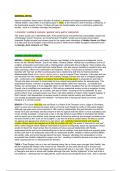
CADC Theories Question and answer 2023CBT Goals 1. to challenge clients to confront faulty beliefs with contradictory evidence that they gather and evaluate. 2. to help clients seek out their faulty beliefs and minimize them. 3. to become aware of automatic thoughts and to change them. Who developed Person-Centered Therapy? Carl and Natalie Rogers in the 1940s Person-Centered Therapy Based on a subjective view of human experiencing. Places faith in. Gives responsibility to client in dealing with their problems Jungian Worldview Personal unconscious, psychological complexes, collective unconscious, shadow within Stages of adjustment Denial, solution finding, disorganization, re-organization, abandonment Jungian theory Developed by Carl Jung. Grounded in the belief that people realize their human potential by finding ways to have a positive impact in the world. Stresses positive, cultural and strength-based factors in a person's development. Highlights that people are constantly going through physical, cognitive, emotional, psychological and spirtual changes. Virginia Satir Developed the human validation process model. She believed that spontaneity, creativity, humor, self-disclosure, risk-taking and personal touch were central to family therapy. Differentiation of the self part of multigenerational family therapy. Involves the psychological separation of intellect, emotion and independence of the self from other. People gain a sense of self identity. Who developed Reality Therapy William Glasser Who developed CBT? Albert Ellis Adlerian Worldview 1. Personal Competence: need for competence, perfectibility and belongingess. 2. Belongingness. 4 stages of Adlerian Counseling and Therapy Strategies are.. 1. Building a trusting relationship 2. Assessment stage 3. Promoting insight 4. Reorientation 4 Jungian Counseling and Therapy Strategies are... 1. Catharsis and Emotional cleansing 2. Elucidation 3. Education 4. Transformation Rational-Emotive-Behavioral Therapy (REBT) Based on the principle that people are not disturbed by events but rather how they see the event. Attitudes & negative self-concepts can start& maintain the process of addiction. REBT concentrates on the here and now rather than the past as to how a person's attitudes, beliefs & self-concepts affect their emotions & behavior. One of the beliefs of this model is that motivations that caused self defeating behaviors of chemical addictions are discomfort, anxiety, & low frustration tolerance. The counselor's job is to help the patient replace these behaviors with rational behaviors. ABC Model of REBT A - Activating event. B- Beliefs & Thoughts. C- Consequences (both emotional & behavioral) Behavioral Modification Theory Based on the idea that all behavior is learned; and what is learned can be unlearned. Learning processes are are tied to the cause, support, & change of behavior & include: Classical Conditioning, Operant Conditioning, & Modeling. Classical Conditioning Substituting a stimulus which brings about the same result. Developed by Pavlov. Operant Conditioning Based on the increase or decrease of certain behaviors through the use of reinforcement. Negative reinforcement can decrease behavior. Developed by Skinner Modeling learning a behavior by observeing another performing the behavior. Then a practice of the behavior occurs followed by reinforcement. Developed by Bandura Control Theory/Reality Theory An approach to counseling which has its base on the idea that it's not the real world that affects one's behavior. Rather it's how the world is perceived to be. Another principle is that people don't have to be a victim of what has happened in the past unless they let it. Parts of control theory/reality theory thinking, feeling, & physiology. This means that the patient has the power to change the way they act & think. Another underlying principle is the emphasis on taking responsibility for satisfying one's needs w/out interfering with the needs of others. A focus is on client changing his total behavior not just his attitudes & feelings. Freudian or Psychoanalytical therapy Therapy based on the idea that people are influenced considered by their unconscious & inner-drives. Conflict is caused by 3 systems interacting. The source of unconscious drives is called the id. The internalized outside world is called the superego. Anxiety is created when there is conflict between the id & the superego. The 3rd system, the ego takes the force of the conflict. This results in the creation of defense mechanisms such as denial. This therapy is helpful when there are many relapses. & serious personality disturbances. Adlerian or Individual Therapy Therapy based on the idea that people are always striving to be better or perfect. It is often thought of as a Growth Model. Developer believed that social urges were what influenced people. When levels of improvement or perfection aren't reached, a feeling of inferiority is felt & dissatisfaction is present. Fictional Finalism Part of Adlerian Therapy. Refers to everyone having a goal that provides a purpose. Sometimes it can be negative a lead to drug abuse Gestalt therpay Therapy based on the idea that people must accept responsibility for what happens to them & find their own way in life. It only deals with the present. One important principle is to help the patient discover what they want to be rather than trying to be someone else. This therapy stresses living with one's feelings rather than running away, even if the feelings make one uncomfortable. Solution Focused Therapy Focuses on what works rather than problems. The idea is to work with the beliefs of the patient to promote change. Family Systems and Addiction Counseling Based on the premise that when a person abuses drugs, the whole family is affected. Several models are being used. Dynamic Family Therapy Based on gaining insight to be able to understand conflicts which are present in the family setting. Experiential/Humanistic Family Therapy Based on the most important factor of recovery is self-determination and awareness. Bowenian Family Therapy Based on the concept that emotions and intellect of a family are entangled. This causes an automatic emotional arousal within the family. The other basis is referred to as differentiation where the individual remains without outside control. Structural Family Therapy When the counselor tries to change the dysfunction structure of the family. Family disease Model Based on the idea that alcoholism is a family disease and the disease itself is codependence Deductive Reasoning The ability to solve problems by working from a given situation to a conclusion Inductive Reasoning The ability to solve problems by working from a specific experience to a conclusion. Taxonomy of Pathology The classification of problems into 2 groups called Axis I disorders, which include behavioral disorders and some physical disorders; and Axis II disorders which are only behavioral Motivational Enhancement Therapy (MET) Therapy based on motivational psychology. Change is internally motivated & very rapid because it is based on the belief that the patient has the capability as well as the responsibility to change. There is an emphasis on Persian choices regarding drug use together with an objective evaluation of behavior. According to ..... positive and negative feedback must be paired together Abraham Maslow The facilitative model of supervision was based on what model of psychotherapy? Carl Roger's client centered therapy In relation to counseling, what is empathy? Being able to understand what another person is experiencing Triangulation a process in which triads result in a 2-against-1 experience Teleogical nature of Humankind The notion that a person's development is impacted by goal-directed drive and purposeful action.

Geschreven voor
- Instelling
- CADC
- Vak
- CADC
Documentinformatie
- Geüpload op
- 5 maart 2023
- Aantal pagina's
- 8
- Geschreven in
- 2022/2023
- Type
- Tentamen (uitwerkingen)
- Bevat
- Vragen en antwoorden
Onderwerpen
-
cadc theories question and answer 2023
-
cbt goals 1 to challenge clients to confront faulty beliefs with contradictory evidence that they gather and evaluate 2 to help clients seek out their faulty

Ook beschikbaar in voordeelbundel