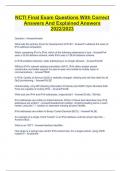
NCTI Final Exam Questions With Correct
Answers And Explained Answers
2022/2023
Question - AnswerAnswer
What was the primary driver for development of IPv6? - AnswerTo address the issue of
IPv4 address exhaustion.
When comparing IPv4 to IPv6, which of the following statements is true - AnswerIPv4
uses a 32-bit address scheme, while IPv6 uses a 128-bit address scheme.
In IPv6-enabled networks, static addressing is no longer allowed. - AnswerFALSE
Without IPv4's network address translation (NAT), IPv6 offers simpler packet
construction and better support for peer-to-peer and mobile-to-mobile types of
communications. - AnswerTRUE
In IPv6, Quality of Service (QoS) is radically changed, utilizing only the flow label for all
QoS provisioning. - AnswerFALSE
Unfortunately, only RIP (Routing Information Protocol) and OSPF (Open Shortest Path
First) are capable of routing IPv6. - AnswerFALSE
What size are IPv4 and IPv6 addresses, respectively? - Answer32-bits, 128-bits.
IPv4 addresses are written in dotted-decimal. Which of these best describes how IPv6
addresses are written? - AnswerHexadecimal notation, dropping leading zeros in each
hextet, using the "::" notation to represent missing all-zero hextets.
IPv6 addresses are written in Binary Coded Decimal (BCD). - AnswerFALSE
An example of a single 16-bit "hextet" in an IPv6 address could be shown like this: -
Answer:54a2:.
What is an "IID"? - AnswerInterface Identifier.
How large is a typical user-centric IPv6 subnet size, for a single subnet, using CIDR
notation? - Answer/64
, What does the notation "2000::/3" mean, in terms of the initial IETF allocation for IPv6
global unicast space? - AnswerThat global unicast addresses always start with the first
three bits "001" (first 3 bits of the address per the "/3" notation).
Which of these prefix lengths would be a reasonable assignment for a service provider?
- Answer/32
Which of these prefix lengths would be a reasonable assignment for a small single-
homed commercial enterprise with no more than 15 or 20 networks? - Answer/48.
What is a unique aspect of an "anycast" address? - AnswerIt is an address typically
assigned to more than one interface, typically on different nodes.
The leftmost 64-bits of an IPv6 unicast address typically describe: - AnswerThe location
in the IPv6 routing hierarchy of a particular subnet.
The rightmost 64-bits of an IPv6 unicast address typically describe: - AnswerThe
specific interface on the subnet.
The main types of IPv6 addresses are: - AnswerUnicast, anycast, and multicast.
What does the term "ULA" mean? - AnswerUnique Local Addresses.
The function of Unique Local Addresses are: - AnswerFor use within a network enclave,
and not routed or announced to the public Internet.
Link-local addresses come from which part of the IPv6 address space? -
AnswerFE8::/10.
IPv6 Multicast addresses always fall within what prefix? - AnswerFF00::/8.
What kind of unicast address does every IPv6 interface have to have? - AnswerLink-
local.
EUI-64 construction includes a unique marker for what purpose? - AnswerA bit within
the IID (rightmost 64-bits) set to indicate the IID was built from a globally-unique token.
The scope over which link-local IPv6 addresses must be unique is: - AnswerOn the link
where the interface is configured.
In the multicast address FF02::1, the "0" describes: - AnswerThe "flags" for the address.
Which is an example of an IPv6 multicast address that a router would normally listen
for? - AnswerFF02::1 (all nodes multicast, interface scope).
Which IPv6 multicast address does a DHCPv6 server listen on? - AnswerFF05::1:3.
Answers And Explained Answers
2022/2023
Question - AnswerAnswer
What was the primary driver for development of IPv6? - AnswerTo address the issue of
IPv4 address exhaustion.
When comparing IPv4 to IPv6, which of the following statements is true - AnswerIPv4
uses a 32-bit address scheme, while IPv6 uses a 128-bit address scheme.
In IPv6-enabled networks, static addressing is no longer allowed. - AnswerFALSE
Without IPv4's network address translation (NAT), IPv6 offers simpler packet
construction and better support for peer-to-peer and mobile-to-mobile types of
communications. - AnswerTRUE
In IPv6, Quality of Service (QoS) is radically changed, utilizing only the flow label for all
QoS provisioning. - AnswerFALSE
Unfortunately, only RIP (Routing Information Protocol) and OSPF (Open Shortest Path
First) are capable of routing IPv6. - AnswerFALSE
What size are IPv4 and IPv6 addresses, respectively? - Answer32-bits, 128-bits.
IPv4 addresses are written in dotted-decimal. Which of these best describes how IPv6
addresses are written? - AnswerHexadecimal notation, dropping leading zeros in each
hextet, using the "::" notation to represent missing all-zero hextets.
IPv6 addresses are written in Binary Coded Decimal (BCD). - AnswerFALSE
An example of a single 16-bit "hextet" in an IPv6 address could be shown like this: -
Answer:54a2:.
What is an "IID"? - AnswerInterface Identifier.
How large is a typical user-centric IPv6 subnet size, for a single subnet, using CIDR
notation? - Answer/64
, What does the notation "2000::/3" mean, in terms of the initial IETF allocation for IPv6
global unicast space? - AnswerThat global unicast addresses always start with the first
three bits "001" (first 3 bits of the address per the "/3" notation).
Which of these prefix lengths would be a reasonable assignment for a service provider?
- Answer/32
Which of these prefix lengths would be a reasonable assignment for a small single-
homed commercial enterprise with no more than 15 or 20 networks? - Answer/48.
What is a unique aspect of an "anycast" address? - AnswerIt is an address typically
assigned to more than one interface, typically on different nodes.
The leftmost 64-bits of an IPv6 unicast address typically describe: - AnswerThe location
in the IPv6 routing hierarchy of a particular subnet.
The rightmost 64-bits of an IPv6 unicast address typically describe: - AnswerThe
specific interface on the subnet.
The main types of IPv6 addresses are: - AnswerUnicast, anycast, and multicast.
What does the term "ULA" mean? - AnswerUnique Local Addresses.
The function of Unique Local Addresses are: - AnswerFor use within a network enclave,
and not routed or announced to the public Internet.
Link-local addresses come from which part of the IPv6 address space? -
AnswerFE8::/10.
IPv6 Multicast addresses always fall within what prefix? - AnswerFF00::/8.
What kind of unicast address does every IPv6 interface have to have? - AnswerLink-
local.
EUI-64 construction includes a unique marker for what purpose? - AnswerA bit within
the IID (rightmost 64-bits) set to indicate the IID was built from a globally-unique token.
The scope over which link-local IPv6 addresses must be unique is: - AnswerOn the link
where the interface is configured.
In the multicast address FF02::1, the "0" describes: - AnswerThe "flags" for the address.
Which is an example of an IPv6 multicast address that a router would normally listen
for? - AnswerFF02::1 (all nodes multicast, interface scope).
Which IPv6 multicast address does a DHCPv6 server listen on? - AnswerFF05::1:3.