STS-C Questions and Answers Rated A+
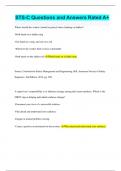
STS-C Questions and Answers Rated A+ Where should the worker's hands be placed when climbing on ladders? -Both hands on a ladder rung -One hand on a rung, and one on a rail -Wherever the worker finds it most comfortable -Both hands on the ladder rails Both hands on a ladder rung Source: Construction Safety Management and Engineering, Hill, American Society of Safety Engineers, 2nd Edition, 2014, pg. 298. A supervisor's responsibility is to influence change among their team members. Which is the FIRST step in helping individuals embrace change? -Document your view of a successful solution. -Plan ahead and understand your audience. -Engage in mutual problem solving. -Create a positive environment for discussions. Plan ahead and understand your audience. Source: The Safety Professionals Handbook, Technical Applications, Haight, American Society of Safety Engineers, 2nd Edition, 2012, pg. 926-927. When rigging slings for lifting materials, the actual load on the sling increases as the angle decreases from 90 degrees (vertical). As a best safety practice to prevent overloads, the sling angle should always be greater than: -55 degrees. -70 degrees. -45 degrees. -80 degrees. 45 degrees. Source: Handbook of Rigging, MacDonald, Rossnagel, McGraw Hill, 5th Edition, 2009, pg. 230. A behavioral approach to safety focuses on consequences as an important motivator for future safe behaviors. Consequences can be described by their timing, consistency, and significance. The MOST powerful consequences are: -Delayed, uncertain, positive. -Soon, uncertain, positive. -Soon, certain, negative. -Soon, certain, positive. Soon, certain, positive. Source: The Behavior-Based Safety Process, Krause, Van Nostrand Reinhold, 2nd Edition, pg. 38. When electric current passes through the body, the result can range from a mild tingling to immediate cardiac arrest. The magnitude of the effect is determined by the amount of current flowing through the body, the path of current through the body, and: -The voltage applied to the circuit. -The age and physical condition of the worker. -The length of time the body remains in the circuit. -The relative humidity of the work setting. The length of time the body remains in the circuit. Source: Construction Safety Management and Engineering, Hill, American Society of Safety Engineers, 2nd Edition, 2014, pg. 428. A chemical cartridge respirator is an example of which type of respiratory protective device? -Air purifying respirator -Rescue respirator

Geschreven voor
- Instelling
- STS-C
- Vak
- STS-C
Documentinformatie
- Geüpload op
- 28 maart 2024
- Aantal pagina's
- 29
- Geschreven in
- 2023/2024
- Type
- Tentamen (uitwerkingen)
- Bevat
- Vragen en antwoorden
Onderwerpen
-
sts c questions and answers rated a

Ook beschikbaar in voordeelbundel