C483 Practice questions and answers
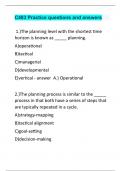
1.)The planning level with the shortest time horizon is known as _____ planning. A)operational B)tactical C)managerial D)developmental E)vertical A.) Operational 2.)The planning process is similar to the _____ process in that both have a series of steps that are typically repeated in a cycle. A)strategy-mapping B)tactical alignment C)goal-setting D)decision-making E)environmental analysis D.) Decision-making 3.)In a SWOT analysis, the absence of reliable suppliers would be considered as a(n): A)weakness and a threat. B)weakness. C)strength. D)opportunity. E)threat. B.) Weakness 4.)A _____ system is a component of the strategic management process designed to support managers in evaluating the organization's progress with its strategy and, when discrepancies exist, taking corrective action. A)span of control B)strategic control C)strategic support D)dynamic network E)strategic integration B.) Strategic Control 5.)The strategy an organization uses to build competitive advantage by being unique in its industry or market segment along one or more dimensions is known as a(n) _____ strategy. A)integrated B)differentiation C)functional D)low-cost E)concentration B.) Differentiation 6.)Which of the following is one among the six components of the strategic management process? A)Skill improvement plan B)Technology assessment C)Stakeholder analysis D)SWOT analysis E)Stockholder reporting D.) SWOT Analysis 7.)Which of the following takes place after a firm formulates its strategy? A)Establishment of mission, vision, and goals B)Analysis of external opportunities and threats C)Strategy implementation D)Analysis of internal strengths and weaknesses E)SWOT analysis C.) Strategy Implementation 8.)A vertical integration strategy is a strategy: A)used to add new businesses that produce related products or are involved in related markets and activities. B)that involves expanding the domain of the organization into supply channels or to distributors. C)employed for an organization that operates a single business and competes in a single industry. D)used to add new businesses that produce unrelated products or are involved in unrelated markets and activities. E)an organization uses to build competitive advantage by being unique in its industry or market segment along one or more dimensions. B.) That involves expanding the domain of the organization into supply channels or to distributors. 9.)_____ is considered as an activity of the external environment of an organization. Refer To: Table 4.1 A)Human resources assessment B)Financial analysis C)Marketing Audit D)Macroeconomic Analysis E)Operations Analysis D.) Macroeconomics Analysis 10.)Benchmarking is the process of assessing how well one company's basic functions and skills compare with: A)government standards. B)supplier and distributor requirements. C)those of another company. D)customer expectations. E)stockholder demands. C.) Those of another company 11.)_____ include sets of actions to be taken when a company's initial plans have not worked well or if events in the external environment require a sudden change. A)Functional plans B)Contingency plans C)Strategic maps D)Differentiation strategies E)Business incubators B.) Contingency plans 12.)Which of the following is true of operational planning? A)It is a long-term plan spanning over three years. B)It is performed by top level managers. C)It identifies specific plans and procedures. D)It focuses only on processes required in the higher organizational levels. E)It translates broad strategic goals into specific goals. C.) It identifies specific plans and procedures 13.)The most effective _____ statements inspire organization members, offering a worthwhile target for the entire organization to work together to achieve. A)vision B)operation C)business definition D)financial E)quality A.) Vision 14.)A(n) _____ illustrates the four key drivers of a firm's long-term success, and shows how goals in each area are linked to others. A)objective script B)GANTT chart C)PERT chart D)decision tree E)strategy map E.) Strategy map 15.)_____ provides individuals and work units with a clear map to follow in future activities. A)Planning B)Charting C)A mission statement D)A BCG matrix E)Staffing A.) Planning 16.)A _____ is the knowledge, expertise, or skill that underlies a company's ability to be a leader in providing a range of specific goods or services. A)knowledge flow B)continuous process C)cognitive ability D)core capability E)dynamic network D.) Core Capability A multifaceted process focusing on creating two-way exchanges with customers to foster intimate knowledge of their needs, wants, and buying patterns is called _____ management. A)customer relationship B)customer analytics C)total quality D)human resources E)buyer-behavior A.) Customer Relationship

Geschreven voor
- Instelling
- WGU Principles of Management - C483
- Vak
- WGU Principles of Management - C483
Documentinformatie
- Geüpload op
- 20 mei 2024
- Aantal pagina's
- 38
- Geschreven in
- 2023/2024
- Type
- Tentamen (uitwerkingen)
- Bevat
- Onbekend
Onderwerpen
-
c483 practice questions and answers

Ook beschikbaar in voordeelbundel