MNG2601 COMPETE EXAM QUESTIONS WITH COMPLETE SOLUTIONS.
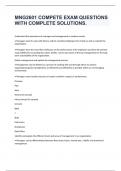
MNG2601 COMPETE EXAM QUESTIONS WITH COMPLETE SOLUTIONS. Understand the importance of managers and management in modern society. • Managers need to cope with diverse and far-reaching challenges from inside as well as outside the organisation. • Managers have the most direct influence on the performance of its employees and have the primary responsibility for inculcating the values, beliefs, norms and values of the top management for the long-term sustainability of the organisation. Define management and explain the management process. • Management can be defined as a process of working with and through others to achieve organisational goals and objectives as effectively and efficiently as possible within an everchanging environment. • Managers need certain resources or inputs to deliver outputs or performance. Previous Play Next Rewind 10 seconds Move forward 10 seconds Unmute 0:01 / 0:15 Full screen Brainpower Read More Identify and explain the different levels and areas of management in an organisation. • Managers can be differentiated between three basic layers, namely top-, middle- and lowerlevel management. • At each of these levels, different functional areas can be distinguished, which include finance, operations, human resources, procurement, research and development, public relations and marketing. Distinguish between the role distribution of managers. Professor Henry Mintzberg concluded that managers play ten roles that can be grouped into three primary headings: interpersonal, informational and decision-making roles. • The interpersonal role has three sub-roles, namely the role of figurehead, leader and liaison. • The informational role has three sub-roles, namely the role of monitor, disseminator and spokesperson. • The decision-making role has four sub-roles namely entrepreneur, problem solver, resource allocator and negotiator. Expound on the various managerial skills and competences needed by managers. Clark L Wilson identified three skill categories, where each category has various branches: • The technical skills category branches into technical expertise, clarification of goals and objectives, problem solving and imagination and creativity. • The teambuilding category branches into listening for insights, directing and coaching, solving problems as teams, and coordinating and cooperating. • The drive category branches into standards of performance, control of detail, energy and exerting pressure. Explain how one can learn to manage successfully. Managers can acquire management skills through management training and development, as well as practical experience. Understand the importance of the management environment when making management decisions. • The management environment is complex and interdependent. • Change is becoming more rapid, discontinuous and turbulent. • Management mistakes are becoming increasingly costly. • Managers need a means to identify strengths, weaknesses, opportunities and threats within the environment to empower them to make better critical choices and choose more feasible courses of action in executing planning, organising, leading and controlling functions. Depict diagrammatically and explain the concepts of the process, systems and contingency approaches in management. • The process approach to management is based on the four main functions of management. According to this approach, the performance of the planning, organising, leading and controlling functions within the organisation is seen as circular and continuous. The process approach focuses on managing the total organisation.

Geschreven voor
- Instelling
- MNG
- Vak
- MNG
Documentinformatie
- Geüpload op
- 17 juni 2024
- Aantal pagina's
- 48
- Geschreven in
- 2023/2024
- Type
- Tentamen (uitwerkingen)
- Bevat
- Vragen en antwoorden
Onderwerpen
-
mng
-
mng2601 compete exam questions with complete solut

Ook beschikbaar in voordeelbundel