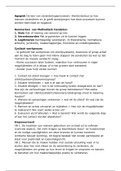
GEG 111 Final Exam (Harper College)
Physical Geography - Looks at the natural processes of the Earth, such as climate and plate tectonics. Human Geography - Looks at the impact and behaviour of people and how they relate to the physical world. Scientific Method - The Scientific Method looks to establish ideas, but also willing to modify, reject of change them when new evidence is found. The Scientific Method: 1. Observe 2. Form a question 3. Create Hypothesis 4. Test Hypothesis 5. Collect Data 6. Draw Conclusion The Four Spheres - 1. Atmosphere (air, gases) 2. Lithosphere (solid crust) 3. Hydrosphere (water, ice) 4. Biosphere (all living organisms) Equator - 0 degrees latitude. It separates the northern and southern hemisphere. Prime Meridian - Longitude. It separates the eastern and western hemisphere. Time Zones - Time zones are formed by the longitude lines. They were calculated by each 15 degrees = 1 hour. So they're 24 standard time zones. Large Map Scale - Map of Illinois Small Map Scale - Map of the world Conic Map Projection - Cone shaped map projection Oval Map Projection - Oval shaped map projection. How we usually we the world map in class. Flat. Planer Map Projection - If we had a globe and drew exactly what we saw from our eye sight onto a flat surface. GPS - Relies on Satellites in orbit to provide precise location and elevation information, sent to a device and triangulate to grid coordinates. 3 satellites help get the Latitude/Longitude. March of the Seasons - There are 4 major events each year which mark a change in the season: Two solstices and two equinoxes The Winter Solstice - Vernal Equinox - Summer Solstice - Autumnal Equinox The Circle of Illumination - The division between day and night over the earth. The circle of illumination bisects (cuts in half) all latitudes on the spring and autumnal equinoxes. At this time, all places have equal day length (12 hours). The circle of illumination always bisects the equator (0 degrees latitude). Solar Insolation - Basically that means how much sunlight is shining down on us. An area with poor insolation levels will need a larger collector than an area with high levels. What happens when the Sun strikes the Earth in uneven ways? - As the sun strikes the earth at uneven ways it creates what we call seasons. B/c of the tilted axis 23.5 we see warmer weather in summer than winter and the amount of day time. Troposphere - Closest to the ground. Examples: Mt.Everest, Commercial jets, some clouds. Temp: 20 C - -60 C and it goes higher. 10 miles. Stratosphere - Ozone layer located here. Also weather balloons and spy planes can be in this area. Temp: -60 C - 0 C as we get higher. 10 - 30 miles. Mesosphere - Meteors, Sprites, Rockets in this area. Temp: 0 C - -85 C. as it goes higher. 30 - 50 miles. Thermosphere - Aircrafts, Satellites. Basically what we call outer space. Temp 1500 C. 80 KM. Albedo - The relative amount (ratio) of light that a surface reflects compared to the total sunlight that falls on it. Low albedo = snow. High albedo = asphalt. Continents vs. Coastal (Marine) Areas - Continental: temperature conditions more extreme land warms and cools rapidly. Less evaporation. Land has a lower specific heat. Land has no mixing between layers. Marine: Temperature more moderate water warms and cools slowly. More evaporation. Surface is transparent. High specific heat. Water has mobility and mixes in ocean currents. Annual Temperature Change North vs. South - The reason why there is a difference in temperature is because the North has way more land than the South does which has a ton more ocean. Land takes a day to change in weather, however, the oceans take a matter of months. Also the mountain on land act as wind barriers. Isotherms - Equal temperature. Isobars - Equal pressure. Isohyet - Equal precipitation. Cyclones - Low pressure centers characterized by surface convergence and rising air. • Commonly associated with significant cloud formation and precipitation Anticyclones - High pressure centers characterized by surface divergence and sinking air. • Commonly associated with relatively clear skies Monsoons - Seasonal reversal of winds , from land to sea, in the tropics and sub tropics • Summer: inland (wet) • Winter: towards the ocean (dry) Subtropical Highs - Dynamic high-pressure areas roughly located between 20° to 35° N and S latitudes; responsible for the hot, dry areas of Earth's arid and semiarid deserts. • Trade winds and westerly winds diverge out of the subtropical highs Land and sea breezes - Sea breezes - Water heats more slowly than land during theday - Wind blows from sea to land • Land breezes - At night, land cools faster - Wind blows from land to sea Mountain and Valley breezes - • Valley breeze: Mountain top during the day heats faster than valley-Upslope winds out of valley • Mountain breeze: - Mountain top cools faster at night - Winds blow from mountain to valley, downslope (upslope during day, downslope at night) Great Pacific Garbage Patch - Occurs due to gyres: The circulation systems within the oceans and is a significant area of marine and manmade litter (especially plastics) trapped within the North Pacific Gyre under the Subtropical High (STH). Gyres: oceanic systems of circulation. Characteristics of El Nino - Atmospheric pressure decreases over the eastern Pacific and rises over the western Pacific. This change in pressure causes the trades to weaken and/or reverse direction. • Upwelling off the west coast of South America declines during the warm phase Properties of water - • Exists as a liquid at most places on Earth's surface • Expands when it freezes; which is important in the weathering of rock • Hydrogen bonding creates surface tension, a "skin" of molecules giving water a stickiness quality - surface tension • Capillarity; water can "climb" up narrow openings. This is important to the movement of groundwater. • Good solvent; water dissolves most substances • High specific heat; it takes a relatively high amount of energy to raise the temperature of water. Phase Changes and Heat Exchange - Water absorbs or releases energy as it changes from one state to another. • IMPORTANT: The heat exchanged between physical states of water provides more than 30% of the energy that powers the general circulation of the atmosphere. Environmental Lapse Rate (ELR) - The decrease in temperature with increasing altitude at a particular location and time. Dry Adiabatic Rate (DAR) - Rate at which "dry" air (i.e. unsaturated air) cools by expansion as it rises or warms by compression as it falls. The average DAR is 10 C°/1000 m (5.5 F°/1000 ft.) Moist Adiabatic Rate (MAR) - Rate at which saturated air cools by expansion as it rises or warms by compression as it falls. The average DAR is 6 C°/1000 m (3.3 F°/1000 ft.) • MAR is lower than DAR because of the latent heat of condensation (cooling) and the latent heat of evaporation (heating) Lifting Condensation Level (LCL) - Altitude at which a parcel of air cools to the dew point temperature, allowing condensation to begin. Frontal Lifting - Occurs along the boundary of unlike air masses (fronts) resulting in the uplifting of the warmer (less dense) air mass. • This type of lifting is common in the Midlatitudes along the Subpolar Low (Polar Front) • Cold and warm fronts are components of Midlatitude Cyclones Cold front - Formed when an advancing cold air mass, which is denser, advances and uplifts a warmer air mass leading to adiabatic cooling and potential instability • An approaching cold front is marked by shifting winds, dropping temperatures, and a drop in barometric pressure as the warm air is uplifted along the front's leading edge • Cumulonimbus clouds, heavy precipitation are associated with cold fronts • A squall line (zone of fast moving high winds and bands of storms along or slightly ahead of a front) may form along a cold front. Squall lines may be hundreds of miles long but are usually 10-20 miles wide. Warm front - • Formed when a warm air mass moves over a colder air mass. The warmer less dense air "rides" over the colder air leading to generally stable conditions Radiation fog - Forms when the radiative cooling of a surface chills the air directly above the surface to dew-point temperature, leading to saturated conditions. Advection fog - Forms when air from one place migrates to another place where the conditions are right for saturation. Evaporation fog - Forms when cold air lies over a warm body of water, causing water molecules to evaporate from the H2O surface into the cold overlying air. Orographic fog - Forms as moist air blows up a mountain slope and becomes saturated. Climate - The collective pattern of weather over many years. Weather - The state of the atmosphere at any specific time and place. Life Cycle of a Midlatitude cyclone - cyclogenesis-- open stage-- occluded stager-- dissolving stage. Midlatititude cyclone movement - Counter-clockwise in northern hem. Clockwise in southern hem. Occurring at mid to high latitudes. Thunderstorms - A thunderstorm is a type of turbulent weather accompanied by thunder, lightning, and characterized by the build up of cumulonimbus clouds • These storms can be associated with strong winds, hail, squall lines, or tornadoes • The source of energy for thunderstorms comes from the uplift of warm, moist air • Rising moist air cools and condenses to form clouds and precipitation. • The condensation process releases significant quantities of latent heat energy, which promotes updrafts and downdrafts of air within the storm Prevalent along the ITCZ Tornadoes (Geography) - Occur in North America more than anywhere else, especially in Texas, the southern part of Oklahoma, Indiana, and Florida. Tornadoes (Measurement) - Pressures inside a tornado usually are about 10% less than those in the surrounding area. Measured by the Enhance Fujita Scale (originaly created by Theodore Fujita). It classifies tornadoes by windspeed. Indicates the damage that will be done. Hurricanes (source of energy) - Warm air and warm seas ensure abundant water vapor and thus the necessary latent heat to fuel the storms. Convert heat energy into mechanical energy. Hurricanes (Geography) - Occur around North America, the western pacific mainly in Japan and the Philippines (typhoons), and in Indonesia, Bangladesh, and India (Cyclones). The Hydrolic Cycle - Vast currents of water, water vapor, ice, and associated energy flowing continuously in an elaborate, open, global system. -It circulates and transforms water throughout Earth's lower atmosphere, hydrosphere, biosphere, and lithosphere. Aral Sea Disaster - Once the fourth largest lake in the world, the Aral Sea is now almost completely dried up due to water diversions by the soviets in the 1960's in order to irrigate the surrounding desert. Groundwater mining and impact on the largest US aquifer - Groundwater mining has resulted in a huge decline in the water table in the region of the high Plains Aquifer. Estimates say that it would take roughly 1000 years for the aquifer to recover if groundwater mining stopped today. Largest Discharge for a River - Amazon River Alluvium - General term for unconsolidated clay, silt, sand, gravel, and mineral fragments deposited by running water. Ultimate base level - Sea level, the average level between low and high tides Dendritic Drainage pattern - Treelike drainage pattern. (right to left) Trellis drainage - Characteristic of dipping or folded topography. (Left to right) Radial drainage - Results when streams flow off a central peak or dome, such as occurs on a volcanic mountain. (all pointing to center)

Geschreven voor
- Instelling
- Harper College
- Vak
- GEG 111 (GEG111)
Documentinformatie
- Geüpload op
- 11 oktober 2024
- Aantal pagina's
- 19
- Geschreven in
- 2024/2025
- Type
- Tentamen (uitwerkingen)
- Bevat
- Vragen en antwoorden
Onderwerpen
-
geg 111
-
geg 111 final exam
-
geg 111 final exam harper college

Ook beschikbaar in voordeelbundel