Was The League of Nations Doomed from the Start?
The Organisation of the League of Nations
- After the signing of the Paris Peace Treaties it was agreed – under Woodrow
Wilson’s 14 Point Programme – that the League of Nations would be set up to
deal with any future disputes
- This was done to avoid another world war
- Unfortunately for Wilson – the US Senate rejected the idea
- Neither Germany nor the USSR were invited to join the organisation initially
Aims of the League
1. Avoid – aggression between nations
2. Facilitate – disarmament
3. Improve – living and working conditions globally
4. Enhance - global co-operation, through trade
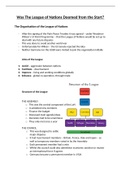
Structure of the League
THE ASSEMBLY
o This was the central component of the LoN
o It admitted new members
o Finance the budget
o Discussed main agenda ideas
o Decisions had to be unanimous
o They only met once a year
THE COUNCIL
o This was designed to settle
major disputes
o It had 4 permanent members – Britain, France, Italy and Japan – as
well as temporary members voted in by the Assembly
o Each permanent member had a veto
o Whilst the council could also administer economic sanction or muster
an international force if agrees
o Germany became a permanent member in 1926
, THE LEAGUE OF NATIONS COMMISSIONS
o These were branches of the league set up to deal with problems cause
by WW1 – such as refugees. Global health and working conditions
o They included: The Health Committee, the Mandates Committee and
the Refugees Committee
THE PERMANENT COURT OF JUSTICE
o This was the League’ court – set in the Hague, Netherlands
o It was the Courts which would give decisions on border disputes and
passed any laws
o It also gave legal advice to the Assembly and Council
o Primarily its responsibility came in upholding or amending peace
treaties
THE INTERNATIONAL LABOUR ORGANISATION
o This brought together employees, employers and governments to try
and create better working conditions
o It collected information and advised governments
THE SECRETARIAT
o This was the part of the League that did the office work – translating
document and keeping records
Why did the USA not join?
- It was seen as linked to the TOV – deemed unfair by many Americans
- It was seen as upholding colonial interests of Britain and France e.g.,
‘mandates
- They had no need to join; the WW1 had made them rich and powerful] they
felt it was a European venture and preferred a policy of isolationism
Points of Strength and Weakness in Organisation
- The Assembly
o They only met once a year – in a fast-moving world where technology
was speeding up events, this was a disaster
o Events were often over before they could be dealt with
o Decisions had to be unanimous – this made it very difficult as everyone
had to agree
The Organisation of the League of Nations
- After the signing of the Paris Peace Treaties it was agreed – under Woodrow
Wilson’s 14 Point Programme – that the League of Nations would be set up to
deal with any future disputes
- This was done to avoid another world war
- Unfortunately for Wilson – the US Senate rejected the idea
- Neither Germany nor the USSR were invited to join the organisation initially
Aims of the League
1. Avoid – aggression between nations
2. Facilitate – disarmament
3. Improve – living and working conditions globally
4. Enhance - global co-operation, through trade
Structure of the League
THE ASSEMBLY
o This was the central component of the LoN
o It admitted new members
o Finance the budget
o Discussed main agenda ideas
o Decisions had to be unanimous
o They only met once a year
THE COUNCIL
o This was designed to settle
major disputes
o It had 4 permanent members – Britain, France, Italy and Japan – as
well as temporary members voted in by the Assembly
o Each permanent member had a veto
o Whilst the council could also administer economic sanction or muster
an international force if agrees
o Germany became a permanent member in 1926
, THE LEAGUE OF NATIONS COMMISSIONS
o These were branches of the league set up to deal with problems cause
by WW1 – such as refugees. Global health and working conditions
o They included: The Health Committee, the Mandates Committee and
the Refugees Committee
THE PERMANENT COURT OF JUSTICE
o This was the League’ court – set in the Hague, Netherlands
o It was the Courts which would give decisions on border disputes and
passed any laws
o It also gave legal advice to the Assembly and Council
o Primarily its responsibility came in upholding or amending peace
treaties
THE INTERNATIONAL LABOUR ORGANISATION
o This brought together employees, employers and governments to try
and create better working conditions
o It collected information and advised governments
THE SECRETARIAT
o This was the part of the League that did the office work – translating
document and keeping records
Why did the USA not join?
- It was seen as linked to the TOV – deemed unfair by many Americans
- It was seen as upholding colonial interests of Britain and France e.g.,
‘mandates
- They had no need to join; the WW1 had made them rich and powerful] they
felt it was a European venture and preferred a policy of isolationism
Points of Strength and Weakness in Organisation
- The Assembly
o They only met once a year – in a fast-moving world where technology
was speeding up events, this was a disaster
o Events were often over before they could be dealt with
o Decisions had to be unanimous – this made it very difficult as everyone
had to agree