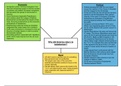
Economic Political
• Immigration policy- banning immigration from • Political development after the war helped
Asia and introducing quotas to limit the number secure the rejection of the Treaty of Versailles
of southern and eastern European immigrants. and the League by the US Senate.
Worried about the spread of communism in • At the end of the war the US held its mid-term
America. elections and the Republican Party gained
• Some Americans (especially Republicans) majority of the seats in Congress- promoted
were dubious about the League of Nations. themselves as champions of isolationism
Businessmen worried about the impact of free showing disparity between the President and
trade, favouring protectionism as the economic the public.
embodiment of isolationism. • Congress commenced March 1919, just a
• Experiencing a post-war slump as industries Wilson was negotiating peace terms in Paris-
readjusted their output away from munitions. his six month absence left a power vacuum in
• Tariffs were introduced or increased to drive up Washington.
the price of foreign imports in order to protect • Senate (Republicans 49 seats and Democrats
the domestic markets. 47 seats). The House (Republican seats went
• US trading partners responded with “retaliatory up by 25 (55.2%)and democrats went down by
tariffs” which made imports from the US more 22 (44.2%). Made up 66th Congress in US.
expensive. • Pro-isolationist Republicans led by Senate
Henry Cabot Lodge critiqued several points of
Why did America return to the T of V. For example they were worried that
isolationism? if they agreed to the terms of the T of V and
League it would restrict America’s freedom of
action.
• Lodge argued that it contravened with the
Monroe Doctrine (19th century) which stated
that the Americas should remain free from
Moral European influence.
• US didn't want to sacrifice lives for something • Senate refused to allow America to join the
they perceived was not worthwhile. League of Nations (1920).
• The people were wary of the economic • On its way to becoming a Superpower.
downfall and therefore wanted to focus on the • Harding replaced Wilson.
country internally.
• Felt like Wilson didn’t secure US morals in the
T of V- self determination wasn’t being properly
used, especially with Japanese sphere of
influence.
• Immigration policy- banning immigration from • Political development after the war helped
Asia and introducing quotas to limit the number secure the rejection of the Treaty of Versailles
of southern and eastern European immigrants. and the League by the US Senate.
Worried about the spread of communism in • At the end of the war the US held its mid-term
America. elections and the Republican Party gained
• Some Americans (especially Republicans) majority of the seats in Congress- promoted
were dubious about the League of Nations. themselves as champions of isolationism
Businessmen worried about the impact of free showing disparity between the President and
trade, favouring protectionism as the economic the public.
embodiment of isolationism. • Congress commenced March 1919, just a
• Experiencing a post-war slump as industries Wilson was negotiating peace terms in Paris-
readjusted their output away from munitions. his six month absence left a power vacuum in
• Tariffs were introduced or increased to drive up Washington.
the price of foreign imports in order to protect • Senate (Republicans 49 seats and Democrats
the domestic markets. 47 seats). The House (Republican seats went
• US trading partners responded with “retaliatory up by 25 (55.2%)and democrats went down by
tariffs” which made imports from the US more 22 (44.2%). Made up 66th Congress in US.
expensive. • Pro-isolationist Republicans led by Senate
Henry Cabot Lodge critiqued several points of
Why did America return to the T of V. For example they were worried that
isolationism? if they agreed to the terms of the T of V and
League it would restrict America’s freedom of
action.
• Lodge argued that it contravened with the
Monroe Doctrine (19th century) which stated
that the Americas should remain free from
Moral European influence.
• US didn't want to sacrifice lives for something • Senate refused to allow America to join the
they perceived was not worthwhile. League of Nations (1920).
• The people were wary of the economic • On its way to becoming a Superpower.
downfall and therefore wanted to focus on the • Harding replaced Wilson.
country internally.
• Felt like Wilson didn’t secure US morals in the
T of V- self determination wasn’t being properly
used, especially with Japanese sphere of
influence.