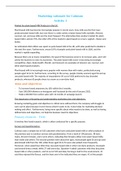
Agents of socialisation: institutions which carry out socialisation Durkheim
Collective conscience: set of shared beliefs/ideas/attitudes/ knowledge - Social order maintained through similarity/conformity in society
common to social group/society ● Can be maintained by strengthening social bonds between people
Functional prerequisites: basic needs that must be met for society to - Social norms/values evolve to move society forwards
function
Organic analogy: society structured/functions like human body; social Parsons
institutions function in relation to each other + if 1 fails the rest of society - Society is system w/ 4 functional prerequisites:
follows ● Goal attainment: resources must be organised/distributed so they reach
Value consensus: norms/values mostly agreed upon by society the people that need them most; usually role of politicians
Social solidarity: cohesion between individuals in a society ensuring ● Adaptation: ability for economy to provide for material needs of
social order/stability population through providing meaningful employment/controlling price of
Social cohesion: extent to which people are bound resources by ensuring adequate supply
together/integrated/share common values ● Integration: how population understands norms/values of society; usually
transmitted through education/family/religion/media
Merton ● Latency:
- Criticised universal functionalism; suggested Functionalists e.g. ○ Pattern maintenance: prepares people for future role in society:
Parsons ignored societal dysfunction promotes ideals e.g. meritocracy
● Took inequality as sign of dysfunction, not healthy society; other
○ Tension management: ability to release tensions
Functionalists see this as inevitable
- Social changes occur in 1 part of system + facilitate changes elsewhere
- Strain theory: structural inequality exists in society; root of criminal
in society (= universal functionalism)
behaviour
- Criticised Parsons: social institutions have functional autonomy (not
interconnected); sections of society independent + don’t change when Eval
others do - Determinism: assumes human behaviour is stable + controlled by external
- Institutions can be replaced (Parsons disagrees) forces
● Not indispensable: secularisation/diff. family types suggest this is - Consensus: ignores conflict; argues shared norms/values keep society in
correct equilibrium but doesn’t explore whose values they are
- Manifest function: intended/conscious purpose/consequence of an ● Marxist: values of capitalist elite
action e.g. intended outcome of a rule ● Feminist: patriarchal values
- Latent function: unintended/unconscious/hidden - Merton argues institutions need dysfunction; conflict theories argue this
purposes/consequences of actions; the ‘real’ reasons/purposes leads to inequality
people’s actions may have as seen by outside observers e.g. a rule - Integration only benefits the majority whose norms.values are seen as the
made to restore peace harming people; harm is latent function ‘norm’; minority groups forced to assimilate
Collective conscience: set of shared beliefs/ideas/attitudes/ knowledge - Social order maintained through similarity/conformity in society
common to social group/society ● Can be maintained by strengthening social bonds between people
Functional prerequisites: basic needs that must be met for society to - Social norms/values evolve to move society forwards
function
Organic analogy: society structured/functions like human body; social Parsons
institutions function in relation to each other + if 1 fails the rest of society - Society is system w/ 4 functional prerequisites:
follows ● Goal attainment: resources must be organised/distributed so they reach
Value consensus: norms/values mostly agreed upon by society the people that need them most; usually role of politicians
Social solidarity: cohesion between individuals in a society ensuring ● Adaptation: ability for economy to provide for material needs of
social order/stability population through providing meaningful employment/controlling price of
Social cohesion: extent to which people are bound resources by ensuring adequate supply
together/integrated/share common values ● Integration: how population understands norms/values of society; usually
transmitted through education/family/religion/media
Merton ● Latency:
- Criticised universal functionalism; suggested Functionalists e.g. ○ Pattern maintenance: prepares people for future role in society:
Parsons ignored societal dysfunction promotes ideals e.g. meritocracy
● Took inequality as sign of dysfunction, not healthy society; other
○ Tension management: ability to release tensions
Functionalists see this as inevitable
- Social changes occur in 1 part of system + facilitate changes elsewhere
- Strain theory: structural inequality exists in society; root of criminal
in society (= universal functionalism)
behaviour
- Criticised Parsons: social institutions have functional autonomy (not
interconnected); sections of society independent + don’t change when Eval
others do - Determinism: assumes human behaviour is stable + controlled by external
- Institutions can be replaced (Parsons disagrees) forces
● Not indispensable: secularisation/diff. family types suggest this is - Consensus: ignores conflict; argues shared norms/values keep society in
correct equilibrium but doesn’t explore whose values they are
- Manifest function: intended/conscious purpose/consequence of an ● Marxist: values of capitalist elite
action e.g. intended outcome of a rule ● Feminist: patriarchal values
- Latent function: unintended/unconscious/hidden - Merton argues institutions need dysfunction; conflict theories argue this
purposes/consequences of actions; the ‘real’ reasons/purposes leads to inequality
people’s actions may have as seen by outside observers e.g. a rule - Integration only benefits the majority whose norms.values are seen as the
made to restore peace harming people; harm is latent function ‘norm’; minority groups forced to assimilate